The slides, written out
AI-drawn illustration. Simplified to explain the idea, not to scale.
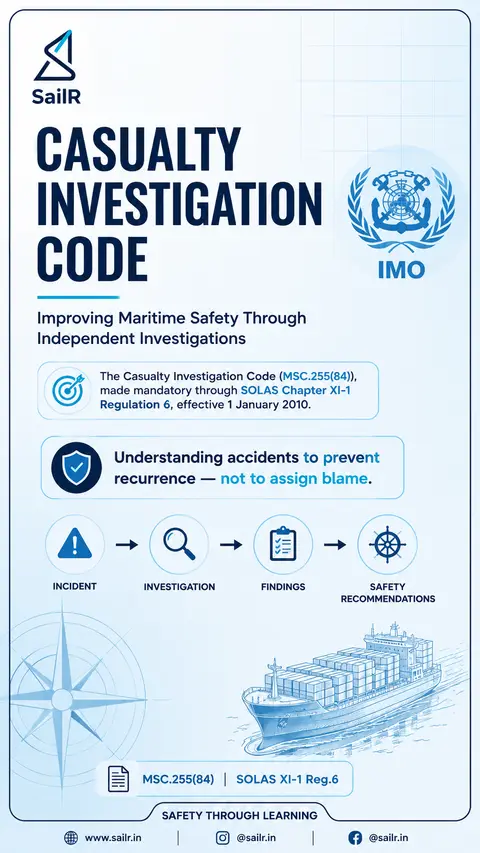
Slide 1 · CASUALTY
CASUALTY
INVESTIGATION
CODE
IMO
Improving Maritime Safety Through
Independent Investigations
The Casualty Investigation Code (MSC.255(84)),
made mandatory through SOLAS Chapter XI-1
Regulation 6, effective 1 January 2010.
Understanding accidents to prevent
recurrence — not to assign blame.
INCIDENT
INVESTIGATION
FINDINGS
SAFETY
RECOMMENDATIONS
MSC.255(84) | SOLAS XI-1 Reg.6
SAFETY THROUGH LEARNING
Slide 2 · 4 CORE PRINCIPLES
4 CORE PRINCIPLES
OF THE CASUALTY INVESTIGATION CODE
Guiding maritime safety investigations for
prevention of future casualties and incidents.
1
CONSISTENT
METHODOLOGY
All flag States should apply
a uniform investigative process
to identify causal factors
and enhance global maritime
safety.
2
IMO
REPORTING
Marine casualty investigation
reports and related information
required under the Code should
be submitted to IMO through
GISIS to facilitate dissemination
of safety lessons.
3
STATE
COOPERATION
Substantially interested States
(e.g., flag State, coastal State,
port State, State of the victim)
should consult and cooperate
during investigations.
4
NO-BLAME
APPROACH
The purpose is to improve
maritime safety and prevent
pollution — not to apportion
blame or determine liability.
THE INVESTIGATION PROCESS
INCIDENT
INVESTIGATION
FINDINGS
SAFETY
RECOMMENDATIONS
Slide 3 · WHY CONFIDENTIALITY MATTERS
WHY CONFIDENTIALITY MATTERS
CHAPTER 23 – CONFIDENTIALITY OF INFORMATION
The Code ensures that information obtained during a marine safety investigation remains protected to encourage open and honest participation.
PROTECTED INFORMATION INCLUDES
Witness statements and interviews
Communications between investigators and involved parties
Shipboard records including VDR data and electronic information
Logbooks and other documentation
Any record created or obtained solely for the safety investigation
DISCLOSURE RULE
Information obtained solely for the purposes of a marine safety investigation should generally remain protected from disclosure in criminal, civil, disciplinary or administrative proceedings.
Disclosure may only occur if a competent authority determines that the public interest in disclosure outweighs the adverse impact on current or future safety investigations.
Confidentiality builds trust, encourages candid reporting and leads to more effective investigations — resulting in safer ships, cleaner seas and stronger safety systems.
| |
Slide 4 · PROTECTION OF WITNESSES
PROTECTION OF WITNESSES
& INVOLVED PARTIES
CHAPTER 24 – PROTECTION FOR WITNESSES AND INVOLVED PARTIES
The Code encourages full and frank cooperation by providing protections for individuals who provide evidence during a marine safety investigation.
BEFORE TAKING EVIDENCE, INVESTIGATORS SHOULD EXPLAIN:
1 NATURE OF THE INVESTIGATION
The purpose, scope and legal basis of the investigation.
2 POSSIBLE SELF-INCRIMINATION RISKS
How the evidence may be used in subsequent proceedings.
3 RIGHTS UNDER NATIONAL LAW
The right not to self-incriminate or to remain silent.
4 APPLICABLE LEGAL PROTECTIONS
Protections available for the person providing the evidence.
IMPORTANT DISTINCTION
The Casualty Investigation Code promotes candid reporting during safety investigations.
However, separate criminal, civil or disciplinary proceedings remain subject to national law and are independent of the safety investigation process.
A casualty investigation seeks to understand the chain of events, identify safety issues and prevent recurrence — not to assign blame.
SAFETY THROUGH LEARNING, NOT BLAME.
Drafted by SailR from our daily lessons. AI-drawn illustration. Simplified to explain the idea, not to scale. Last updated 19 Oct 2026.
Spotted a mistake?