The slides, written out
AI-drawn illustration. Simplified to explain the idea, not to scale.
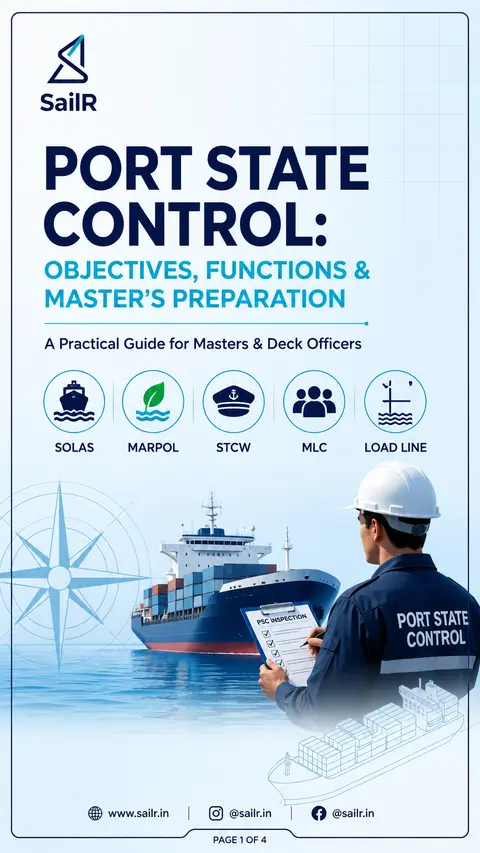
Slide 1 · PORT STATE CONTROL
PORT STATE CONTROL:
OBJECTIVES, FUNCTIONS & MASTER'S PREPARATION
A Practical Guide for Masters & Deck Officers
SOLAS
MARPOL
STCW
MLC
LOAD LINE
PORT STATE CONTROL
PSC INSPECTION
Slide 2 · WHY DOES PORT STATE CONTROL EXIST?
WHY DOES PORT STATE CONTROL EXIST?
Port State Control (PSC) is a key instrument used by coastal States to verify compliance of foreign-flag ships with international maritime conventions and standards.
OBJECTIVES OF PSC
1. Enforcement of International Regulations
Ensure ships, their equipment and crew comply with SOLAS, MARPOL, STCW, MLC, Load Line and other applicable conventions.
2. Elimination of Substandard Shipping
Identify and detain ships with serious deficiencies that pose a threat to safety, security, crew welfare or the environment.
3. Protection of Life, Environment & Welfare
Protect life at sea, the marine environment and the working and living conditions of seafarers.
FUNCTIONS OF PSC
Verify the ship's condition
Ensure the ship and its equipment meet convention requirements.
Verify crew competency
Ensure the ship is manned and operated in compliance with applicable standards.
Check safety equipment
Confirm availability and proper maintenance of life-saving and fire-fighting appliances.
Verify pollution prevention
Ensure prevention of pollution from ship operations.
Detain unsafe ships
Prevent the ship from sailing until all serious deficiencies are rectified.
UNCLOS ARTICLE 219
The Port State must, as far as practicable, prevent a vessel which it has reasonable grounds for believing is unseaworthy, or which has failed to comply with applicable international rules and standards and is thereby causing or threatening to cause major damage to the marine environment, from proceeding to sea and allow it only to proceed to the nearest appropriate repair yard.
| |
Slide 3 · PSC READINESS
PSC READINESS
STARTS BEFORE PORT ENTRY
A MASTER'S CHECKLIST FOR FULL COMPLIANCE
Preparation is a continuous state of mind. The best PSC inspection
is one where the PSCO has nothing to find.
1. DOCUMENTS
All statutory certificates
(SSCEC, SSC, SSR, IOPP,
IAPP, Load Line, ISM,
ISSC, MLC, etc.)
Class records and
Conditions of Class
with rectification
Crew certificates,
rest hours records
& Continuous
Synopsis Record
Oil Record Book
and Garbage Record
Book in order
Previous PSC
deficiencies closed
and documented
2. NAVIGATION
EQUIPMENT
Charts and publications
up-to-date and
corrected
ECDIS, Radar, GPS,
AIS, Echo Sounder
operational
Magnetic compass
correct – deviation
card updated
GMDSS equipment
operational
Bridge watch system
and alarms tested
3. EMERGENCY
EQUIPMENT
Lifeboats, life rafts
and launching gear
ready for use
Daily testing in adverse
conditions (lifeboat
engines, emergency
fire pump, etc.)
Fire-fighting systems
operational and
properly tagged
Gases detection system
calibrated
Emergency generator
tested and ready
4. DRILLS & CREW
PREPAREDNESS
Fire drill and abandon
ship drill conducted
recently
Crew briefing on PSC
process and expectations
Crew aware of their
duties and emergency
procedures
Competence and
confidence under
pressure
5. MAINTENANCE
& HOUSEKEEPING
Machinery spaces clean,
dry and safe
No oil leaks or excessive
wear and tear
Safety signs, escape
routes and fire plans
clearly displayed
Bilges, tanks and deck
spaces properly
maintained
6. COMMUNICATION
& REPORTING
Report known defects
to company, flag state
and class
Obtain exemptions or
Conditions of Class
if applicable
Prove proactive
management of
deficiencies
Maintain open and
professional interaction
with PSCO
KEY REMINDER
PSC success is achieved through continuous compliance
and a proactive safety culture — not last-minute preparation.
A prepared ship, a confident crew, and complete documentation
are your best defence against detention.
Slide 4 · ENGINE ROOM FIRE
ENGINE ROOM FIRE:
MASTER'S INQUIRY PROCESS
A SYSTEMATIC APPROACH TO FIND THE ROOT CAUSE
A major fire demands a thorough and objective investigation.
Follow a structured process to ensure safety, compliance and prevention.
STEP 1
SECURE THE SCENE & PRESERVE EVIDENCE
• Isolate and lock out all fuel, oil and electrical supplies.
• Ensure atmosphere testing, risk assessment and enclosed-space entry permit before entry.
• Photograph and document all evidence (valves, pipes, equipment, burn patterns).
• Seal logs (ER Log, Oil Record Book, Engine Control Room) for inquiry.
STEP 2
CONVENE THE INQUIRY PANEL
• Master as Chair.
• Chief Engineer or delegated engineering representative.
• Recording Officer (not a party to events).
• Company representative / DPA as required by the SMS.
STEP 3
GATHER FACTS & RECONSTRUCT EVENTS
• Interview witnesses separately.
• Collect and review logs, permits and records.
• Reconstruct timeline – from first observation back to the initiating event.
• Identify immediate causes and contributing factors.
STEP 4
IDENTIFY ROOT CAUSE
• Was it equipment failure, maintenance lapse, design issue, human error or other factor?
• Use root cause tools (e.g., 5 Whys, Fishbone Diagram).
• Focus on why safeguards failed, not on blaming individuals.
STEP 5
REPORT & FOLLOW UP
• Prepare formal inquiry report.
• Include chronology, damage assessment, root cause, and corrective actions.
• Submit to Company DPA, Flag State (if required), Class and Insurers.
• Implement corrective and preventive actions and monitor effectiveness.
KEY PRINCIPLES
SAFETY FIRST
Ensure the ship, crew and environment are safe.
OBJECTIVE & FAIR
Collect facts, not assumptions.
FACT BASED
Decisions must be supported by evidence and records.
LEARN & IMPROVE
Use lessons learned to strengthen SMS and prevent recurrence.
REMEMBER
A lesson learned is a future accident prevented.
Focus on improving systems, not on pointing fingers.
| |
Drafted by SailR from our daily lessons. AI-drawn illustration. Simplified to explain the idea, not to scale. Last updated 19 Oct 2026.
Spotted a mistake?