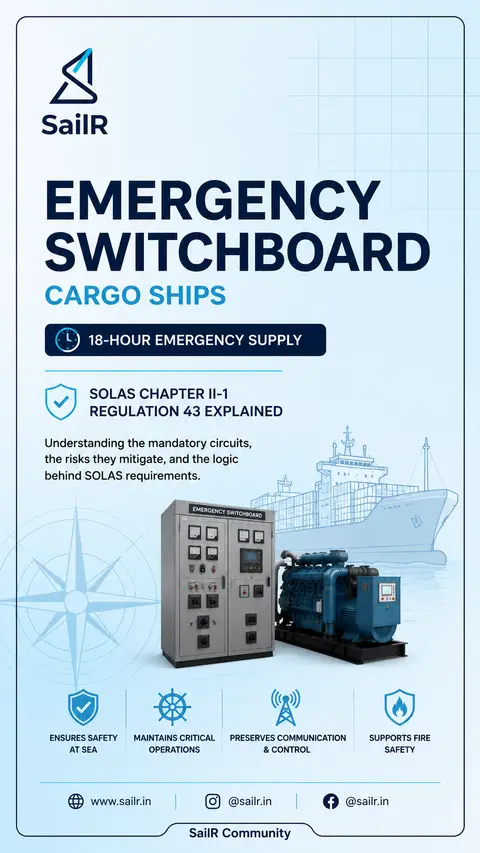
The slides, written out
AI-drawn illustration. Simplified to explain the idea, not to scale.
Slide 1 · EMERGENCY
EMERGENCY
SWITCHBOARD
CARGO SHIPS
18-HOUR EMERGENCY SUPPLY
SOLAS CHAPTER II-1
REGULATION 43 EXPLAINED
Understanding the mandatory circuits,
the risks they mitigate, and the logic
behind SOLAS requirements.
ENSURES SAFETY
AT SEA
MAINTAINS CRITICAL
OPERATIONS
PRESERVES COMMUNICATION
& CONTROL
SUPPORTS FIRE
SAFETY
Slide 2 · MANDATORY CIRCUITS
MANDATORY CIRCUITS
18-HOUR EMERGENCY SUPPLY
Essential systems that must be supplied by the Emergency Switchboard.
01 EMERGENCY LIGHTING
Service & accommodation alleyways, stairways & exits
Machinery spaces & main generating stations (including control positions)
Control stations, machinery control rooms, main & emergency switchboards
Stowage positions for firemen's outfits
Steering gear room
Cargo pump-rooms (tanker specific)
Fire pump, sprinkler pump (if fitted), emergency bilge pump starting positions
02 NAVIGATION & SAFETY LIGHTS
All navigation lights required by the International Regulations for Preventing Collisions at Sea (COLREGS).
03 RADIO & COMMUNICATION EQUIPMENT
VHF radio installation
MF/HF radio installation (if fitted)
Internal communication equipment required in an emergency (talk-back systems, telephones at control positions)
04 NAVIGATIONAL EQUIPMENT
Navigational equipment required under SOLAS Chapter V Regulation 19 that depends upon the emergency source of electrical power (e.g., radar, ECDIS, GPS, AIS). Administrations may exempt certain ships under 5,000 GT where permitted by SOLAS.
05 FIRE SAFETY SYSTEMS
Fire detection and fire alarm system
Required electrically supplied fire-fighting equipment (e.g., one fire pump) where applicable.
06 SIGNALING & INTERNAL SYSTEMS
Intermittent operation of:
– Daylight signalling lamp
– Ship's whistle
– Manually operated call points
– All internal signals required in an emergency (general alarm, watertight door indicators, etc.)
07 STEERING GEAR
Emergency power shall be available to steering gear in accordance with the applicable SOLAS steering gear requirements for the approved installation.
08 ESSENTIAL ANCILLARIES (TRANSITIONAL SOURCE)
A transitional source of emergency power shall supply the prescribed emergency services for at least 30 minutes while the emergency generator assumes the load.
Covers critical functions during the gap between main power failure and emergency generator run-up.
Includes essential lighting, navigation aids (if required), and watertight door power & control circuits (if applicable).
All systems must be available for 18 hours after the loss of the main electrical supply.
Slide 3 · WHY THESE CIRCUITS
WHY THESE CIRCUITS
MATTER
THE REAL RISKS AT SEA
These circuits are selected to ensure the ship remains
safe, controllable and communicative during a blackout.
THE REAL RISK
CIRCUITS SELECTED & WHAT THEY DO
LOSS OF
NAVIGATIONAL
CONTROL
If you lose steering
on a dark night near
a traffic lane...
STEERING GEAR, NAVIGATION
LIGHTS, NAVIGATION EQUIPMENT
Keeps the ship steerable and visible to
other vessels, preventing collision and
drift hazards.
LOSS OF
SITUATIONAL
AWARENESS
In a blackout, you
get deaf and blind...
NAVIGATION LIGHTS, FIRE
DETECTION, COMMUNICATION
EQUIPMENT, INTERNAL SIGNALS
Ensures you know what's happening
and can alert others. Maintains vital
communication and alarm systems.
LOSS OF
INTERNAL &
ESCAPE SAFETY
Darkness during fire
or flooding puts lives
at extreme risk...
EMERGENCY LIGHTING,
WATERTIGHT DOOR CIRCUITS
(WHERE APPLICABLE)
Provides safe escape routes, muster
station visibility and ability to isolate
flooding compartments.
LOSS OF
FIREFIGHTING
CAPABILITY
A fire during blackout
can escalate rapidly...
FIRE DETECTION & ALARM
SYSTEM, REQUIRED FIRE PUMP(S)
Detects fire early and ensures at least
one fire pump is available to fight
and contain the fire.
LOSS OF
PROPULSION
RESTORATION
If the main engine
cannot be restarted,
you are adrift...
ESSENTIAL AUXILIARIES &
CONTROL SYSTEMS
Supplies essential auxiliaries and
control systems required for blackout
recovery as per the ship's approved
electrical design.
COMMON-MODE
FAILURE
A fire, explosion or
collision can take out
the main power...
SEPARATE EMERGENCY GENERATOR
& EMERGENCY SWITCHBOARD
Located away from machinery spaces
and critical hazard areas to ensure
independence and reliability.
KEY PRINCIPLE
Emergency power preserves
life, navigation, communication
and fire safety until the ship recovers
or reaches a safe condition.
PROTECTS
LIFE
MAINTAINS
CONTROL
ENSURES
COMMUNICATION
SUPPORTS
FIRE SAFETY
18h 18-HOUR
ENDURANCE
As required by
SOLAS II-1
Regulation 43
Slide 4 · SOLAS II-1 REGULATION 43
SOLAS II-1 REGULATION 43
EMERGENCY POWER FLOW
HOW THE SYSTEM PROTECTS THE SHIP
From power failure to safe ship operation —
the 18-hour emergency supply in action.
1
MAIN POWER FAILURE
Loss of main electrical supply
due to blackout or casualty.
2
AUTOMATIC BLACKOUT
System detects failure and
triggers emergency sequence.
3
TRANSITIONAL SOURCE
OF EMERGENCY POWER
(≥ 30 MINUTES)
Supplies prescribed emergency
services for at least 30 minutes
while the emergency generator
assumes the load.
4
EMERGENCY GENERATOR
AUTOMATICALLY STARTS
Starts automatically and supplies
the emergency switchboard
within the time required by SOLAS.
5
EMERGENCY SWITCHBOARD
ENERGISED
The emergency switchboard
automatically supplies the
prescribed emergency services.
EMERGENCY
LIGHTING
COMMUNICATION
SYSTEMS
NAVIGATION
EQUIPMENT*
FIRE SAFETY
SYSTEMS
STEERING &
ESSENTIAL
SYSTEMS
6
EMERGENCY SERVICES MAINTAINED
Essential emergency services remain available
in accordance with SOLAS Chapter II-1
Regulation 43 until normal power is restored
or the ship reaches a safe condition.
* Navigational equipment required by SOLAS Chapter V
Regulation 19 that depends on the emergency source
of electrical power.
SYSTEM HIGHLIGHTS
INDEPENDENT
EMERGENCY GENERATOR
Located above the uppermost
continuous deck, away from
machinery spaces and critical
hazards.
SEPARATE EMERGENCY
SWITCHBOARD
Physically separated from the
main switchboard to avoid
common-mode failure.
AUTOMATIC CHANGEOVER
Automatic transfer of the required
emergency loads from main
power to emergency power
without manual intervention.
18-HOUR ENDURANCE
Cargo ships must have
emergency power capacity
for a minimum of 18 hours.
SOLAS COMPLIANT
Designed in accordance with
SOLAS Chapter II-1 Regulation 43.
KEY FACTS
Transitional source supplies prescribed
emergency services for at least 30 minutes.
Emergency generator and switchboard
must be independent and protected from
machinery space hazards.
Essential emergency services must remain
available for 18 hours after loss of the
main electrical supply.
The design maintains essential emergency
services in accordance with SOLAS
Chapter II-1 Regulation 43.
Drafted by SailR from our daily lessons. AI-drawn illustration. Simplified to explain the idea, not to scale. Last updated 19 Oct 2026.
Spotted a mistake?