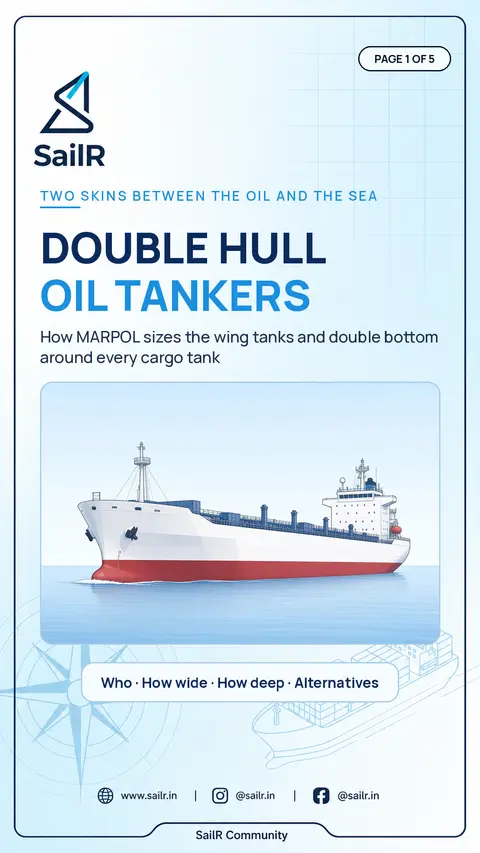
Double hull oil tanker midship section: MARPOL wing tank and double bottom requirements
- Chief Mate
- 2nd Mate
- MEO Class 4
- MEO Class 2
- UK Management
- times asked
- 91
- times asked
- questions
- 12
- questions
- last asked
- 2026
- last asked
Every cargo tank on a modern oil tanker sits inside a ring of ballast spaces that never hold oil. Here is how MARPOL Annex I regulation 19 sets the wing tank width, the double bottom depth and the allowed alternatives.
The slides, written out
AI-drawn illustration. Simplified to explain the idea, not to scale.
Slide 1 · Two skins between the oil and the sea
Two skins between the oil and the sea. Double hull oil tankers: how MARPOL sizes the wing tanks and double bottom around every cargo tank. The four parts are who, how wide, how deep and alternatives.
Slide 2 · Which tankers
Which tankers. By deadweight, tankers below 600 t are not covered, 600 t up to 5,000 t need a double bottom, and 5,000 t and above need a full double hull. Delivered on or after 6 July 1996: regulation 19 applies to oil tankers of 600 tonnes deadweight and above. For 5,000 dwt and above, the entire cargo tank length is protected by ballast tanks or spaces other than oil tanks, with wing tanks and a double bottom along the entire cargo tank length. Below 5,000 dwt, the option is a double bottom with h = B/15, at least 0.76 m, and cargo tanks of max 700 m³ unless wing tanks are fitted. Nothing forward: no oil in any space forward of the collision bulkhead. Ref: MARPOL Annex I, regulations 1.28.6, 19.1, 19.2, 19.3, 19.6, 19.7.
Slide 3 · The midship section
The midship section. The cargo tank sits inside wing tanks at the side shell and a double bottom over the bottom shell, measured from the baseline. Wing tanks: w = 0.5 + DW/20,000 m, or 2.0 m, whichever is less, and never under 1.0 m. Double bottom: h = B/15 m, or 2.0 m, whichever is less, and never under 1.0 m. Turn of the bilge: where h and w differ, w governs above 1.5h from the baseline. How measured: at any cross-section, at right angles to the side shell and to the bottom shell. Ref: MARPOL Annex I, regulations 19.3.1, 19.3.2, 19.3.3.
Slide 4 · Inside the protective spaces
Inside the protective spaces. Suction wells may dip into the double bottom if as small as practicable, with at least 0.5h left to the bottom shell. Piping kept apart: ballast pipes stay out of cargo tanks, and cargo pipes stay out of ballast tanks; short, fully welded lengths may be exempted. Ballast capacity: crude tankers from 20,000 dwt and product carriers from 30,000 dwt have wing, double bottom and peak tanks that give at least the required segregated ballast capacity. Room to inspect: Administrations consider maintenance and inspection of wing and double bottom tanks when approving the design. Ref: MARPOL Annex I, regulations 19.3.4, 19.3.5, 19.3.6, 19.8.
Slide 5 · Alternative designs
Alternative designs. Mid-deck design: the double bottom may be dispensed with if cargo and vapour pressure on the bottom shell does not exceed the sea pressure outside, with a safety factor of 1.1. Partition height: at least B/6 or 6 m, whichever is less, and not above 0.6D from the baseline; wing tanks are still fitted and there is a single bottom shell. Other designs need at least the same protection in collision or stranding and approval in principle by MEPC, the Marine Environment Protection Committee. Common mistake: 2.0 m is the cap, not the minimum. The minimum for w and h is 1.0 m. Ref: MARPOL Annex I, regulations 19.3.1, 19.3.2, 19.4, 19.5.
What it is
A double hull oil tanker carries every cargo tank inside a protective ring of spaces that never hold oil. MARPOL Annex I requires the entire cargo tank length to be protected by ballast tanks or spaces other than tanks that carry oil, with wing tanks or spaces at the sides and double bottom tanks or spaces underneath (MARPOL Annex I, regulation 19.3).
The requirement applies to oil tankers of 600 tonnes deadweight and above delivered on or after 6 July 1996. That date is a defined term. It covers a tanker whose building contract was placed on or after 6 July 1993, or with no contract, whose keel was laid on or after 6 January 1994, or which was delivered on or after 6 July 1996. A tanker that has undergone a major conversion on matching dates is caught as well (MARPOL Annex I, regulations 1.28.6, 19.1).
The current text sits in the revised Annex I adopted by IMO Res. MEPC.117(52), which entered into force on 1 January 2007 (IMO Res. MEPC.117(52), operative paragraph 3).
Why it matters
The protective spaces are there for collision and stranding. Regulation 19 itself measures any alternative design against the level of protection against oil pollution in the event of collision or stranding, which tells you what the wing tanks and double bottom are for (MARPOL Annex I, regulation 19.5).
The double hull also shapes ballast work. On crude oil tankers of 20,000 tonnes deadweight and above and product carriers of 30,000 tonnes deadweight and above, the wing tanks, double bottom tanks, forepeak and after peak together must give at least the segregated ballast capacity that regulation 18 demands (MARPOL Annex I, regulation 19.3.4).
That capacity has a purpose of its own. Regulation 18 sizes segregated ballast so the ship can operate safely on ballast voyages without using cargo tanks for water ballast, apart from the cases it allows (MARPOL Annex I, regulations 18.1, 18.2).
How it works on board
Draw the midship section and start with the wing tanks. They run either the full depth of the ship's side or from the top of the double bottom to the uppermost deck, ignoring a rounded gunwale. The cargo tanks sit inboard of the moulded line of the side shell by at least the distance w, measured at right angles to the side shell at any cross-section (MARPOL Annex I, regulation 19.3.1).
For tankers of 5,000 tonnes deadweight and above, w is 0.5 + DW/20,000 metres or 2.0 metres, whichever is less, and never less than 1.0 metre. DW is the deadweight in tonnes, measured in water of relative density 1.025 at the summer load waterline (MARPOL Annex I, regulations 1.23, 19.3.1).
Under the cargo tanks the double bottom depth h, measured at right angles to the bottom shell plating, is B/15 metres or 2.0 metres, whichever is less, with a minimum of 1.0 metre. B is the maximum breadth of the ship amidships, measured to the moulded line of the frame, in metres (MARPOL Annex I, regulations 1.22, 19.3.2).
The turn of the bilge is where sketches go wrong. Where h and w differ, w has preference at levels more than 1.5h above the baseline. (MARPOL Annex I, regulation 19.3.3).
Suction wells in the cargo tanks may protrude into the double bottom below the line set by h. They must be as small as practicable, and the distance from the well bottom to the bottom shell plating must be at least 0.5h (MARPOL Annex I, regulation 19.3.5).
Piping is kept apart. Ballast piping, including sounding and vent piping to ballast tanks, does not pass through cargo tanks, and cargo piping does not pass through ballast tanks. Short lengths may be exempted if they are completely welded or equivalent (MARPOL Annex I, regulation 19.3.6).
The rules
Regulation 19.1: applies to oil tankers of 600 tonnes deadweight and above delivered on or after 6 July 1996 (MARPOL Annex I, regulation 19.1).
Regulation 19.3: for 5,000 tonnes deadweight and above, the entire cargo tank length is protected by ballast tanks or spaces other than oil tanks (MARPOL Annex I, regulations 19.2, 19.3).
Regulation 19.4: the double bottom may be dispensed with where cargo and vapour pressure on a single bottom boundary does not exceed the external sea pressure with a safety factor of 1.1, and any horizontal partition sits at least B/6 or 6 metres above the baseline, whichever is less, and no higher than 0.6D (MARPOL Annex I, regulation 19.4).
Regulation 19.5: other designs are accepted only if they give at least the same protection and are approved in principle by the Marine Environment Protection Committee (MARPOL Annex I, regulation 19.5).
Regulation 19.6: below 5,000 tonnes deadweight, a double bottom of h = B/15 with a minimum of 0.76 metre, and cargo tanks of no more than 700 cubic metres unless wing tanks of w = 0.4 + 2.4DW/20,000 metres, minimum 0.76 metre, are fitted (MARPOL Annex I, regulation 19.6).
Regulation 19.7: no oil in any space forward of the collision bulkhead (MARPOL Annex I, regulation 19.7).
In a mid-deck design the wing tanks are still arranged as for a full double hull, except that below 1.5h above the baseline the cargo tank boundary may run vertically down to the bottom plating (MARPOL Annex I, regulation 19.4.3).
Administrations approving a double hull design must have due regard to general safety, including the need to maintain and inspect the wing and double bottom tanks or spaces (MARPOL Annex I, regulation 19.8).
Common mistakes
The most common slip is to quote 2 metres as the minimum width or depth. In regulation 19.3, 2.0 metres is the upper value of the requirement and 1.0 metre is the floor. Working the formula, w only reaches the 2.0 metre cap at 30,000 tonnes deadweight and falls to the 1.0 metre minimum at 10,000 tonnes deadweight and below (MARPOL Annex I, regulation 19.3.1).
The double bottom behaves the same way. B/15 reaches 2.0 metres when the breadth is 30 metres, so a beamier tanker still needs only 2.0 metres, while a narrow one never goes below 1.0 metre (MARPOL Annex I, regulation 19.3.2).
Another slip is drawing a wing tank of width w all the way down into the bilge. Above 1.5h it is w that governs. Below that level, the arrangement at the turn of the bilge follows the boundary lines shown in the regulation's figure (MARPOL Annex I, regulation 19.3.3).
Small tankers trip people up too. Below 5,000 tonnes deadweight a tanker may instead take the lighter option, where the minimum figure is 0.76 metre and wing tanks are needed only if a cargo tank exceeds 700 cubic metres (MARPOL Annex I, regulation 19.6).
In exams
Asked 91 times across 12 different questions, most recently in 2026. Asked most in Chief Mate (37), 2nd Mate (29), MEO Class 4 (18), MEO Class 2 (6).
Drafted by SailR from the regulations cited. AI-drawn illustration. Simplified to explain the idea, not to scale. Last updated 29 Oct 2026.
Spotted a mistake?