The slides, written out
AI-drawn illustration. Simplified to explain the idea, not to scale.
Slide 1 · MLC 2006
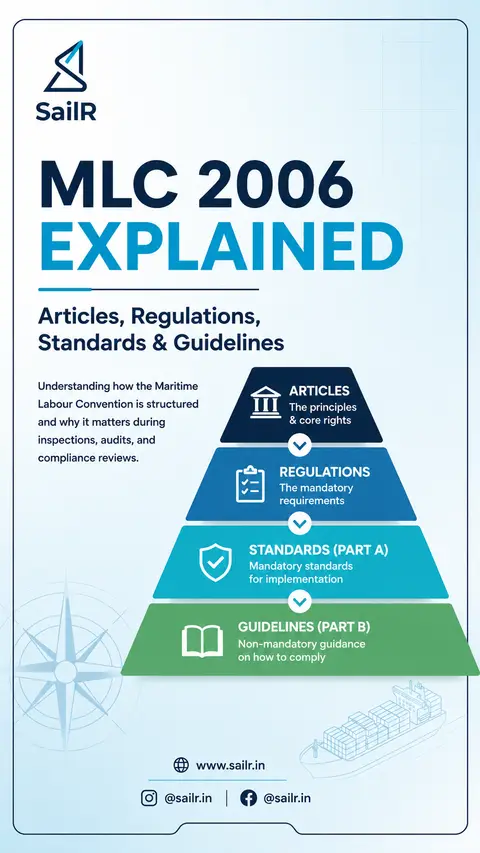
MLC 2006
EXPLAINED
Articles, Regulations,
Standards & Guidelines
Understanding how the Maritime
Labour Convention is structured
and why it matters during
inspections, audits, and
compliance reviews.
ARTICLES
The principles
& core rights
REGULATIONS
The mandatory
requirements
STANDARDS (PART A)
Mandatory standards
for implementation
GUIDELINES (PART B)
Non-mandatory guidance
on how to comply
Slide 2 · The Legal Structure
The Legal Structure
of MLC 2006
The MLC is built in a hierarchy.
Authority decreases downward while detail increases.
01
ARTICLES
• Fundamental rights
• Core principles
• Constitutional provisions
02
REGULATIONS
• Mandatory requirements
• Define what must
be achieved
03
STANDARDS (PART A)
• Mandatory implementation
• Detailed compliance
requirements
04
GUIDELINES (PART B)
• Recommended methods
• Non-mandatory guidance
AUTHORITY DECREASES DOWNWARD
WHILE DETAIL INCREASES DOWNWARD.
|
Slide 3 · WHAT'S MANDATORY
WHAT'S MANDATORY
AND WHAT'S GUIDANCE?
MLC 2006 is divided into two parts.
Understanding the difference is critical!
PART A
STANDARDS
(Mandatory)
PART B
GUIDELINES
(Non-mandatory)
Mandatory
Must be implemented
by Member States
Non-mandatory
Provide guidance
on how to comply
Used during
certification
and inspections
Must receive
"due consideration"
(Article VI.2)
Basis for compliance
assessment by
Flag & Port States
Provide recommended
approaches and
good practice
No opt-out
unless allowed through
substantial equivalence
(Article VI)
Support practical
implementation
for States, shipowners,
and seafarers
VS
PART B EXPLAINS HOW COMPLIANCE MAY BE ACHIEVED,
WHILE PART A DEFINES WHAT MUST BE ACHIEVED.
Slide 4 · THE KEY POINT
THE KEY POINT
MOST PEOPLE MISS
Article VI requires Members to give
"DUE CONSIDERATION"
to Part B Guidelines.
IMPORTANT CLARIFICATION
A State does NOT have to adopt
a Guideline word-for-word.
However, any alternative implementation must
still satisfy the relevant mandatory requirements
of Part A.
INSPECTION PERSPECTIVE
PSC officers may view Part B as evidence
of accepted good practice.
If your ship follows an alternative arrangement,
it should be supported by:
Flag State
requirements
DMLC
documentation
Company
procedures
KNOW THE DIFFERENCE.
PASS THE INSPECTION.
Drafted by SailR from our daily lessons. AI-drawn illustration. Simplified to explain the idea, not to scale. Last updated 19 Oct 2026.
Spotted a mistake?