Fixed CO₂ Fire Extinguishing System – Principles, Components & Safe Operation
- MEO Class 4
- MEO Class 2
- ETO
- UK Management
- Chief Mate
- MEO Class 1
- times asked
- 101
- times asked
- questions
- 21
- questions
- last asked
- 2026
- last asked
The slides, written out
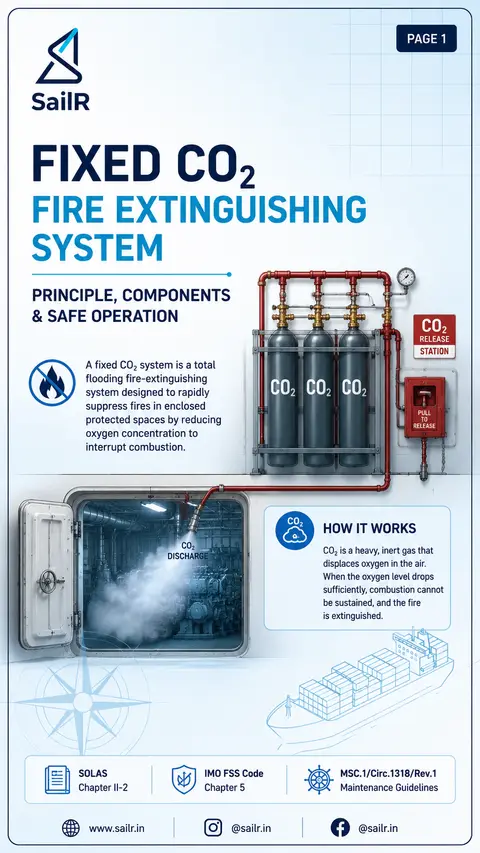
AI-drawn illustration. Simplified to explain the idea, not to scale.
Slide 1 · FIXED CO2
FIXED CO2
FIRE EXTINGUISHING
SYSTEM
PRINCIPLE, COMPONENTS
& SAFE OPERATION
CO2 RELEASE STATION
PULL TO RELEASE
A fixed CO2 system is a total flooding fire-extinguishing system designed to rapidly suppress fires in enclosed protected spaces by reducing oxygen concentration to interrupt combustion.
CO2 DISCHARGE
HOW IT WORKS
CO2 is a heavy, inert gas that displaces oxygen in the air. When the oxygen level drops sufficiently, combustion cannot be sustained, and the fire is extinguished.
SOLAS Chapter II-2
IMO FSS Code Chapter 5
MSC.1/Circ.1318/Rev.1 Maintenance Guidelines
Slide 2 · MAJOR COMPONENTS
MAJOR COMPONENTS
OF FIXED CO2 FIRE EXTINGUISHING SYSTEM
A fixed CO2 system comprises high-pressure cylinders, piping, valves and safety devices working together to quickly suppress fire in enclosed spaces.
1 CO2 STORAGE ROOM
Dedicated compartment
Well ventilated
Leak detection and safe access
2 CO2 CYLINDERS
High-pressure storage (typical 45 kg, ~55 bar)
Connected to common manifold
Fitted with safety bursting discs
3 MANIFOLD & DISTRIBUTION PIPING
CO2 from cylinders discharges into common manifold
Permanent steel piping network
Supplies protected spaces
4 DISTRIBUTION VALVES
Direct CO2 to selected protected space
Prevent unintended discharge
Clearly identified for each space
5 RELEASE STATION
Located outside the protected space
Used to operate the approved release controls
Includes alarm activation
6 SAFETY DEVICES
Non-return (check) valves
Pressure relief devices
Safety bursting discs
Audible pre-discharge alarm
Mechanical safety arrangements
System configuration may vary depending on manufacturer, vessel type and approval requirements.
SOLAS Chapter II-2
IMO FSS Code Chapter 5
MSC.1/Circ.1318/Rev.1 Maintenance Guidelines
TO ENGINE ROOM
CO2 RELEASE STATION
PULL TO RELEASE
ALARM
CO2 ROOM
Slide 3 · EMERGENCY RELEASE
EMERGENCY RELEASE
SEQUENCE (ENGINE ROOM)
Follow the approved procedure. Ensure complete evacuation before releasing CO2.
1
CONFIRM FIRE
• Identify fire and assess if fixed CO2 release is necessary.
2
EVACUATE PERSONNEL
• Ensure complete evacuation from the machinery space.
• Conduct personnel accountability.
3
SECURE MACHINERY SPACE
• Stop ventilation fans.
• Close fire dampers.
• Shut quick-closing fuel, diesel oil & lube oil valves.
• Stop fuel and lube oil pumps.
• Close all openings to the space.
4
ACTIVATE WARNING ALARM
• Operate the CO2 pre-discharge alarm to warn personnel.
• Allow sufficient time for safe evacuation.
5
RELEASE CO2
• Operate the approved release controls in accordance with the manufacturer's instructions.
• CO2 will discharge through the distribution valve to the selected protected space.
6
KEEP SPACE SEALED
• Do not re-enter until:
✔ Fire is confirmed extinguished
✔ Space is ventilated
✔ Atmosphere is tested
✔ Entry is authorised
NEVER DISCHARGE CO2 WHILE PERSONNEL REMAIN INSIDE THE PROTECTED SPACE.
SOLAS
Chapter II-2
IMO FSS Code
Chapter 5
MSC.1/Circ.1318/Rev.1
Maintenance Guidelines
Slide 4 · INSPECTION, MAINTENANCE
INSPECTION, MAINTENANCE
& BEST PRACTICES
Regular inspection and proper maintenance ensure the CO2 system is ready for the critical moment.
ROUTINE INSPECTION
Verify condition and security of CO2 cylinders.
Check release controls, handles and safety arrangements.
Inspect piping, valves, nozzles and supports.
Confirm alarms, signage and emergency lighting.
Ensure CO2 room ventilation fan and leak detection system are operational.
Maintain all records in accordance with the planned maintenance system.
PERIODIC MAINTENANCE
Cylinder Content Verification
Verify contents/weight as per manufacturer's permitted tolerance. Recharge cylinders outside approved limits.
Operational Inspection
Test system operation in accordance with manufacturer's instructions.
Hydrostatic Testing
Cylinders shall undergo hydrostatic testing at the intervals and test pressure specified by the manufacturer and applicable regulations.
System Integrity
Carry out inspections and tests of pipework, valves and nozzles as required by the approved maintenance programme.
COMMON MISTAKES TO AVOID
Releasing CO2 before complete evacuation.
Leaving ventilation fans or dampers in open position.
Opening the space immediately after discharge.
Bypassing or tampering with safety devices.
Ignoring maintenance intervals or system defects.
KEY BEST PRACTICES
Know your system and the approved release procedure.
Train all relevant personnel regularly.
Ensure clear access to release station at all times.
Keep CO2 room clean, ventilated and accessible.
Conduct drills and review procedures periodically.
KEY REFERENCES
SOLAS Chapter II-2 Regulation 10
IMO Fire Safety Systems (FSS) Code Chapter 5
MSC.1/Circ.1318/Rev.1 Revised Guidelines for the Maintenance and Inspection of Fixed Fire-Extinguishing Systems
In exams
Asked 101 times across 21 different questions, most recently in 2026. Asked most in MEO Class 4 (51), MEO Class 2 (17), ETO (14), UK Management (9).
Drafted by SailR from our daily lessons. AI-drawn illustration. Simplified to explain the idea, not to scale. Last updated 19 Oct 2026.
Spotted a mistake?