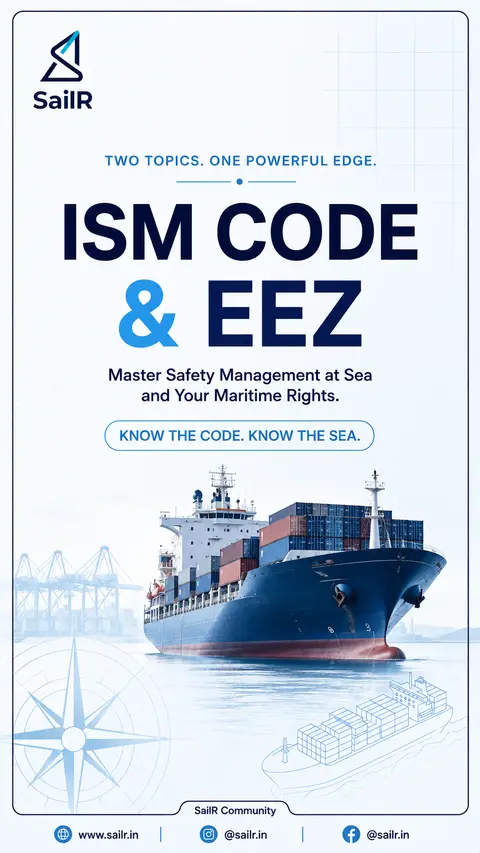
The slides, written out
AI-drawn illustration. Simplified to explain the idea, not to scale.
Slide 1 · TWO TOPICS
TWO TOPICS. ONE POWERFUL EDGE.
ISM CODE
& EEZ
Master Safety Management at Sea
and Your Maritime Rights.
KNOW THE CODE. KNOW THE SEA.
Slide 2 · ISM CODE
ISM CODE
OBJECTIVES
Safe Ships. Safe People. Clean Seas.
SECTION 1.2.1
The objectives of the ISM Code
are to ensure:
Safety at sea
Prevention of human injury
or loss of life
Avoidance of damage to the
environment, particularly the
marine environment, and to property
KEY TAKEAWAY
The ISM Code provides an international
standard for the safe management and
operation of ships and pollution prevention.
ISM Code | Section 1.2.1
Slide 3 · SLIDE 2 OF 4
ISM CODE:
COMPANY OBJECTIVES
SECTION 1.2.2
A company should strive to:
01
SAFE OPERATIONS
Provide for safe practices in ship operation and a safe working environment.
02
RISK CONTROL
Assess all identified risks to its ships, personnel and the environment, and establish appropriate safeguards.
03
CONTINUOUS IMPROVEMENT
Continuously improve safety management skills of personnel ashore and aboard, including preparing for emergencies related to both safety and environmental protection.
EXAM INSIGHT
ISM is not just about following procedures.
It is about identifying risk, controlling risk and continuously improving safety management.
ISM Code | Section 1.2.2
| |
Slide 4 · THE SMS
THE SMS:
WHAT MUST IT ENSURE?
SECTION 1.2.3
The Safety Management System should ensure:
COMPLIANCE
Mandatory rules
and regulations
PLUS
TAKING INTO ACCOUNT
Applicable codes, guidelines and standards
recommended by:
IMO
Administrations
Classification
societies
Maritime industry
organizations
THE ISM PHILOSOPHY
The Code is expressed in broad terms because shipping
companies and operating conditions differ.
It is based on general principles and objectives,
not a one-size-fits-all prescriptive system.
COMMITMENT FROM THE TOP
IS THE CORNERSTONE OF GOOD
SAFETY MANAGEMENT.
The attitudes and motivation of individuals at every level
ultimately drive the result.
ISM Code | Section 1.2.3
Slide 5 · SLIDE 4 OF 4
EXCLUSIVE
ECONOMIC ZONE (EEZ)
UP TO 200 NM
The EEZ extends up to 200 nautical miles from the
baselines from which the breadth of the territorial sea is measured.
COASTAL STATE
Has sovereign
rights for:
Exploration and exploitation
Conservation and management
of natural resources
Living and non-living resources of
the waters, seabed and subsoil
It also has
specified jurisdiction
concerning:
Marine scientific research
Protection and preservation of
the marine environment
Artificial islands, installations
and structures
OTHER STATES
Within the EEZ,
other States retain,
subject to UNCLOS:
Freedom of navigation
Freedom of overflight
Freedom to lay submarine
cables and pipelines
EXAM TRAP
EEZ ≠ TERRITORIAL SEA
The EEZ is not full territorial sovereignty.
The coastal State has specified sovereign rights and jurisdiction,
while other States retain the rights and freedoms provided by UNCLOS.
LEGAL REFERENCE
UNCLOS Articles 55, 56, 57 & 58
UNCLOS | Articles 55, 56, 57 & 58
Drafted by SailR from our daily lessons. AI-drawn illustration. Simplified to explain the idea, not to scale. Last updated 19 Oct 2026.
Spotted a mistake?