The slides, written out
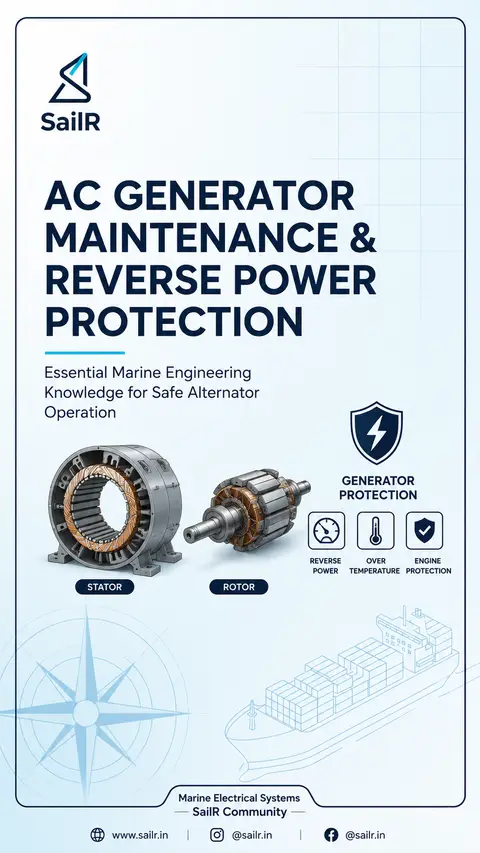
AI-drawn illustration. Simplified to explain the idea, not to scale.
Slide 1 · AC GENERATOR
AC GENERATOR
MAINTENANCE &
REVERSE POWER
PROTECTION
Essential Marine Engineering
Knowledge for Safe Alternator
Operation
GENERATOR
PROTECTION
REVERSE
POWER
OVER
TEMPERATURE
ENGINE
PROTECTION
STATOR
ROTOR
Marine Electrical Systems
Slide 2 · ROUTINE CARE OF
ROUTINE CARE OF
AC GENERATOR
COMPONENTS
Stator and Rotor Maintenance Checklist
BEFORE MAINTENANCE
Stop prime mover
Lock-out / Tag-out
Isolate alternator
Isolate space heater
Tag everything clearly
STATOR CARE
ROTOR CARE
INSPECTION
Check terminal connections for tightness
Inspect general insulation condition
INSPECTION
Check terminal connections for tightness
Inspect general insulation condition
CLEANING
Clean windings with vacuum cleaner (rubber hose & soft nozzle)
Remove dust, carbon dust and loose debris
CLEANING
Clean windings with vacuum cleaner (rubber hose & soft nozzle)
Remove dust, carbon dust and loose debris
OIL / GREASE REMOVAL
If oil or grease is present (especially on lower parts), open drain plugs
Clean with approved electro-cleaner or degreasant
MECHANICAL CHECKS
Measure air gap between rotor and stator all around
Ensure uniform clearance, especially at the bottom
MECHANICAL CHECKS
Measure air gap between rotor and stator all around
Ensure uniform clearance, especially at the bottom
MECHANICAL CHECKS
Measure air gap between rotor and stator all around
Ensure uniform clearance, especially at the bottom
ADDITIONAL CHECKS
Check bearings – oil level & condition
Inspect cooling air intake & exhaust passages
Check slip rings & brush gear (wear, pitting, brush tension)
Always follow the manufacturer's maintenance instructions and safety procedures.
Marine Electrical Systems
Slide 3 · GENERATOR
GENERATOR
INSULATION TESTING
Correct Testing Ensures Reliability & Prevents Failures
STEP 1
Disconnect the
neutral point
STEP 2
Measure insulation
resistance using
megger
1000V
MΩ
STEP 3
Perform the
following tests
1 Rotor to Earth
2 Stator Phase A to Earth
3 Stator Phase B to Earth
4 Stator Phase C to Earth
5 Phase to Phase
A-B / B-C / C-A
IF MOISTURE IS PRESENT
Dry windings in accordance
with manufacturer instructions
Continuously monitor
temperature
Follow insulation class
temperature limits
SAFETY NOTE
Poor insulation can cause:
• Earth faults
• Flashover
• Generator trip
• Equipment damage
• Fire risk
EVALUATION OF RESULTS
Compare against
OEM recommended
limits
Apply temperature
correction to the
readings
Review historical
trend for any
deterioration
Re-varnish windings
if insulation is
degraded
Proper insulation testing and maintenance extends generator life
and ensures safe, reliable operation.
Marine Electrical Systems
Slide 4 · PRIME MOVER FAILURE
PRIME MOVER FAILURE
IN PARALLEL OPERATION
Understanding Reverse Power & Motoring Condition
WHAT HAPPENS WHEN ONE GENERATOR LOSES DRIVING POWER?
Generator A & Generator B running in parallel
Generator B loses prime mover power
Generator B remains connected to busbar
Generator B becomes a synchronous motor
Reverse power flow occurs
Engine experiences motoring condition
RISKS OF MOTORING
Engine overheating
Exhaust manifold overheating
Turbocharger damage
High mechanical stress & wear
Piston seizure, valve burning & serious engine damage
The surviving generator drives the motoring generator electrically. The engine is driven without fuel, causing severe stress, overheating and potential damage.
PROTECTION SYSTEMS THAT SAFEGUARD AGAINST REVERSE POWER
1 REVERSE POWER RELAY
kW
Detects reverse power flow
Trips generator circuit breaker
Primary protection against motoring
Low pickup setting with short intentional delay
2 PRIME MOVER PROTECTIONS
Overspeed protection
Lubricating oil low pressure trip
Jacket water high temperature alarm
Other engine safety protections as fitted
3 CIRCUIT BREAKER INTERLOCKS
Prevent breaker closing under fault condition
Ensures safe synchronization
Protects switchboard and equipment
4 OVERCURRENT RELAY (BACKUP)
Acts as backup protection
Trips on excessive current draw
Supplements reverse power protection
OPERATOR ACTION IF REVERSE POWER PROTECTION FAILS
Monitor generator kW indication & load sharing
Observe PMS indications & alarms
Watch for abnormal load distribution
Open the affected generator breaker immediately
DO NOT DELAY – IMMEDIATE ACTION PREVENTS DAMAGE.
NOTE
Emergency generator and shore supply are interlocked against paralleling with the main switchboard to prevent similar motoring conditions.
REVERSE POWER PROTECTION IS THE PRIMARY DEFENSE AGAINST GENERATOR MOTORING DAMAGE.
Marine Electrical Systems
Drafted by SailR from our daily lessons. AI-drawn illustration. Simplified to explain the idea, not to scale. Last updated 19 Oct 2026.
Spotted a mistake?