The slides, written out
AI-drawn illustration. Simplified to explain the idea, not to scale.
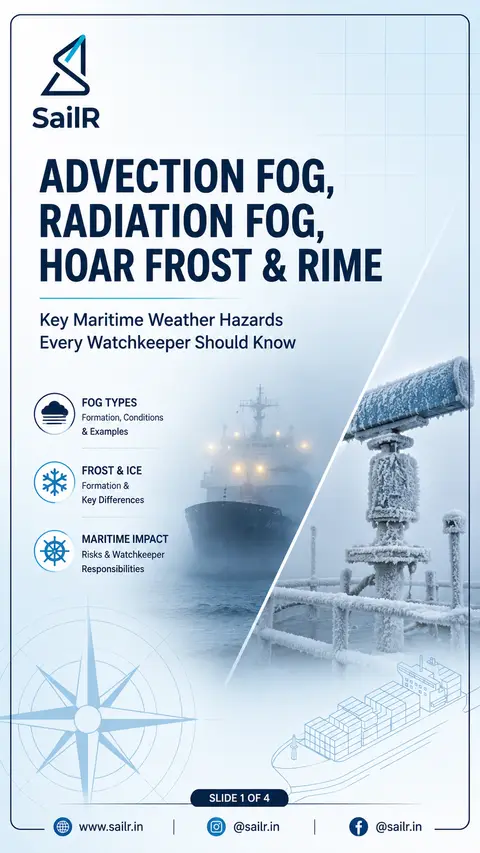
Slide 1 · ADVECTION FOG,
ADVECTION FOG,
RADIATION FOG,
HOAR FROST & RIME
Key Maritime Weather Hazards
Every Watchkeeper Should Know
FOG TYPES
Formation, Conditions
& Examples
FROST & ICE
Formation &
Key Differences
MARITIME IMPACT
Risks & Watchkeeper
Responsibilities
Slide 2 · FOG TYPES EVERY
FOG TYPES EVERY
MARINER SHOULD RECOGNIZE
ADVECTION FOG
(SEA FOG)
VS
RADIATION FOG
Warm, moist air moves horizontally over a colder sea surface.
Common at sea, especially over cold currents.
Can occur day or night, in any season.
Often widespread and persistent.
Visibility may remain poor for hours or days.
Forms mainly over land due to rapid night-time surface cooling.
Clear skies and light winds.
Ground cools quickly, air reaches dew point, fog forms.
Common in river estuaries, low-lying areas and harbour approaches.
Often dissipates after sunrise, but may persist in winter.
REAL-WORLD EXAMPLE
GRAND BANKS OF NEWFOUNDLAND
Warm Gulf Stream air flows over the cold Labrador Current — classic advection fog zone.
REAL-WORLD EXAMPLE
COASTAL HARBOUR APPROACHES AT DAWN
Fog forms over coastal plains and drifts into harbour approaches at sunrise.
WATCHKEEPER'S NOTE
Fog reduces visibility and affects navigation safety. Radar, AIS and sound signals become critical — and remember, sound signals can be distorted in fog.
Slide 3 · FROST OR ICE?
FROST OR ICE?
KNOW THE DIFFERENCE
HOAR FROST
VS
RIME
Forms by direct deposition
of water vapour (sublimation)
onto cold surfaces.
Requires surface temperature
below freezing and below
the frost point.
Occurs in calm to light
wind conditions.
Appears feathery, crystalline
and delicate — like ice needles.
Common on superstructure,
rails, rigging, radar mast,
and exposed fittings.
Main hazard: slippery decks,
ladders and reduced grip.
Forms when supercooled
water droplets freeze instantly
on contact.
Forms on surfaces below
freezing in freezing fog,
drizzle or low cloud.
Usually occurs in windy
conditions that bring
supercooled droplets.
Appears dense, opaque,
white and granular.
Builds up on windward sides
— forecastle, anchor windlass,
radar, lifeboats, aerials.
Main hazards: heavy ice loading,
radar blockage, equipment
damage and breakage risk.
WATCHKEEPER ALERT
Rime accumulation can create significant topside icing hazards.
Monitor weather reports and take preventive action.
QUICK COMPARISON
FEATURE
HOAR FROST
RIME
FORMATION
Water vapour deposits directly
Supercooled droplets freeze on impact
SURFACE CONDITION
Below freezing & below frost point
Below freezing
WIND CONDITION
Calm to light
Usually windy
APPEARANCE
Feathery, crystalline
Dense, granular, opaque
MARITIME HAZARD
Slips, reduced visibility
Heavy ice loading, radar blockage
Slide 4 · QUICK COMPARISON
QUICK COMPARISON
AT A GLANCE
FOG COMPARISON
FEATURE
ADVECTION FOG (SEA FOG)
RADIATION FOG
CAUSE
Warm, moist air moves horizontally over cooler sea surface.
Surface cooling at night causes air to reach dew point.
LOCATION
At sea, especially over cold currents.
Primarily over land and coastal approaches.
WIND CONDITION
Light to moderate winds (≈ 4–15 knots favorable*).
Calm to light winds (< 5 knots).
TIME
Any time, day or night, any season.
Night to early morning.
PERSISTENCE
May last for many hours to several days.
Often dissipates after sunrise, may persist in winter.
THICKNESS
Can be deep (hundreds of metres).
Usually shallow (tens of metres).
WATCHKEEPER FOCUS
Radar, AIS, sound signals – visibility can remain poor for extended periods.
Expect improvement after sunrise, but stay alert during pilot operations.
*Many marine forecasting references cite approximately 4–15 knots as favorable, but no universally accepted fixed wind range exists.
ICE / FROST COMPARISON
FEATURE
HOAR FROST
RIME
FORMATION
Direct deposition of water vapour (sublimation).
Supercooled droplets freeze on impact.
SURFACE REQUIRED
Below freezing AND below frost point.
Below freezing (droplet impact).
WIND CONDITION
Calm to light.
Usually windy (brings supercooled droplets).
APPEARANCE
Feathery, crystalline, delicate.
Dense, granular, opaque.
MARITIME HAZARD
Slips, reduced grip, reduced visibility.
Heavy ice loading, radar blockage, damage risk.
KEY TAKEAWAY
Understanding how fog and ice form helps you anticipate visibility and icing hazards — protect your ship, your crew and the voyage.
Drafted by SailR from our daily lessons. AI-drawn illustration. Simplified to explain the idea, not to scale. Last updated 19 Oct 2026.
Spotted a mistake?