The slides, written out
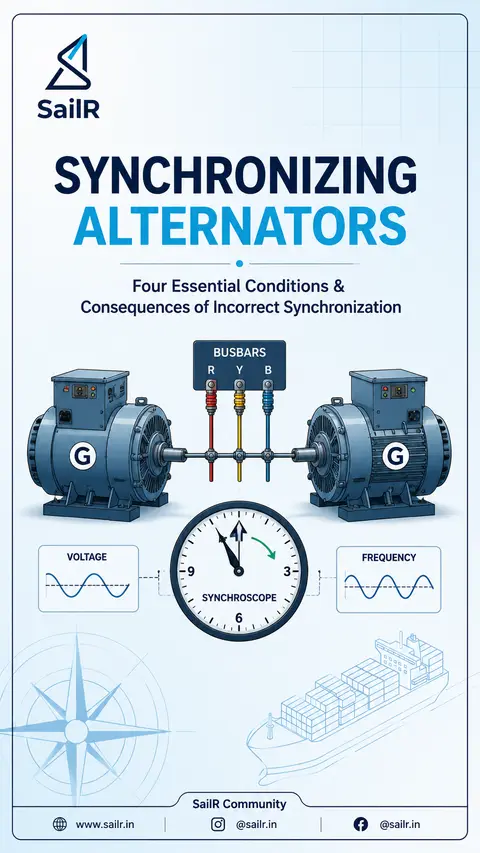
AI-drawn illustration. Simplified to explain the idea, not to scale.
Slide 1 · SYNCHRONIZING
SYNCHRONIZING
ALTERNATORS
Four Essential Conditions &
Consequences of Incorrect Synchronization
BUSBARS
R Y B
G
G
VOLTAGE
SYNCHROSCOPE
9 3 6
FREQUENCY
Slide 2 · BEFORE CLOSING
BEFORE CLOSING
THE BREAKER
All four conditions must be satisfied before synchronizing an alternator.
1
SAME VOLTAGE
Match the RMS voltage of the incoming generator with the busbar voltage.
Adjust using AVR.
Prevents large reactive current on closing.
GENERATOR
BUSBAR
2
SAME FREQUENCY
Match the frequency of the incoming machine with the busbar frequency.
Adjust using governor speed control.
Prevents hunting, power swings and mechanical stress.
GENERATOR
BUSBAR
Typical tolerance: within 0.1 – 0.2 Hz
3
SAME PHASE SEQUENCE
Phase rotation (R-Y-B) of the incoming generator must match the busbars.
Check using synchronizing lamps or phase-sequence indicator.
If the phase sequence is wrong, the indication depends on the synchronizing method used.
If an incorrect phase sequence is detected, interchange any two incoming generator phase connections before attempting synchronization.
4
VOLTAGES IN PHASE
Corresponding phase voltages must reach their positive peak at the same instant.
Check using the synchroscope.
Close the breaker when the pointer is just before 12 o'clock position (around 11 o'clock) and moving slowly in the clockwise (FAST) direction.
SYNCHROSCOPE
FAST DIRECTION Close just before 12 o'clock
GOLDEN RULE:
Never synchronize until all four conditions are satisfied.
Slide 3 · WHAT HAPPENS IF
WHAT HAPPENS IF
SYNCHRONIZATION
IS WRONG?
Closing the breaker out of synchronism causes a massive
circulating current. The machines fight each other to pull into
step, causing severe electrical and mechanical damage.
ELECTRICAL
EFFECTS
Large
circulating
current
Overcurrent
trip of one
or both
generators
Reverse
power
operation
Possible
blackout
of entire ship
MECHANICAL
EFFECTS
Shaft
torsional
shock
Broken
couplings
& damaged
keyways
Rotor diode
failure in
brushless
alternators
Stator
winding
movement
or deformation
Severe
vibration &
noise
IMMEDIATE SYMPTOMS
Loud
bang
Severe
vibration
Breaker
trip
Load
instability
CONSEQUENCES
Damage to
both electrical
machines
Reduced
reliability
& lifespan
High repair
costs &
downtime
Embarrassment
& loss of
confidence
INCORRECT SYNCHRONIZATION CAN DAMAGE BOTH
ELECTRICAL AND MECHANICAL COMPONENTS WITHIN MILLISECONDS.
ALWAYS ENSURE ALL CONDITIONS ARE MET BEFORE CLOSING THE BREAKER.
Slide 4 · SAFE SYNCHRONIZING
SAFE SYNCHRONIZING
PROCEDURE
STEP–BY–STEP CHECKLIST
1
START GENERATOR
Start the incoming generator
and warm up.
2
STABILIZE SPEED
Bring the speed to rated value
and let it stabilize.
3
MATCH VOLTAGE
Adjust AVR to match the RMS
voltage with busbar voltage.
4
MATCH FREQUENCY
Adjust governor to match the
frequency within 0.1 – 0.2 Hz.
5
VERIFY PHASE SEQUENCE
Ensure same phase rotation (R-Y-B)
using synchronizing lamps or
phase-sequence indicator.
6
OBSERVE SYNCHROSCOPE
Pointer should move slowly in
the FAST (clockwise) direction.
7
POINTER AT 11 O'CLOCK
Close the breaker just before
the pointer reaches 12 o'clock.
8
CLOSE THE BREAKER
Close the breaker smoothly
and firmly.
9
CONFIRM LOAD SHARING
Check voltage, current and kW
sharing. Ensure stable operation.
TIPS FOR SUCCESS
Use AVR for voltage
correction.
Use governor for
frequency correction.
Never rush the process.
Patience prevents
damage.
Cross-check with a
second engineer.
Follow manufacturer &
ship's procedures.
REMEMBER THE
FOUR GOLDEN RULES
EQUAL VOLTAGE
EQUAL FREQUENCY
CORRECT PHASE
SEQUENCE
VOLTAGES IN PHASE
FOLLOW PROCEDURE.
PROTECT EQUIPMENT.
ENSURE RELIABLE POWER.
Drafted by SailR from our daily lessons. AI-drawn illustration. Simplified to explain the idea, not to scale. Last updated 19 Oct 2026.
Spotted a mistake?