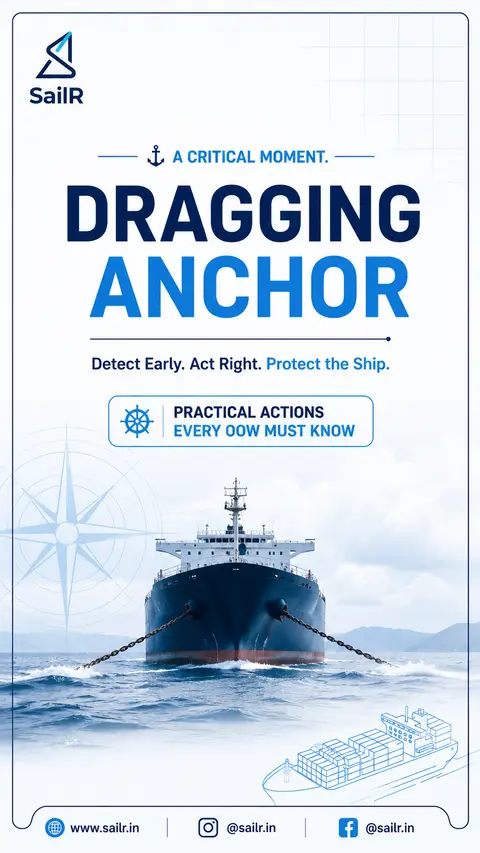
The slides, written out
AI-drawn illustration. Simplified to explain the idea, not to scale.
Slide 1 · A CRITICAL MOMENT
A CRITICAL MOMENT.
DRAGGING
ANCHOR
Detect Early. Act Right. Protect the Ship.
PRACTICAL ACTIONS
EVERY OOW MUST KNOW
Slide 2 · DRAGGING ANCHOR?
DRAGGING ANCHOR?
CONFIRM IT FAST.
Detect early. Verify. Don't assume.
1
CHECK WECDIS / ECDIS
• Check the anchor watch / drag alarm
• Check vessel's position against the Bridge Swinging Circle
• A fix outside the circle = dragging
OUTSIDE = DRAGGING
2
CROSS CHECK THE POSITION
• Take clearing bearings or shore transits
• Use available independent position fixing methods
• Check the anchor cable for abnormal movement, vibration or lifting
3
CHECK THE TRACK
• Look for unexpected movement or the characteristic figure of eight yawing pattern
4
CHECK NEARBY VESSELS
• Confirm whether your vessel or another anchored vessel is moving
KEY MESSAGE
Suspect dragging?
Do not delay action while repeatedly trying to prove it.
Slide 3 · DRAGGING SUSPECTED?
DRAGGING SUSPECTED?
CALL THE MASTER.
Inform. Prepare. Be ready to act.
Notify the Master without delay
1
MASTER / COMMANDING OFFICER
Inform the Master immediately.
2
ENGINE
Bring main propulsion to immediate notice.
3
ANCHOR PARTY
Close up and prepare for immediate action.
4
CABLE
Be prepared to veer more cable.
5
SECOND ANCHOR
Prepare the second anchor for letting go, if fitted.
6
ANCHOR WATCH
Maintain a proper, continuous anchor watch.
STAY OR GO?
The Master must assess:
Weather and forecast
Wind and tidal stream
Holding ground
Available sea room
Nearby traffic and hazards
Should we remain anchored or proceed to sea?
Do not wait until the situation becomes critical.
Slide 4 · CONTROL THE YAW
CONTROL THE YAW.
USE THE SECOND
ANCHOR RIGHT.
Timing and cable length make the difference.
01
VEER MORE CABLE
• Use the maximum usable cable appropriate to the vessel and conditions.
• More cable helps keep the pull on the anchor more nearly horizontal and allows the cable to absorb yawing and pitching stresses.
MORE CABLE KEEPS THE PULL ON THE ANCHOR MORE NEARLY HORIZONTAL AND ALLOWS THE CABLE TO ABSORB YAWING AND PITCHING STRESSES.
02
SECOND ANCHOR READY
• If a second anchor is available and required:
PREFERRED:
• Let go the second anchor at the extremity of the yaw.
• This is the preferred method and can help prevent the first anchor breaking out.
LET GO AT THE EXTREMITY OF THE YAW
03
SHORT LENGTH OUT
• After letting go the second anchor, veer a short length so the second anchor can hold at short stay.
SHORT STAY
04
STILL DRAGGING?
• Veer more cable.
• Use propulsion as appropriate.
• Or weigh anchor and proceed if required.
IMPORTANT
If the vessel has a vulnerable bow sonar dome, keep anchor cables clear of it.
Slide 5 · WHEN DRAGGING CONTINUES?
WHEN DRAGGING CONTINUES?
TAKE DECISIVE
ACTION.
Protect the ship. Follow the Master's decision.
01
TWO ANCHORS AT LONG STAY
DRIVE INTO THE WIND
Use gentle ahead power to drive the ship up to windward between the anchors.
Hold the vessel there when the cables are leading aft on either quarter.
The cables' constricting effect helps keep the ship stationary and head to wind.
Position must be fixed frequently.
Use gentle ahead power to drive the ship up to windward between the anchors.
02
SINGLE ANCHOR
HARDER TO CONTROL
The same technique may be attempted, but it is harder to control.
There is a greater risk of the vessel falling off the wind and dropping back sharply, increasing the load on the cable and potentially causing the anchor to break out.
03
IF DANGER IS DEVELOPING
LEE SHORE • SHOAL WATER • TRAFFIC • INSUFFICIENT SEA ROOM
Use propulsion.
Weigh anchor if practicable.
In extremis, slip the cable.
04
CONTROLLED DRAGGING
If there is sufficient sea room to leeward, and no traffic, and no danger of reaching water too deep for the anchor to hold, controlled dragging may be acceptable.
This is a positive decision by the Master, not something that happens by default.
IMPORTANT
If the vessel has a vulnerable bow sonar dome, keep anchor cables clear of it.
Drafted by SailR from our daily lessons. AI-drawn illustration. Simplified to explain the idea, not to scale. Last updated 19 Oct 2026.
Spotted a mistake?