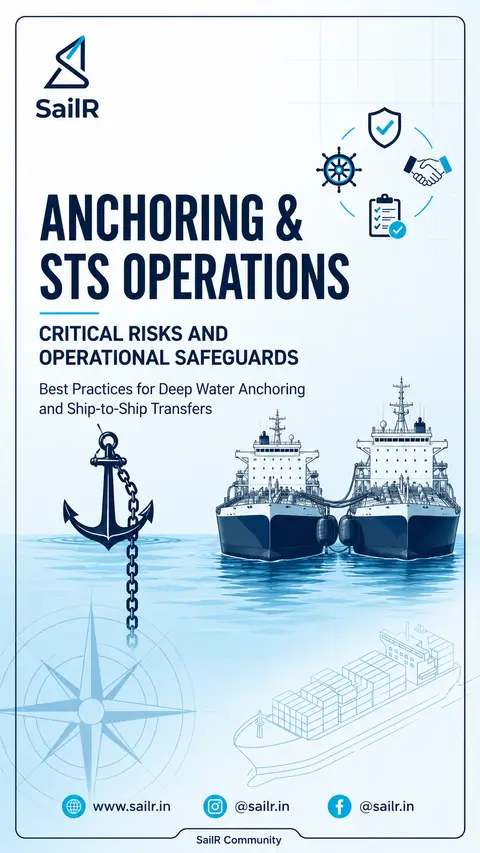
The slides, written out
AI-drawn illustration. Simplified to explain the idea, not to scale.
Slide 1 · ANCHORING &
ANCHORING &
STS OPERATIONS
CRITICAL RISKS AND
OPERATIONAL SAFEGUARDS
Best Practices for Deep Water Anchoring
and Ship-to-Ship Transfers
Slide 2 · DEEP WATER ANCHORING
DEEP WATER ANCHORING
Risks Involved & Key Safeguards
A. MAJOR RISKS
B. KEY SAFEGUARDS
1. SHOCK LOADING
Anchor or cable damage from uncontrolled deployment.
2. VESSEL DRIFT
Ship may drift before the anchor is properly set on the seabed.
3. REDUCED HOLDING
Insufficient scope can significantly reduce holding effectiveness and increase the risk of dragging.
4. DIFFICULT RECOVERY
Heavy chain loads and seabed suction can overload equipment during weighing.
5. WEATHER DETERIORATION
Limited reserve holding capability in deteriorating conditions.
1. GO / NO-GO ASSESSMENT
Determine required cable length based on water depth, holding ground, weather forecast and available chain.
2. CONTROLLED VEERING
Walk the anchor down under control in accordance with vessel procedures, avoiding uncontrolled free-fall.
3. MINIMAL HEADWAY
Ship should be stopped or making slight sternway during anchor deployment.
4. ADEQUATE SEA ROOM
Ensure sufficient sea room to complete the anchoring evolution safely.
5. MONITOR SWINGING CIRCLE
Set VRM on radar at estimated swinging circle and ensure safe distance from other vessels.
6. ANCHOR WATCH
Establish continuous anchor watch, monitor cable direction and tension. Keep engine ready for immediate use.
Slide 3 · SHIP-TO-SHIP
SHIP-TO-SHIP
TRANSFER OPERATIONS
Precautions for Safe Operations
1. PRE-TRANSFER CHECKS
VESSEL COMPATIBILITY
Check freeboard difference, manifold arrangement and suitability.
MOORING & FENDER PLAN
Agree mooring lines, fender position and emergency towing-off wires.
CARGO SYSTEM INSPECTION
Inspect hoses, gaskets, bolts, and ensure ESD system is functional.
COMMUNICATIONS TESTING
Establish dedicated VHF channel and conduct comms check between all stations.
EMERGENCY PREPAREDNESS
Firefighting arrangements, spill equipment and MOB plan in place.
ENVIRONMENTAL ASSESSMENT
Confirm wind, sea, swell, current within limits of STS plan.
2. DURING TRANSFER
MONITOR MOORINGS
Continuously monitor and adjust lines for tide, draft change and vessel movement.
CHECK HOSE CONDITION
Watch for chafing, excess tension, kinks or any abnormal deformation.
CONTROL TRANSFER RATES
Start at low rate for line pressurisation and leak check. Increase rate only after confirmation.
MONITOR DRAFT & TRIM
Adjust moorings as drafts change and freeboards reduce.
TRACK WEATHER CHANGES
Monitor wind and sea state. Be ready to suspend operations if limits are approached.
MAINTAIN COMMUNICATION
Keep continuous communication between bridge and cargo control rooms.
3. POST-TRANSFER & BREAKAWAY
DISCONNECT CARGO HOSES
Drain, blank and lift hoses clear. Crank away hard arms or hoses safely.
MOORING LINE RELEASE
Mooring release sequence shall follow the approved unmooring plan and POAC instructions.
SAFE SEPARATION
Departing vessel uses own engine to move clear. Maintain comms until clear.
DOCUMENTATION
Complete STS record form, update cargo manifest and log any observations.
REPORTING
Record in Deck Log Book and report any incident per company SMS procedures.
PLANNING
MOORING
TRANSFER
MONITORING
Slide 4 · OPERATIONAL
OPERATIONAL
SAFETY CHECKLIST
Plan Well. Operate Safely.
A. DEEP WATER ANCHORING
SCOPE ASSESSED
Required cable length assessed based on water depth,
holding ground, weather and available chain.
HOLDING GROUND CHECKED
Seabed type evaluated to ensure adequate
holding capability.
SEA ROOM VERIFIED
Sufficient sea room available to complete anchoring
evolution and swinging circle is safe.
ENGINE READINESS CONFIRMED
Main engine ready for immediate use in case of
emergency or dragging.
ANCHOR WATCH ESTABLISHED
Anchor watch initiated with parallel index lines,
radar/GPS monitoring and regular checks.
B. STS OPERATIONS
STS PLAN APPROVED
STS Operations Plan reviewed and approved
by all parties.
ESD TESTED
Emergency Shutdown system tested and
communication confirmed.
FENDER ARRANGEMENT VERIFIED
Fenders positioned as per approved plan
and secured properly.
COMMUNICATIONS ESTABLISHED
Dedicated VHF channels confirmed between
bridges and cargo control rooms.
EMERGENCY RESPONSE READY
Firefighting equipment, spill kit and MOB
arrangements ready for immediate use.
WEATHER LIMITS REVIEWED
Weather forecast checked and within limits
of the approved STS plan.
SAFE OPERATIONS BEGIN WITH PROPER PLANNING
Protecting People • Cargo • Vessel • Environment
Drafted by SailR from our daily lessons. AI-drawn illustration. Simplified to explain the idea, not to scale. Last updated 19 Oct 2026.
Spotted a mistake?