The slides, written out
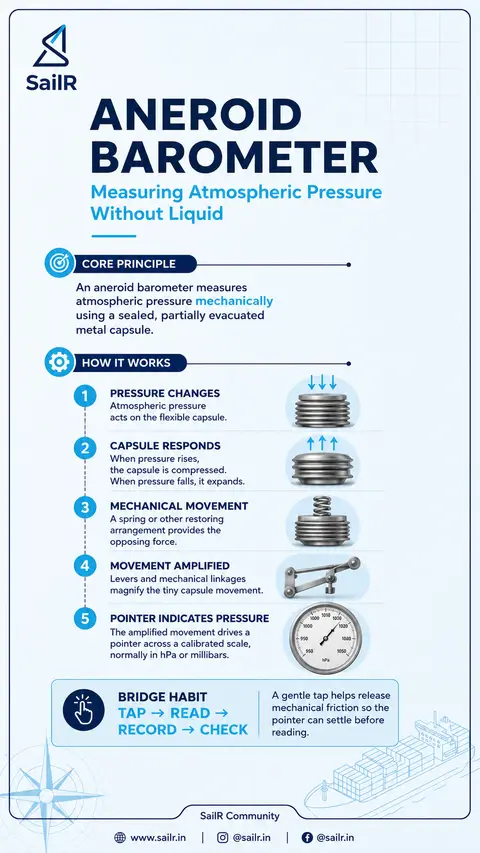
AI-drawn illustration. Simplified to explain the idea, not to scale.
Slide 1 · ANEROID BAROMETER
ANEROID BAROMETER
Measuring Atmospheric Pressure Without Liquid
CORE PRINCIPLE
An aneroid barometer measures atmospheric pressure mechanically using a sealed, partially evacuated metal capsule.
HOW IT WORKS
1
PRESSURE CHANGES
Atmospheric pressure acts on the flexible capsule.
2
CAPSULE RESPONDS
When pressure rises, the capsule is compressed. When pressure falls, it expands.
3
MECHANICAL MOVEMENT
A spring or other restoring arrangement provides the opposing force.
4
MOVEMENT AMPLIFIED
Levers and mechanical linkages magnify the tiny capsule movement.
5
POINTER INDICATES PRESSURE
The amplified movement drives a pointer across a calibrated scale, normally in hPa or millibars.
BRIDGE HABIT
TAP → READ → RECORD → CHECK
A gentle tap helps release mechanical friction so the pointer can settle before reading.
| |
Slide 2 · SLIDE 2 OF 4
CORRECTING
THE BAROMETER READING
Before Recording Pressure
1
INSTRUMENT / INDEX CORRECTION
Accounts for the individual instrument's error.
Use the correction certificate, correction card or comparison with a standard instrument.
2
HEIGHT / SEA LEVEL CORRECTION
A barometer located above sea level measures a lower pressure than the corresponding sea-level pressure.
Therefore, when reducing station pressure to sea level, the appropriate height correction is applied according to the applicable table or method.
TRADITIONAL APPROXIMATE RULE
Height in ft × 1.10 ÷ 30
≈ correction in hPa
WORKED EXAMPLE
Barometer height = 30 ft
Increase by 10%
30 × 1.10 = 33 ft
Correction
33 ÷ 30 = 1.10 hPa
Correction
= +1.1 hPa
(to be added)
IMPORTANT
Do NOT apply a height correction twice.
If the barometer is already adjusted to indicate sea-level pressure, follow the correction certificate or posted correction instructions.
Where applicable, the correction table may use height and temperature as its arguments. Follow the instrument's correction table or certificate.
NOTE
Use the height correction table from the instrument manual. The arguments are the height above sea level and the outside air temperature.
Slide 3 · SLIDE 3 OF 4
WHY ANEROID
BAROMETERS
Suit Shipboard Use
Aneroid barometers are more practical for shipboard use,
but they are not immune to movement.
01
SHIP MOVEMENT
Mercury barometers are difficult to operate correctly at sea.
Rolling, pitching and vibration disturb the mercury column
and make accurate readings more difficult.
02
ROBUST & LIQUID FREE
No mercury column or fragile mercury column.
No mercury spill risk.
Built with durable components for routine
shipboard use.
03
COMPACT INSTALLATION
Can be conveniently mounted on the bridge.
Install it where concussion, vibration and
ship movement are minimized.
04
EASY TO READ
Pointer and calibrated dial give a quick
and clear reading.
No need to read a moving mercury meniscus.
SHIPBOARD BEST PRACTICE
Mount Securely
Minimize Vibration
Keep Conditions Stable
Tap Gently
Read Accurately
Slide 4 · SLIDE 4 OF 4
ANEROID BAROMETER
6 Points You Should Remember
01
PRINCIPLE
A partially evacuated flexible capsule responds to atmospheric pressure.
02
MECHANISM
Capsule movement is amplified by mechanical linkages and levers.
03
READING
Tap gently before reading to reduce the effect of mechanical friction.
04
CORRECTION
Apply the instrument correction and the appropriate sea-level / height correction according to the instrument's correction certificate or table.
05
SHIPBOARD LOCATION
Mount securely where concussion, vibration and ship movement are minimized.
06
AVOID DOUBLE CORRECTION
If the instrument already indicates sea-level pressure, do not apply the height correction again.
REFERENCE INSTRUMENT
A mercury barometer may be used for comparison where available, but calibrated precision aneroid and digital barometers are also used for marine pressure observations.
EXAM LINE
"Aneroid barometers are preferred for practical shipboard use because they avoid the operational difficulties of a mercury column, while still requiring proper installation, calibration and correction."
REFERENCE BASIS
WMO Guide to Instruments and Methods of Observation (Marine Observations), NOAA / National Weather Service Marine Observation Guidance.
Drafted by SailR from our daily lessons. AI-drawn illustration. Simplified to explain the idea, not to scale. Last updated 19 Oct 2026.
Spotted a mistake?