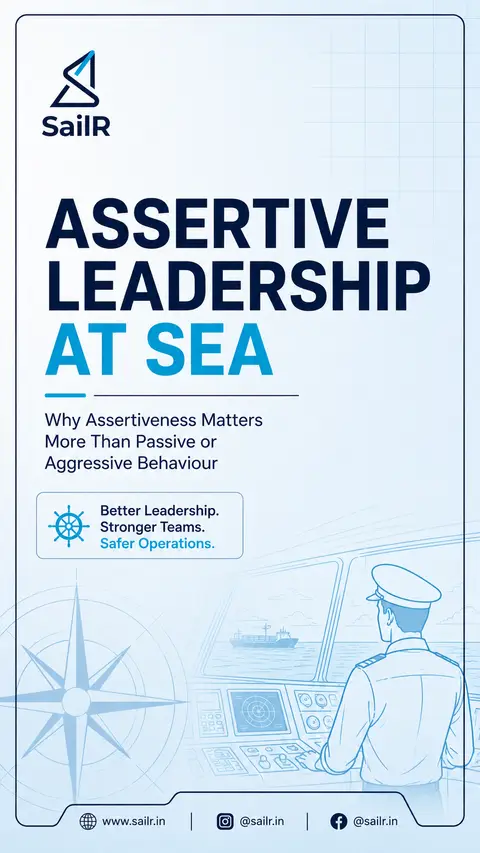
The slides, written out
AI-drawn illustration. Simplified to explain the idea, not to scale.
Slide 1 · ASSERTIVE
ASSERTIVE
LEADERSHIP
AT SEA
Why Assertiveness Matters
More Than Passive or
Aggressive Behaviour
Better Leadership.
Stronger Teams.
Safer Operations.
Slide 2 · 3 LEADERSHIP
3 LEADERSHIP
STYLES ONBOARD
Understanding the impact of how you lead
your team at sea.
PASSIVE
AGGRESSIVE
ASSERTIVE
CHARACTERISTICS
CHARACTERISTICS
CHARACTERISTICS
• Avoids confrontation
• Hesitates to correct
mistakes
• Weak communication
• Shouting or intimidation
• Poor listening
• Fear-based control
• Clear communication
• Respectful authority
• Calm decision-making
OPERATIONAL IMPACT
OPERATIONAL IMPACT
OPERATIONAL IMPACT
Passive leadership can
negatively affect safety
culture and operational
standards.
Aggressive behaviour may
reduce trust and discourage
open communication
onboard.
Assertive leadership
supports effective
teamwork, safety culture,
and operational clarity.
THE GOAL IS BALANCE:
Lead with authority, communicate with respect,
and keep safety at the core of every decision.
VERIFIED REFERENCE
IMO STCW Code – Leadership and Teamwork Skills
Table A-II/1 and A-II/2
Slide 3 · ESSENTIAL QUALITIES
ESSENTIAL QUALITIES
OF A SHIPBOARD LEADER
The qualities that build strong teams and safe operations.
1
CONFIDENCE &
AUTHORITY
Inspires trust through
competence, knowledge
and calm, decisive
leadership.
2
EMPATHY &
UNDERSTANDING
Understands crew
challenges and
backgrounds to build
strong, united teams.
3
CALM UNDER
PRESSURE
Remains composed in
crisis, assesses quickly
and makes the right
decisions.
4
CLEAR
COMMUNICATION
Provides direct, respectful
and unambiguous
instructions. Encourages
open communication.
5
DELEGATION &
TRUST
Assigns responsibilities
effectively and trusts
the team to deliver
with accountability.
6
LEADING BY
EXAMPLE
Demonstrates
professionalism,
discipline and safety
through actions.
GREAT LEADERS DON'T JUST GIVE ORDERS,
THEY EARN TRUST AND BUILD LEADERS.
VERIFIED REFERENCE
IMO STCW Code
Leadership and Teamwork Skills
Table A-II/1 and A-II/2
Slide 4 · VERIFIED MARITIME
VERIFIED MARITIME
LEADERSHIP PRINCIPLES
Backed by IMO standards and international best practices.
KEY REFERENCES
IMO STCW CODE
Leadership and Teamwork Skills Requirements
• Table A-II/1 and A-II/2
IMO MODEL COURSE 1.39
Leadership and Teamwork
• Develops leadership, decision-making,
and team management competencies.
IMO MODEL COURSE 1.22
Bridge Resource Management
• Promotes effective communication,
situational awareness and teamwork on bridge.
ISM CODE
Safety Culture & Communication
• Requires open communication, defined authority,
and a strong safety culture onboard.
KEY TAKEAWAY
The most effective maritime leaders
balance authority, communication,
professionalism, and empathy
to maintain safe ship operations.
Follow SailR for more verified,
exam-focused maritime content.
Drafted by SailR from our daily lessons. AI-drawn illustration. Simplified to explain the idea, not to scale. Last updated 19 Oct 2026.
Spotted a mistake?