The slides, written out
AI-drawn illustration. Simplified to explain the idea, not to scale.
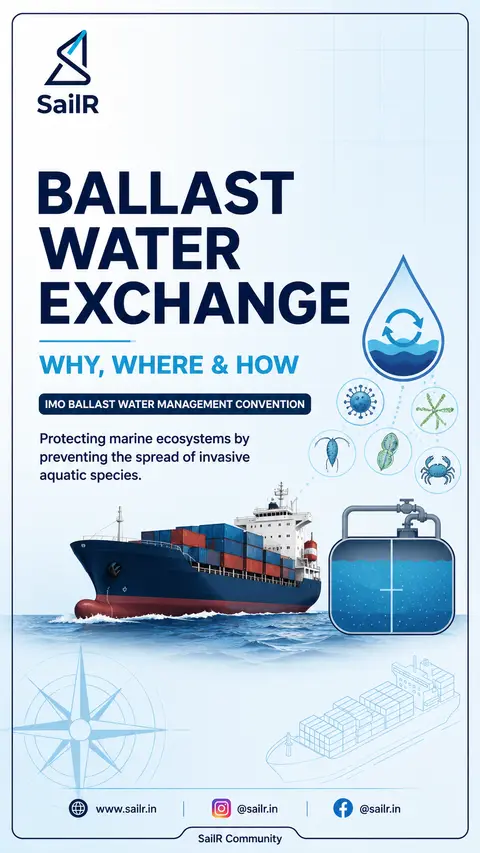
Slide 1 · BALLAST
BALLAST
WATER
EXCHANGE
WHY, WHERE & HOW
IMO BALLAST WATER MANAGEMENT CONVENTION
Protecting marine ecosystems by
preventing the spread of invasive
aquatic species.
Slide 2 · WHY & WHERE
WHY & WHERE
DO WE EXCHANGE
BALLAST WATER?
WHY?
When ballast water is taken onboard in one port, it may contain bacteria, algae, plankton, larvae and other aquatic organisms.
Discharging untreated ballast water into another ecosystem can introduce invasive species that threaten biodiversity, fisheries and local environments.
The IMO Ballast Water Management Convention establishes international measures to reduce this environmental risk.
WHERE?
PREFERRED EXCHANGE AREA
At least 200 nautical miles from the nearest land
Water depth 200 metres or greater
≥ 200 NM
ALTERNATIVE (WHEN PREFERRED AREA IS NOT POSSIBLE)
As far from land as possible and at least 50 nautical miles from the nearest land
Water depth 200 metres or greater
≥ 50 NM
Reference:
IMO BWM Convention – Regulation B-4
Slide 3 · THREE BALLAST WATER EXCHANGE METHODS
THREE BALLAST WATER EXCHANGE METHODS
1
SEQUENTIAL METHOD
DISCHARGE (Empty Tank)
REFILL (Fill with Ocean Water)
Empty ballast tank
Refill with ocean water
ADVANTAGES
Simple procedure
CONSIDERATIONS
Temporary reduction in stability
Hull girder stresses must remain within allowable limits
2
FLOW-THROUGH METHOD
Pump clean seawater into a full tank
Overflow original ballast water
Overflow (Top)
Seawater Inlet (Bottom)
≈ 3 TANK VOLUMES
= 95% Exchange Efficiency
REQUIREMENT
Pump approximately three tank volumes to achieve the required 95% volumetric exchange efficiency, unless equivalent efficiency is demonstrated by another approved method.
3
DILUTION METHOD
Clean seawater enters from the top
Original ballast water leaves from the bottom
ADVANTAGES
Continuous exchange
Reduced stratification
Maintains ballast level
Seawater Inlet (Top)
Discharge (Bottom)
Slide 4 · SAFE OPERATIONS & KEY TAKEAWAYS
SAFE OPERATIONS & KEY TAKEAWAYS
BEFORE STARTING
Follow the approved Ballast Water Management Plan.
Assess the following:
Stability
Trim
Hull Girder Stresses
Weather
Traffic Conditions
Ship Limitations
Record every ballast operation in the Ballast Water Record Book.
BALLAST WATER RECORD BOOK
KEY TAKEAWAYS
PREVENT INVASIVE SPECIES
Protect marine ecosystems by preventing the spread of harmful aquatic organisms.
FOLLOW REGULATION B-4
Exchange ballast water at approved locations: 200 NM / 200 m depth or 50 NM (alternative).
USE AN APPROVED EXCHANGE METHOD
Sequential, Flow-Through or Dilution – achieve 95% exchange efficiency.
PRIORITIZE SAFETY
Ensure safe operations at all times. The Master's judgement is critical.
Safe operations today, sustainable oceans tomorrow.
Drafted by SailR from our daily lessons. AI-drawn illustration. Simplified to explain the idea, not to scale. Last updated 19 Oct 2026.
Spotted a mistake?