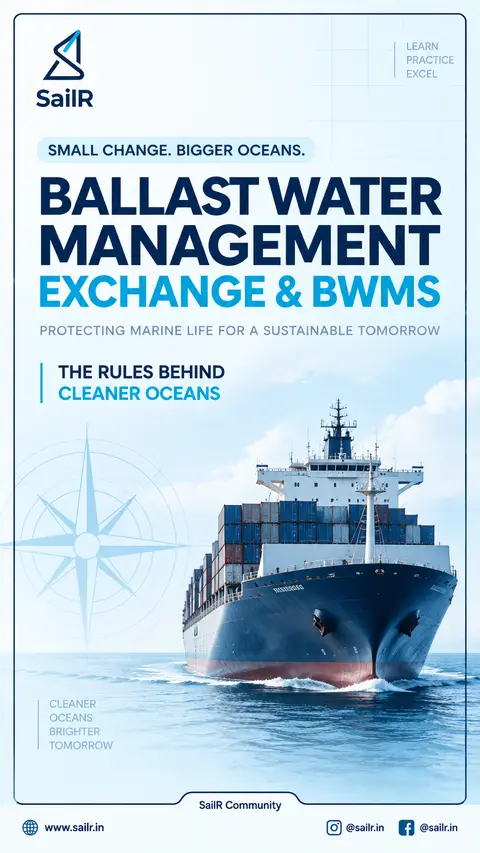
The slides, written out
AI-drawn illustration. Simplified to explain the idea, not to scale.
Slide 1 · LEARN
LEARN
PRACTICE
EXCEL
SMALL CHANGE. BIGGER OCEANS.
BALLAST WATER
MANAGEMENT
EXCHANGE & BWMS
PROTECTING MARINE LIFE FOR A SUSTAINABLE TOMORROW
THE RULES BEHIND
CLEANER OCEANS
CLEANER
OCEANS
BRIGHTER
TOMORROW
Slide 2 · LEARN
LEARN
PRACTICE
EXCEL
BALLAST WATER EXCHANGE
KEY HAZARDS AT SEA
OPERATIONAL SAFETY | STABILITY | STRUCTURAL INTEGRITY
01 HULL STRENGTH
Sequential exchange changes:
• Shear forces
• Bending moments
• Trim
• Draft
Bending Moment
Shear Force
Monitor loading condition throughout the operation.
02 STABILITY & FREE SURFACE
Partially filled tanks can create free surface effects, reducing effective GM.
Stability must be monitored throughout exchange.
03 SEA & WEATHER CONDITIONS
Rolling and partially filled tanks can increase operational risk.
Exchange should only be carried out when conditions permit safe operation.
04 LIST & TRIM
Uneven ballast operations can produce undesirable list or trim changes.
List
Trim
Follow the approved sequence and ballast plan.
MASTER'S DECISION + STABILITY ASSESSMENT
= SAFE EXCHANGE
SAFER SEAS BRIGHTER TOMORROW
Slide 3 · LEARN
LEARN
PRACTICE
EXCEL
BALLAST WATER EXCHANGE
D-1 BALLAST WATER
EXCHANGE STANDARD
WHERE IT APPLIES | HOW TO DO IT | KEY CONSIDERATIONS
01
WHERE D-1 EXCHANGE APPLIES
Ballast water exchange must be conducted in the following areas (Regulation B-4):
Where possible:
If this cannot be achieved:
≥ 200 NM
from nearest land
As far from land as possible, but at least:
≥ 50 NM
from nearest land
≥ 200 m
water depth
≥ 200 m
water depth
02
D-1 EXCHANGE METHOD AND STANDARD
95%
VOLUMETRIC
EXCHANGE
For the pumping-through
method, pumping through
3 × tank volume
is considered to meet the
D-1 standard.
Pumping through less than
three times the tank volume
may be accepted where the ship
can demonstrate that at least
95% volumetric exchange
has been achieved.
03
IMPORTANT CONSIDERATIONS
Ship safety
and stability
Weather and
sea conditions
Equipment
limitations
Follow the approved
sequence and
ballast plan
PLAN THE EXCHANGE. PROTECT THE SHIP.
PROTECT OUR OCEANS.
Source:
IMO BWM Convention | Regulations B-4 & D-1
IMO G6 Guidelines (as amended)
CLEANER
OCEANS
BRIGHTER
TOMORROW
Slide 4 · LEARN
LEARN
PRACTICE
EXCEL
BALLAST WATER MANAGEMENT SYSTEM
WHAT DOES THE
BWMS ACHIEVE?
CLEANER OCEANS | HEALTHIER ECOSYSTEMS | SAFER TOMORROW
01 PURPOSE
To prevent, minimize and ultimately eliminate
the transfer of harmful aquatic organisms and pathogens
through ballast water and sediments.
02 D-2 PERFORMANCE STANDARD
Organism / Indicator | Discharge Standard
≥ 50 µm | < 10 viable organisms / m³
≥ 10 µm and < 50 µm | < 10 viable organisms / ml
Toxigenic Vibrio cholerae (O1 and O139) | < 1 cfu / 100 ml
Escherichia coli | < 250 cfu / 100 ml
Intestinal Enterococci | < 100 cfu / 100 ml
03 TREATMENT TECHNOLOGIES
MECHANICAL
Filtration / separation
PHYSICAL
UV and other physical treatment methods
CHEMICAL
Disinfection / electrolysis-based treatment
D-2 is a PERFORMANCE STANDARD.
Source:
IMO BWM Convention | Regulation D-2 | IMO BWMS Code
CLEANER OCEANS BRIGHTER TOMORROW
Slide 5 · LEARN
LEARN
PRACTICE
EXCEL
BWM COMPLIANCE
WHAT MUST THE
SHIP MANAGE?
PLAN | RECORD | TREAT | COMPLY
01
BALLAST WATER
MANAGEMENT PLAN (BWMP)
BALLAST WATER
MANAGEMENT
PLAN
Ship specific plan
approved by the
Administration
(Regulation B-1).
Describes procedures
to implement the
requirements.
02
BALLAST WATER
RECORD BOOK (BWRB)
BALLAST WATER
RECORD BOOK
Records ballast
uptake, treatment,
discharge and other
relevant operations
(Regulation B-2).
Must be properly
maintained and
available for inspection.
03
INTERNATIONAL
BWM CERTIFICATE
INTERNATIONAL
BALLAST WATER
MANAGEMENT
CERTIFICATE
Issued to ships
subject to the
Convention's survey
and certification
requirements
(400 GT and above
to which it applies).
04
BALLAST WATER
MANAGEMENT SYSTEM (BWMS)
Must be type-approved
in accordance with the
IMO BWMS Code
(Regulation D-3).
Operate and maintain
as per approved
documentation and
manufacturer's
instructions.
IMPORTANT
D-2 phase-in completed on 8 September 2024
Ships subject to the Convention must comply with the applicable
D-2 performance standard.
BWM COMPLIANCE PROTECTS
OUR OCEANS AND FUTURE GENERATIONS
Source:
IMO BWM Convention | Regulations B-1, B-2 & D-2
IMO BWMS Code
CLEANER
OCEANS
BRIGHTER
TOMORROW
Drafted by SailR from our daily lessons. AI-drawn illustration. Simplified to explain the idea, not to scale. Last updated 19 Oct 2026.
Spotted a mistake?