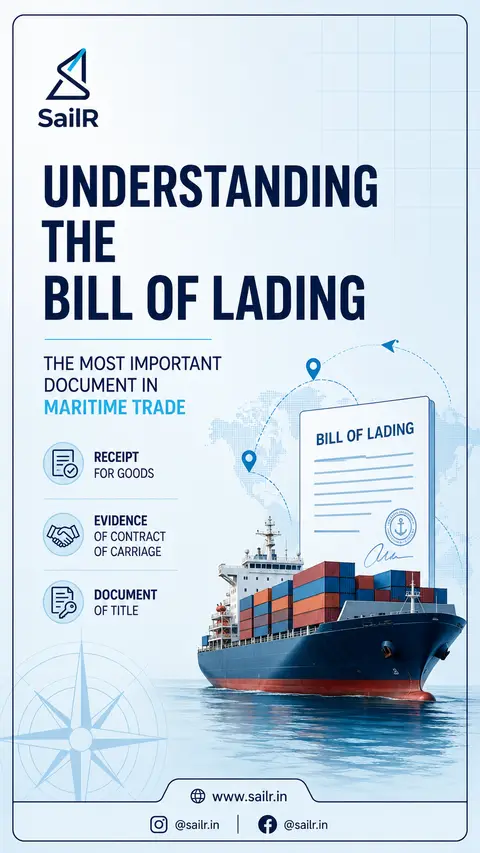
The slides, written out
AI-drawn illustration. Simplified to explain the idea, not to scale.
Slide 1 · UNDERSTANDING
UNDERSTANDING
THE
BILL OF LADING
THE MOST IMPORTANT
DOCUMENT IN
MARITIME TRADE
RECEIPT
FOR GOODS
EVIDENCE
OF CONTRACT
OF CARRIAGE
DOCUMENT
OF TITLE
Slide 2 · FUNCTIONS OF A
FUNCTIONS OF A
BILL OF LADING
THREE KEY AND INTERLINKED FUNCTIONS
1
RECEIPT
FOR GOODS
Confirms the carrier has
received the goods.
States the quantity
(packages, weight
or volume).
States the apparent
order and condition
of the cargo.
"Shipped on Board"
B/L acts as proof that
the goods are on board.
2
EVIDENCE OF
CONTRACT OF
CARRIAGE
Reflects the terms and
conditions of carriage.
Defines the carrier's
obligations and liabilities.
Incorporates applicable
law (e.g., Hague-Visby
Rules) and exceptions
(e.g., perils of the sea).
Serves as the best
evidence of the pre-
existing carriage
agreement.
3
DOCUMENT
OF TITLE
A negotiable B/L functions
as a document of title,
representing rights to
the goods.
Allows transfer of
ownership rights through
endorsement.
Enables cargo to be bought,
sold or used as collateral
while in transit.
Required for lawful delivery
of the cargo at the
destination port.
A BILL OF LADING CONNECTS CARGO,
CARRIER AND CARGO OWNER THROUGH
ONE LEGALLY SIGNIFICANT DOCUMENT.
Slide 3 · DELIVERY PRECAUTIONS
DELIVERY PRECAUTIONS
WHEN ORIGINAL BILL OF LADING IS
CARRIED ON BOARD FOR DELIVERY
Follow these critical steps to ensure safe and proper delivery
of cargo and protect the interests of Owners.
1
VERIFY
AUTHORITY
Confirm the identity of the person claiming delivery
as per company procedures.
Confirm their authority to receive the cargo
on behalf of the consignee.
Verify supporting documents / letter of
authorization if applicable.
Follow local regulations and owner instructions.
2
VERIFY
DOCUMENTATION
Ensure surrender of the original B/L(s) required
under carrier's procedures and applicable law.
Check the endorsement chain is complete,
clear and consistent.
Compare B/L details with cargo manifest,
stowage plan and Mate's Receipts.
Ensure the B/L corresponds to the cargo actually
carried and is in the same condition.
3
DELIVERY
CONTROLS
Follow owner's instructions and company procedures
for cargo release.
If the B/L(s) are not in your possession, ensure delivery
orders come from a trusted and authorized source.
Any discrepancy or irregularity must be brought to the
attention of Owners / P&I immediately.
Never release cargo without proper documentation
and explicit authorization.
WRONG DELIVERY CAN EXPOSE OWNERS AND
THE MASTER TO SIGNIFICANT LEGAL LIABILITY.
Slide 4 · "SIGNED AS PRESENTED"
"SIGNED AS PRESENTED":
WHAT THE MASTER
MUST KNOW
A common charter-party clause. It gives the charterer the
right to present the Bill of Lading, but the Master retains the
responsibility to ensure its accuracy.
CHARTERER'S EXPECTATION
Presents the B/L for signature
as prepared.
Expects immediate execution
without changes.
Relies on the clause in the
charter-party.
VS
MASTER'S RESPONSIBILITY
Verify quantity, description and
condition of cargo.
Ensure the particulars are accurate
and consistent with facts.
Protect the interests of Owners
and act in good faith.
Comply with applicable law, company
policies and P&I guidance.
NEVER knowingly sign an inaccurate Bill of Lading.
An LOI does not automatically make an inaccurate B/L legally acceptable.
WHEN A DISCREPANCY IS FOUND
1
B/L
PRESENTED
2
VERIFY
THE FACTS
3
DISCREPANCY
FOUND?
4
NOTIFY
OWNERS
5
SEEK P&I
ADVICE / LOI
IF APPLICABLE
6
PROCEED ONLY
UNDER APPROVED
INSTRUCTIONS
The Master may sign Bills of Lading as presented,
but remains responsible for ensuring that the document
accurately reflects the cargo and circumstances
known to the vessel.
Drafted by SailR from our daily lessons. AI-drawn illustration. Simplified to explain the idea, not to scale. Last updated 19 Oct 2026.
Spotted a mistake?