Boiler safety valves on ships: how many are required, how they are set, accumulation test and surveys
- MEO Class 2
- MEO Class 4
- MEO Class 1
- UK Management
- times asked
- 69
- times asked
- questions
- 11
- questions
- last asked
- 2026
- last asked
Safety valves protect a marine boiler against overpressure. Here is what SOLAS, Indian guidance and class rules require for fitting, setting, testing and surveying them.
The slides, written out
AI-drawn illustration. Simplified to explain the idea, not to scale.
Slide 1 · Two valves
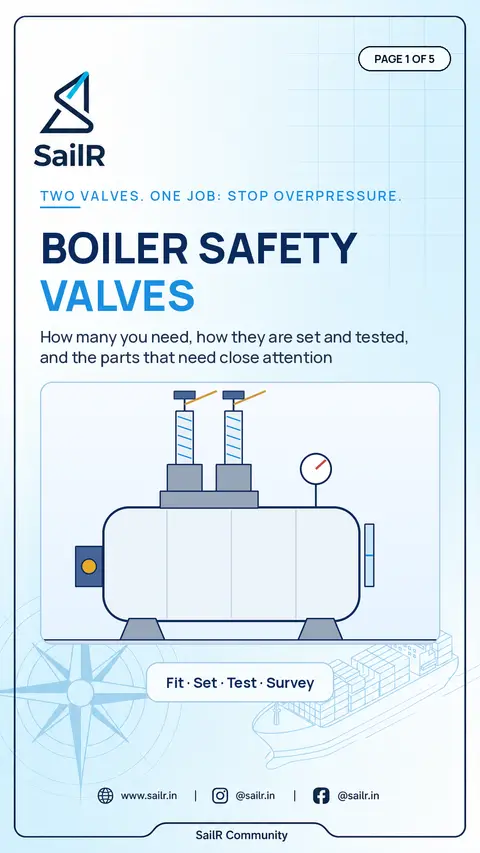
Two valves. One job: stop overpressure. Boiler safety valves: how many you need, how they are set and tested, and the parts that need close attention. The four steps are fit, set, test and survey.
Slide 2 · Two valves, not one
Two valves, not one. A cylindrical boiler has at least two valves, and a water tube boiler has at least one on the steam drum and one on the superheater. Under SOLAS, every steam boiler and unfired steam generator has at least two safety valves of adequate capacity. Only one valve is allowed if the Administration is satisfied, and India applies MSC.1/Circ.1286, which calls for a technical risk assessment. Water tube boilers have at least one valve on each saturated steam drum and each superheater. Easing gear lifts the valves by mechanical means from a safe position. Ref: SOLAS II-1/32.1. MS Notice 15 of 2023, Annexure I. LR Rules Pt 5 Ch 10, paras 15.2.4, 16.2.1, 16.2.2.
Slide 3 · Parts that need close attention
Parts that need close attention. The section of a spring-loaded safety valve shows the seal and lock cap, compression screw, spring, spindle, outlet to the waste steam pipe, valve lid, seat, easing gear and a drain on its own line with no valve or cock. After setting, the spring and compression screw are encased and locked or sealed so nobody can tamper with them or overload them. If the spring breaks, the valve must not be able to lift out of its seat. Working parts need clearance to move freely. Seats are secured, and capacity adjusters are fixed so dismantling at survey leaves them unchanged. Ref: LR Rules Pt 5 Ch 10, paras 15.2.2, 15.2.3, 15.2.5, 15.2.6, 15.2.8.
Slide 4 · Setting and the accumulation test
Setting and the accumulation test. Pressure is shown as a percentage of approved design pressure: valves are set at or below 100% of design pressure, they lift no later than 103%, and 110% is the accumulation test limit. Valves are set under steam to no more than the approved design pressure, and lifting at 103% at most is the working tolerance. The test runs with stop valves closed and full firing: 15 minutes for cylindrical boilers and up to 7 minutes for water tube boilers. Pressure may rise no more than 10% of design pressure, and only enough feed water is supplied to keep a safe level. Superheater valves are set allowing for the superheater pressure drop, so the boiler stays within its approved pressure. Ref: LR Rules Pt 5 Ch 10, paras 15.4.1, 16.3.1, 16.3.2, 16.5.1.
Slide 5 · Surveys and records
Surveys and records. The timeline shows one 5-year special survey period from start to end, with example spacing. Within that period there is an external survey every year with an easing gear test, and at least two internal surveys no more than 36 months apart. Every year the external survey includes a safety valve test with its easing gear. At each internal survey the valve adjustment is verified. For exhaust gas economisers, if steam can't be raised in port, the valves are set at sea and logged for the surveyor. Common mistake: a valve or cock on a safety valve drain. Each safety valve needs its own unrestricted drain. Ref: IACS UR Z18, paras 2.1, 2.2. LR Rules Pt 5 Ch 10, para 15.2.8.
What it is
A boiler safety valve is the device that stops a steam boiler from building pressure beyond what it was approved for. SOLAS requires every steam boiler and every unfired steam generator to carry not less than two safety valves of adequate capacity. The Administration may accept a single valve only when it is satisfied that the protection against overpressure is still adequate. (SOLAS II-1/32.1)
For Indian ships, the Directorate has set out how that satisfaction is reached. MS Notice 15 of 2023 directs that the interpretation in MSC.1/Circ.1286 be followed, so a single valve is accepted only after a satisfactory technical risk assessment. (MS Notice 15 of 2023, Annexure I)
Water tube boilers follow the same minimum of two valves, with an added rule on where they sit. Each saturated steam drum and each superheater carries at least one safety valve, and the valves are proportioned so the superheater is protected from overheating in all service conditions. (LR Rules Pt 5 Ch 10, paras 16.2.1, 16.2.2, 16.2.4)
Why it matters
The valve only protects the boiler if nobody can quietly change its setting. Class rules require the valves, spindles, springs and compression screws to be encased and locked or sealed after setting, so they cannot be tampered with or overloaded in service. (LR Rules Pt 5 Ch 10, para 15.2.2)
The design also has to fail safe. If a spring fractures, the valve must not be able to lift out of its seat. (LR Rules Pt 5 Ch 10, para 15.2.3)
How it works on board
When you open up a safety valve, the parts that matter most are the ones the rules name. Working parts need adequate clearances so the valve moves freely. Seats must be effectively secured. Any device that controls discharge capacity must be positively secured, so that dismantling the valve at a survey does not change its adjustment. (LR Rules Pt 5 Ch 10, paras 15.2.5, 15.2.6)
Easing gear lifts the valves without anyone reaching the valve itself. It must work by mechanical means and be operable from a safe position at the boiler or engine room platforms. (LR Rules Pt 5 Ch 10, para 15.2.4)
The discharge side needs as much care as the valve. Each safety valve has its own unrestricted drain, taken from the lowest part of the discharge side with a continuous fall to a place where hot steam or condensate cannot hurt anyone. The drain bore is at least 19 mm. Waste steam pipes are led to the atmosphere and supported with expansion arrangements so the valve chest carries no undue load, and each exhaust gas economiser has its own separate waste steam pipes. (LR Rules Pt 5 Ch 10, paras 15.2.8, 15.3.3, 15.3.6)
Setting is done under steam. Each valve is set to a pressure no higher than the approved design pressure of the boiler, and the setting is accepted if the valve lifts at not more than 103 per cent of that pressure. That 3 per cent is a working tolerance on the lift, and the setting itself stays at or below design pressure. (LR Rules Pt 5 Ch 10, paras 15.4.1, 16.3.1)
The accumulation test then proves that the valves can carry away all the steam the boiler can make. On a cylindrical boiler the stop valves are closed under full firing for 15 minutes, and the pressure must not rise more than 10 per cent of the design pressure. Only enough feed water is given to hold a safe working level. On a water tube boiler the test runs for a period not exceeding seven minutes, with the same 10 per cent limit. (LR Rules Pt 5 Ch 10, paras 15.4.1, 16.5.1)
Where the test could endanger the superheaters of a fired boiler, the class society may agree to omit it. In that case the valve maker certifies each valve's rated capacity and the boiler maker certifies the boiler's maximum evaporation. (LR Rules Pt 5 Ch 10, para 16.5.2)
Superheater valves need one more allowance. Their setting must account for the pressure drop through the superheater, so that when they discharge the boiler itself stays within its approved pressure. (LR Rules Pt 5 Ch 10, para 16.3.2)
The rules
The surveys follow the IACS unified requirement on machinery surveys:
Boilers are examined internally at least twice in each 5-year special survey period, and no more than 36 months may pass between two examinations. (IACS UR Z18, para 2.1)
The adjustment of the safety valves is verified at every internal survey, and the valves and relieving gear are examined and tested. (IACS UR Z18, para 2.1)
Every year, within the Annual Survey window, the boiler gets an external survey that includes testing the safety valve with its relieving gear. (IACS UR Z18, para 2.2)
For exhaust gas economisers, the Chief Engineer tests the safety valves at sea within the annual window and records the test in the log book for the surveyor. If steam cannot be raised in port at an internal survey, the Chief Engineer may set the valves at sea and log the results. (IACS UR Z18, paras 2.1, 2.2)
An internal survey can be extended by up to 3 months only in exceptional circumstances, and only after the easing gear has been examined and operationally tested along with the other listed checks. (IACS UR Z18, paras 2.1, 2.3)
Common mistakes
Fitting a valve or cock in a safety valve drain line defeats the drain. The rules allow none in these drains, and each valve needs its own unrestricted drain. (LR Rules Pt 5 Ch 10, para 15.2.8)
Quoting the setting as 3 per cent above working pressure is another error. The valve is set no higher than the approved design pressure, and 103 per cent is only the limit for the lift. (LR Rules Pt 5 Ch 10, para 15.4.1)
Reading the accumulation limit as 10 per cent of working pressure is also wrong. The rule measures it against the design pressure. (LR Rules Pt 5 Ch 10, paras 15.4.1, 16.5.1)
Treating the easing gear as a survey-day item is a mistake. The relieving gear is tested every year, and an extension of the internal survey depends on it being examined and operationally tested. (IACS UR Z18, paras 2.2, 2.3)
In exams
Asked 69 times across 11 different questions, most recently in 2026. Asked most in MEO Class 2 (43), MEO Class 4 (24), MEO Class 1 (1), UK Management (1).
Sources
- SOLAS regulation II-1/32.1, Steam boilers and boiler feed systems, safety valves, as quoted in DGS MS Notice 15 of 2023
- SOLAS regulation II-1/32, full text imorules.com copy
- DGS MS Notice 15 of 2023 9 November 2023 , Guidance on "To the Satisfaction of Administration" in IMO Conventions, Annexure I, item 27 MSC.1/Circ.1286 applied to SOLAS II-1/32.1
- Lloyd's Register Rules and Regulations for the Classification of Ships July 2022 , Pt 5 Ch 10, Section 15, paras 15.2.2 to 15.2.8, 15.3.3, 15.3.6, 15.4.1 imorules.com copy
- Lloyd's Register Rules and Regulations for the Classification of Ships July 2022 , Pt 5 Ch 10, Section 16, paras 16.2.1, 16.2.2, 16.2.4, 16.3.1, 16.3.2, 16.5.1, 16.5.2 imorules.com copy
- IACS UR Z18 Rev.9, April 2020 , Survey of Machinery, section 2, Survey of Steam Boilers, paras 2.1, 2.2, 2.3
Drafted by SailR from the regulations cited. AI-drawn illustration. Simplified to explain the idea, not to scale. Last updated 1 Nov 2026.
Spotted a mistake?