The slides, written out
AI-drawn illustration. Simplified to explain the idea, not to scale.
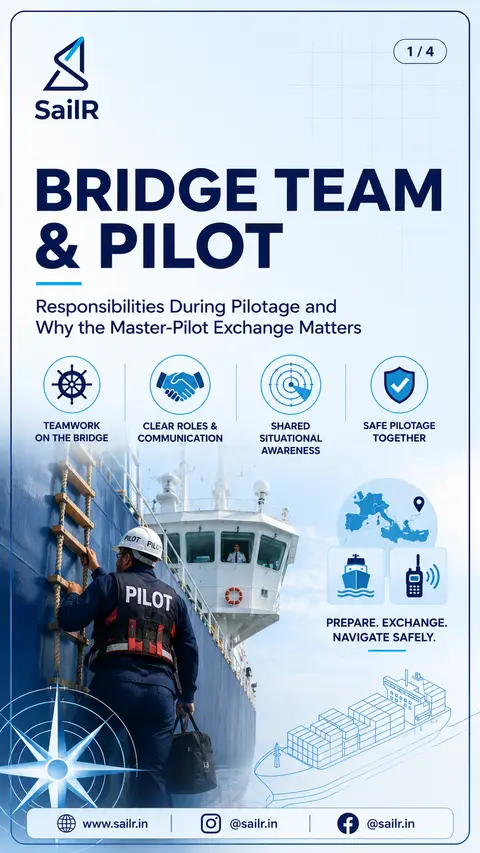
Slide 1 · 1 / 4
BRIDGE TEAM & PILOT
Responsibilities During Pilotage and Why the Master-Pilot Exchange Matters
TEAMWORK ON THE BRIDGE
CLEAR ROLES & COMMUNICATION
SHARED SITUATIONAL AWARENESS
SAFE PILOTAGE TOGETHER
PREPARE. EXCHANGE. NAVIGATE SAFELY.
Slide 2 · 2 / 4
WHEN THE PILOT
IS ON BOARD
The pilot's presence does not relieve the
Master or OOW of their duties.
KEY RESPONSIBILITIES OF THE BRIDGE TEAM
1
MONITOR THE PILOT
Maintain an independent
check of the vessel's
position, heading and
movement.
2
SUPPORT THE PILOT
Ensure navigation equipment
is available, operational and
familiar to the pilot.
3
MAINTAIN A FULL WATCH
The OOW continues lookout,
traffic monitoring,
updating the passage plan
and logging events.
4
COMMUNICATE CLEARLY
Orders should be clearly
communicated, acknowledged
and monitored to ensure
correct execution.
5
INTERVENE IF NECESSARY
The Master retains overriding
authority and must intervene
if safety is endangered.
The bridge team's job is to be a fully engaged,
critical-thinking safety net around the pilot,
not a passive audience.
Slide 3 · 3 / 4
THE NEED FOR THE
MASTER-PILOT EXCHANGE
One Team. One Shared Mental Model.
The Master-Pilot Exchange ensures both parties understand the
ship, the voyage and the plan before pilotage begins.
SHIP INFORMATION
Draft
LOA / Beam
Manoeuvring
characteristics
Equipment
status
Any defects or
limitations
The Master provides accurate
information about the vessel.
PILOT INFORMATION
Local conditions
(Tide, Current, Weather)
Traffic situation
Pilotage route
and intentions
Tug arrangements
and resources
Berthing
arrangements
The pilot shares local knowledge,
conditions and operational plans.
AGREED PASSAGE PLAN
Critical waypoints
and turning points
Speed profile
and manoeuvres
Tug usage and
responsibilities
Contingency plans
(Anchorages, Emergency)
Risk assessment
and mitigation
Both parties confirm the plan, key
points and contingencies.
COMMUNICATION PROTOCOLS
Working language
How orders will be given
and acknowledged
Bridge communication
procedures
Alarm signals and
emergency calls
Who will communicate
with tugs / shore
Clear communication prevents
misunderstandings.
INFORMATION
PILOT
EXCHANGE
The Master-Pilot Exchange
is a continuous process
throughout the pilotage,
not a one-time event.
If both parties operate on assumptions,
accidents happen. Exchange information. Build trust.
Navigate safely.
Slide 4 · 4 / 4
KEY TAKEAWAYS
Safe Pilotage Depends on Teamwork
PILOT ≠ REPLACEMENT
The pilot provides local expertise, but the bridge team remains fully engaged and responsible.
MASTER
OOW
PILOT
MONITOR CONTINUOUSLY
Maintain an independent check of the vessel, the environment and the pilot's actions.
COMMUNICATE CLEARLY
Orders should be clearly communicated, acknowledged and monitored. Share concerns without hesitation.
ORDER
ACKNOWLEDGED
EXECUTED
EXCHANGE INFORMATION
Conduct a thorough Master-Pilot Exchange every time. No shortcuts. Build a shared understanding.
MASTER RETAINS AUTHORITY
The Master has overriding authority and must intervene if the safety of the vessel is at risk.
Safe pilotage is achieved through effective cooperation between the Master, bridge team and pilot.
REFERENCES
IMO Resolution A.960(23) Recommendations on Training and Operational Procedures for Maritime Pilots Other Than Deep-Sea Pilots
ICS Bridge Procedures Guide Guidance on Pilotage, Bridge Team Responsibilities and Master-Pilot Exchange
IMPA MPX Guidance Guidance on the Master-Pilot Exchange
PREPARE. EXCHANGE. NAVIGATE SAFELY.
Drafted by SailR from our daily lessons. AI-drawn illustration. Simplified to explain the idea, not to scale. Last updated 19 Oct 2026.
Spotted a mistake?