The slides, written out
AI-drawn illustration. Simplified to explain the idea, not to scale.
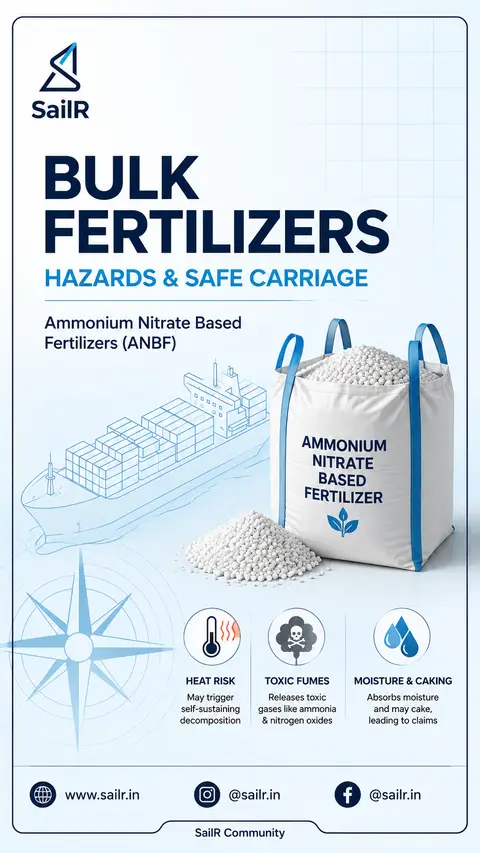
Slide 1 · BULK FERTILIZERS
BULK FERTILIZERS
HAZARDS & SAFE CARRIAGE
Ammonium Nitrate Based Fertilizers (ANBF)
AMMONIUM NITRATE BASED FERTILIZER
HEAT RISK
May trigger self-sustaining decomposition
TOXIC FUMES
Releases toxic gases like ammonia & nitrogen oxides
MOISTURE & CAKING
Absorbs moisture and may cake, leading to claims
Slide 2 · MAJOR HAZARDS
MAJOR HAZARDS
WITH BULK FERTILIZERS
1
SELF-SUSTAINING
DECOMPOSITION (SSD)
• Exposure to significant
heat can initiate a
self-sustaining
decomposition
reaction.
• Produces its own heat.
• Releases toxic gases
(ammonia, nitrogen
oxides).
• Heat can spread to
adjacent holds.
2
TOXIC FUMES &
EXPLOSION RISK
• Decomposition releases
highly toxic fumes.
• Contamination with
organic material (fuel oil,
etc.) or confinement
with heat increases
explosion risk.
• History of ammonium
nitrate disasters is a
serious reminder.
3
CAKING & MOISTURE
SENSITIVITY
• Fertilizers are hygroscopic
and absorb moisture.
• Leads to caking and
hard lumps.
• Causes discharge delays,
operational issues and
heavy commercial
claims.
• Temperature gradients
(hot to cold) enhance
caking.
4
CARGO SHIFTING
& STABILITY RISK
• Some fertilizers and bulk
cargoes can liquefy if
moisture exceeds
limits.
• Always check the
Transportable
Moisture Limit (TML)
in the IMSBC Code
schedule.
UNDERSTANDING THESE HAZARDS IS THE FIRST
STEP TOWARDS SAFE CARRIAGE AND PREVENTING
ACCIDENTS & CLAIMS.
Slide 3 · SAFE CARRIAGE CHECKLIST
SAFE CARRIAGE CHECKLIST
BEST PRACTICES AT EVERY STAGE
1 BEFORE LOADING
Verify Shipper's Declaration
Ensure declaration includes ammonium nitrate content, chloride content and total combustible organic material.
Confirm IMSBC Code Schedule
Check correct schedule and UN Number of the cargo.
Inspect Cargo Holds
Holds must be clean, dry and free from oil, residues and combustible material.
2 DURING LOADING
Control Moisture
Suspend loading during rain or whenever moisture may adversely affect cargo quality, in accordance with the IMSBC Code, shipper instructions and terminal procedures.
Inspect Cargo Condition
Ensure cargo is free-flowing and free from caked lumps. Report and document any issues immediately.
Eliminate Heat Sources
Ensure cargo hold lights are switched off when not required and eliminate unnecessary heat sources in accordance with the vessel's SMS.
3 DURING THE VOYAGE
No Routine Ventilation
Cargo spaces shall not be ventilated during the voyage as per IMSBC Code requirements.
Monitor Cargo Temperature
Monitor and record cargo temperature daily using the vessel's approved monitoring arrangements.
Watch for Warning Signs
Look for rapid temperature rise, ammonia smell, condensation under hatch covers or visible fumes.
Good preparation and continuous monitoring are the keys to a safe and claim-free voyage.
Slide 4 · EMERGENCY RESPONSE
EMERGENCY RESPONSE
IF SELF-SUSTAINING DECOMPOSITION (SSD)
IS SUSPECTED
1
RAISE THE ALARM
& MUSTER CREW
• Notify the Master immediately.
• Muster all available personnel
for emergency response.
2
WEAR SCBA &
PROTECTIVE CLOTHING
• Toxic gases (ammonia, NOx)
are dangerous.
• Use appropriate PPE at all times.
3
PROVIDE MAXIMUM
VENTILATION
• Open all hatch covers to release
pressure and toxic gases.
• Do this from a safe position.
4
APPLY COPIOUS
QUANTITIES OF WATER
• Use water to cool the cargo and stop
the decomposition.
• Best method: injection pipes inserted
into hot spots.
• Surface flooding/spraying as required
(consider stability).
5
COOL ADJACENT
BULKHEADS
• Continuously apply water on hatch
covers, bulkheads and decks above
adjacent holds to prevent heat
spread.
6
DO NOT USE CO2
OR FOAM SYSTEMS
• They are ineffective against
SSD as the reaction does
not require oxygen.
IMPORTANT
WATER IS THE ONLY
EFFECTIVE MEDIUM
Use copious quantities
of water to cool the
cargo and stop SSD.
TOXIC FUMES
Ammonia and nitrogen
oxides are released.
Ensure proper ventilation
and safe working
practices.
MONITOR
CONTINUOUSLY
Keep monitoring
temperatures and
condition until the cargo
is completely safe.
RECORD & REPORT
Document all readings,
actions taken and report
to the Master.
EARLY DETECTION AND RAPID COOLING
ARE THE MOST EFFECTIVE RESPONSES TO
SELF-SUSTAINING DECOMPOSITION.
Drafted by SailR from our daily lessons. AI-drawn illustration. Simplified to explain the idea, not to scale. Last updated 19 Oct 2026.
Spotted a mistake?