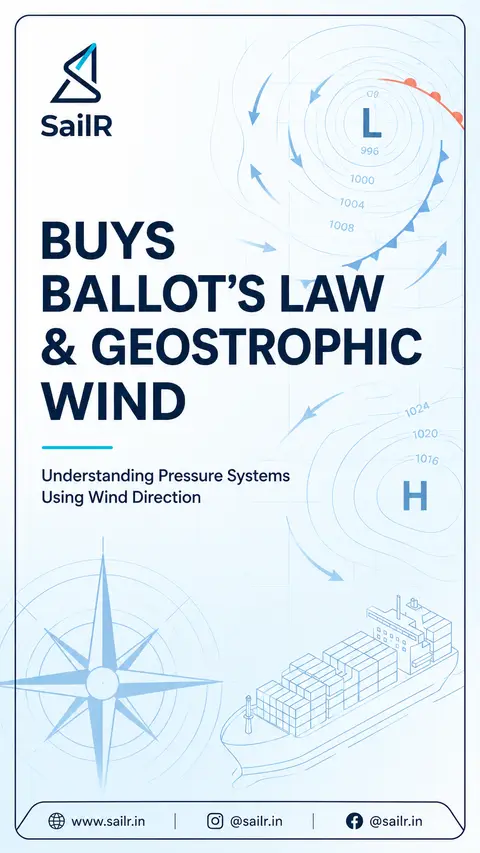
The slides, written out
AI-drawn illustration. Simplified to explain the idea, not to scale.
Slide 1 · L
L
996
1000
1004
1008
BUYS
BALLOT'S LAW
& GEOSTROPHIC
WIND
Understanding Pressure Systems
Using Wind Direction
1024
1020
1016
H
Slide 2 · BUYS BALLOT'S LAW
BUYS BALLOT'S LAW
If you stand with your back to the wind, you can find the relative position of pressure systems.
NORTHERN HEMISPHERE
Back to Wind
WIND
LOW PRESSURE
HIGH PRESSURE
L
H
SOUTHERN HEMISPHERE
Back to Wind
WIND
HIGH PRESSURE
LOW PRESSURE
H
L
KEY TAKEAWAY
If you stand with your back to the wind:
• Northern Hemisphere → Low pressure lies to your left.
• Southern Hemisphere → Low pressure lies to your right.
A quick rule-of-thumb to help locate pressure systems when information is limited.
Slide 3 · GEOSTROPHIC WIND
GEOSTROPHIC WIND
In the free atmosphere, wind flows parallel to straight isobars when two forces are in balance.
FORCE BALANCE
PRESSURE GRADIENT FORCE
Pushes air from high pressure toward low pressure.
WIND
Flows parallel to isobars
CORIOLIS FORCE
Caused by Earth's rotation; deflects moving air 90° to the right in NH.
When these two forces are equal and opposite, GEOSTROPHIC WIND is established.
KEY CONDITIONS FOR GEOSTROPHIC WIND
ABOVE PLANETARY BOUNDARY LAYER
Frictional effects are negligible.
NEGLIGIBLE FRICTION
Occurs in the free atmosphere.
AWAY FROM EQUATOR
Coriolis force is significant.
NEARLY STRAIGHT ISOBARS
Curvature is minimal. (See next slide)
IMPORTANT
Geostrophic wind represents the wind at about the top of the boundary layer. Surface winds are affected by friction and are therefore slower and cross the isobars toward lower pressure.
Slide 4 · FROM WEATHER CHART
FROM WEATHER CHART
TO WIND ESTIMATE
Using the geostrophic wind scale
to estimate surface wind speed.
1
MEASURE ISOBAR SPACING
Use dividers to measure the
perpendicular distance between
two adjacent isobars.
2
USE GEOSTROPHIC
WIND SCALE
Transfer the spacing to the
geostrophic wind scale
printed on the chart.
3
SELECT CORRECT LATITUDE
Use the column that matches
your vessel's latitude.
4
ESTIMATE GEOSTROPHIC WIND
Read the geostrophic wind speed
corresponding to your spacing
and latitude.
5
APPLY SURFACE CORRECTION
Surface winds are weaker and
cross the isobars toward lower
pressure due to friction.
6
APPROXIMATE SURFACE WIND
Reduce geostrophic wind by
about 20–35% to get the
approximate surface wind.
KEY REMINDERS
LATITUDE MATTERS
Coriolis force varies
with latitude. Always
use the column nearest
to your vessel's latitude.
NEAR EQUATOR
Within about 5° of the
equator, geostrophic
assumptions break
down. Buys Ballot
and the scale are not
reliable here.
CURVED ISOBARS
Around deep lows or
highs, gradient wind
differs from geostrophic
wind due to centrifugal
force.
• Around a LOW:
gradient wind is
slightly weaker.
• Around a HIGH:
gradient wind is
slightly stronger.
SURFACE WINDS
Generally weaker than
geostrophic winds by
about 20–35% and
cross isobars toward
lower pressure.
EXAMPLE: Geostrophic Wind = 30 kt → Surface Wind ≈ 20–24 kt
Understanding wind–pressure relationships
helps mariners anticipate weather changes
and improve voyage planning.
Drafted by SailR from our daily lessons. AI-drawn illustration. Simplified to explain the idea, not to scale. Last updated 19 Oct 2026.
Spotted a mistake?