The slides, written out
AI-drawn illustration. Simplified to explain the idea, not to scale.
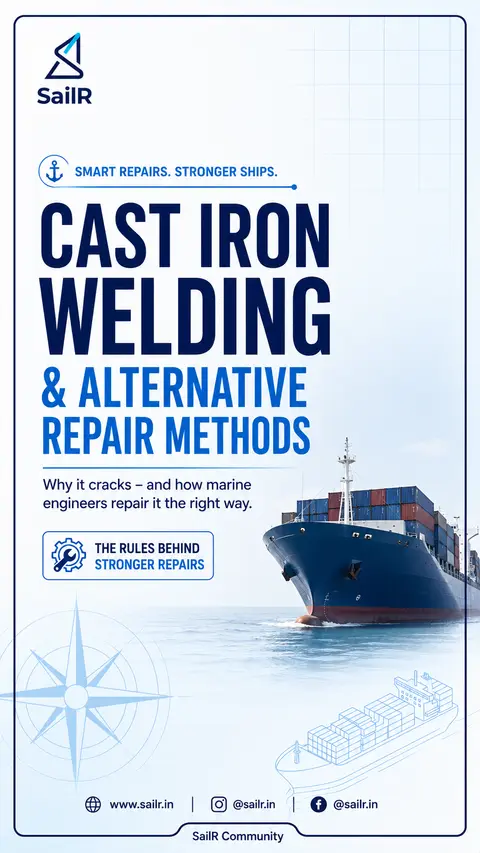
Slide 1 · SMART REPAIRS
SMART REPAIRS. STRONGER SHIPS.
CAST IRON
WELDING
& ALTERNATIVE
REPAIR METHODS
Why it cracks – and how marine engineers repair it the right way.
THE RULES BEHIND STRONGER REPAIRS
| |
Slide 2 · 01/04
WHY
CAST IRON WELDING
IS A CHALLENGE
Understanding the problems is the first step
to the right repair.
01
MICROSTRUCTURE
HIGH CARBON & HARD STRUCTURES
Grey cast iron typically contains about 2–4.5% carbon.
Rapid cooling can produce hard, brittle structures
in the weld area and HAZ, including iron carbides
and martensite. These increase cracking risk and
can make the repaired area difficult to machine.
02
THERMAL STRESS & CRACKING
Cast iron has low ductility. Uneven heating and
cooling create thermal stresses. Because it cannot
stretch, cracks can form in or near the weld
during cooling.
03
POROSITY & CONTAMINATION
Contamination and reactions involving the casting
can contribute to weld porosity. Oil, grease and
other impurities can increase porosity risk.
04
RESIDUAL STRESS
Welding can leave residual tensile stresses in
the repair area. Combined with hard, brittle
structures and cyclic service loading,
these stresses can increase the risk of
crack initiation or propagation.
Bottom takeaway:
Cast iron can be welded — but controlling heat,
cooling rate, microstructure and stress is critical.
Slide 3 · 02/04
HEAT CONTROL
IS CRITICAL
Preheat • Control • Slow Cooling
HEAT CONTROL
WHY PREHEAT?
Preheating reduces the thermal gradient between the weld area and the surrounding casting. This slows cooling, reduces HAZ hardening and helps reduce thermal stresses and cracking risk.
PREHEAT IS NOT ONE FIXED TEMPERATURE
The required temperature depends on:
• Cast iron grade
• Microstructure
• Component thickness and geometry
• Welding process
• Welding procedure and allowable HAZ hardness
For example, TWI gives typical values around
300°C for ferritic flake iron and
300–330°C for pearlitic flake iron
for MMA/MIG processes.¹
IMPORTANT: Do not treat 200–400°C as a universal cast iron welding requirement.
AFTER WELDING
Allow the casting to cool slowly. This reduces thermal shock and residual-stress-related cracking.¹
TEMPERATURE
TIME
Rapid Cooling (High Risk)
Slow Cooling (Lower Risk)
¹ Source: TWI – Weldability of Materials: Cast Irons (Technical Guidance)
Slide 4 · 03/04
ALTERNATIVE
REPAIR METHODS
When welding is not the best option.
01
METAL STITCHING / COLD PINNING
Engineered stitching pins and locks mechanically restore structural integrity and distribute loads without welding heat. This can help avoid heat related distortion and residual stresses in suitable components.
02
METAL FILLED EPOXY / COMPOSITE SYSTEMS
Selected surface, sealing, corrosion or erosion repairs can use metal filled epoxy or composite systems. This is not metallurgical welding. Suitability depends on loading, temperature, pressure and the applicable repair requirements.
METAL EPOXY
METAL EPOXY
03
BRONZE / BRAZE WELDING
The parent cast iron is not melted. The lower melting filler bonds to the surface. This can avoid many of the disadvantages associated with fusion welding, although joint strength and service conditions must be assessed for the specific application.
BRONZE FILLER
04
REPLACEMENT / RECONSTRUCTION
Where damage exceeds acceptable repair limits, an engineered replacement casting or other approved reconstruction may be required. The method depends on geometry, loading, alignment, component criticality and applicable requirements.
Slide 5 · 04/04
HOW TO CHOOSE
THE RIGHT
REPAIR METHOD
Choose the method that is safe, reliable and right for the job.
01
WELDING
Consider when:
• Cast iron grade is suitable
• An approved welding procedure is available
• Heat and cooling can be controlled
• Required inspection and acceptance can be achieved
02
METAL STITCHING
Consider for suitable:
• Cracked castings
• Engine blocks and casings
• Alignment critical components
• Repairs where welding heat creates unacceptable risk
03
BRAZE / COMPOSITE REPAIR
Consider for selected:
• Surface restoration
• Sealing applications
• Local damage
• Repairs where metallurgical fusion is undesirable
04
REPLACEMENT
May be required when:
• Damage exceeds repair limits
• Component criticality demands replacement
• Engineering assessment does not support repair
• Applicable OEM / class requirements may require replacement
FINAL ENGINEERING MESSAGE
There is no single "best" cast iron repair method.
The correct choice depends on material, crack location, damage extent, component criticality, access, loading and applicable repair requirements.
| |
BRONZE FILLER
EPOXY COMPOSITE
Drafted by SailR from our daily lessons. AI-drawn illustration. Simplified to explain the idea, not to scale. Last updated 19 Oct 2026.
Spotted a mistake?