The slides, written out
AI-drawn illustration. Simplified to explain the idea, not to scale.
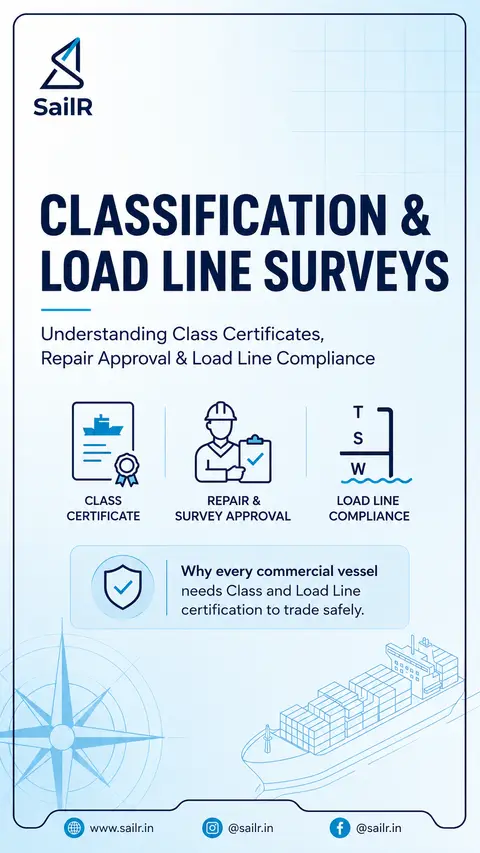
Slide 1 · CLASSIFICATION &
CLASSIFICATION &
LOAD LINE SURVEYS
Understanding Class Certificates,
Repair Approval & Load Line Compliance
CLASS CERTIFICATE
REPAIR & SURVEY APPROVAL
LOAD LINE COMPLIANCE
Why every commercial vessel needs Class and Load Line certification to trade safely.
Slide 2 · WHY IS A CLASS
WHY IS A CLASS
CERTIFICATE ISSUED?
The Ship's Engineering Passport
Issued after construction and trials, the Certificate of Class
confirms the vessel complies with classification society rules
for its intended service.
1 PROOF OF COMPLIANCE
Confirms the vessel complies
with classification society
rules for hull, machinery
and systems.
5 ENABLES
SAFE
TRADING
A valid Class
Certificate is
essential for
international
trading and
port acceptance.
2 SUPPORTS
INSURANCE
& FINANCE
Class status is
generally required
for hull insurance,
P&I cover and
vessel financing.
CERTIFICATE
OF CLASS
3 SUPPORTS
STATUTORY
CERTIFICATION
Many flag states
authorize recognised
organizations to
perform statutory
surveys.
4 COMMERCIAL
ACCEPTANCE
Provides confidence to
charterers, insurers and
regulators that the vessel
is maintained to a high
engineering standard.
KEY TAKEAWAY
Class confirms compliance with technical
rules and survey requirements, but does
not legally guarantee seaworthiness.
Slide 3 · 03/04
REPAIRS & ALTERATIONS:
WHEN TO CALL CLASS?
Any major repair or structural alteration must be
reported to and approved by the classification society.
This keeps your vessel safe, compliant and insurable.
NOTIFY CLASS WHEN:
WHY IT MATTERS
Structural steel
renewals
Bulkhead
modifications
Rudder
repairs
Shafting
repairs
Main engine
foundation
repairs
Safety-critical
system
modifications
(e.g. fire mains,
CO2 systems)
MAINTAINS
CLASS VALIDITY
Unauthorized work can
lead to suspension or
withdrawal of class.
ENSURES STRUCTURAL
INTEGRITY
Surveyors verify that
repairs do not weaken
critical structures.
APPROVED REPAIR
PROCEDURES
Ensures correct materials,
welding, testing and
restoration standards.
PROTECTS INSURANCE
& STATUTORY
COMPLIANCE
Non-compliance can
void insurance claims
and statutory certificates.
IMPORTANT NOTE
Do not start any major repair or structural modification
without class approval. Always consult your class society
before commencing the work.
SAILR INSIGHT
When in doubt, consult Class before commencing work.
A quick call today prevents costly setbacks tomorrow.
Slide 4 · 04/04
INTERNATIONAL LOAD LINE
SURVEYS EXPLAINED
Ensuring adequate freeboard and watertight integrity
in accordance with the International Load Line Convention, 1966.
1 INITIAL SURVEY
Before the vessel enters service
Deck line and load line marks
Correct position and permanent marking
Watertight integrity
Hull below freeboard deck is watertight
Weathertight closures
Hatch covers, scuttles, ventilators, air pipes, doors and closing appliances
Freeboard arrangements
Correct assignment of freeboard
Conditions of assignment
Hull structure and associated equipment verified
RESULT:
International Load Line Certificate Issued
2 PERIODICAL SURVEYS
ANNUAL SURVEY
Within ±3 months of each anniversary date
Load line marks
Verified for correct position and visibility
Hull condition
General external and internal inspection
Watertight integrity
Verify no loss of watertightness
Weathertight closures
Check openings and closing appliances
Conditions of assignment
Ensure continued compliance
RESULT:
Certificate Endorsed
RENEWAL SURVEY
Every 5 years
Internal examinations
Holds, tanks, voids and structural spaces
Thickness measurements
Where required based on survey findings
Structural inspections
Shell plating, sternframe, bulkheads, deck structure, rudder, etc.
Watertight integrity
Comprehensive verification of watertight boundaries
RESULT:
Certificate Renewed (Subject to Convention Requirements)
REMEMBER
Class surveys verify compliance with classification rules.
Load Line surveys verify freeboard and watertight integrity.
Together they ensure safe, compliant and reliable vessel operations.
Drafted by SailR from our daily lessons. AI-drawn illustration. Simplified to explain the idea, not to scale. Last updated 19 Oct 2026.
Spotted a mistake?