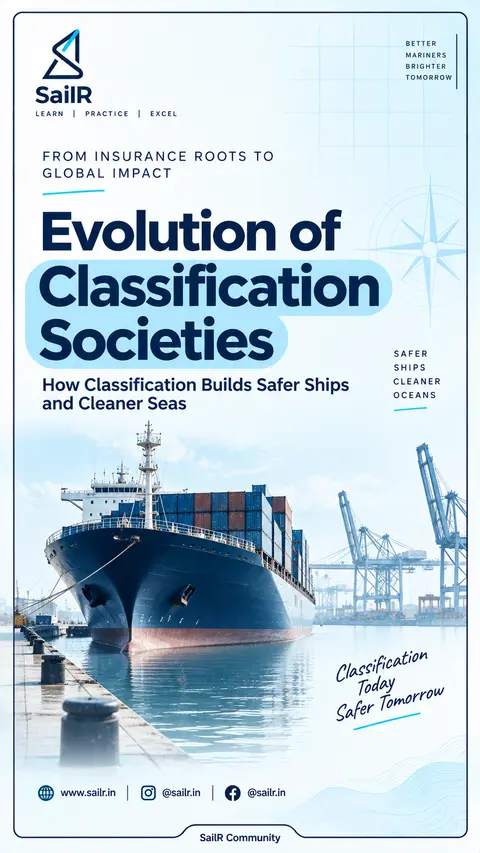
The slides, written out
AI-drawn illustration. Simplified to explain the idea, not to scale.
Slide 1 · LEARN | PRACTICE | EXCEL
FROM INSURANCE ROOTS TO
GLOBAL IMPACT
Evolution of
Classification
Societies
How Classification Builds Safer Ships
and Cleaner Seas
BETTER
MARINERS
BRIGHTER
TOMORROW
SAFER
SHIPS
CLEANER
OCEANS
Classification
Today
Safer Tomorrow
Slide 2 · LEARN | PRACTICE | EXCEL
BETTER
MARINERS
BRIGHTER
TOMORROW
EVOLUTION OF CLASSIFICATION SOCIETIES
FROM INSURANCE ROOTS TO GLOBAL IMPACT
Evolution of
Classification Societies
INSURANCE
CREATED
THE FIRST
REGISTER
Built on Trust. Today for Safer Ships and Cleaner Seas.
1760
The Beginning
Lloyd's Register originated at Edward Lloyd's Coffee House in London, to help underwriters assess the risk of insuring ships.
1764
First Register Book
The first Register Book was begun in 1764, listing ships, their condition, age and equipment.
1775
A1 Notation Introduced
The A1 notation first appeared in the 1775 Register, which later became the familiar class notation.
LLOYD'S COFFEE HOUSE 1760
REGISTER OF SHIPS 1764
LLOYD'S REGISTER A1 1775
The Big Shift
Register → Rules → Engineering
From recording the condition of ships to developing technical standards for safer and stronger ships.
Hull Scantlings
Machinery
Materials
Construction
A safer maritime world began with a register.
Exam Takeaway
Classification began from insurance and commerce, before evolving into a technical safety system.
Source: Lloyd's Register | LR Foundation
| |
CHART YOUR GROWTH
Slide 3 · LEARN | PRACTICE | EXCEL
BETTER
MARINERS
BRIGHTER
TOMORROW
EVOLUTION OF CLASSIFICATION SOCIETIES
How Classification
Works Today
From Design Approval to Lifelong Safety
Standards
Today
Safer Ships
Tomorrow
1
DESIGN REVIEW
Drawings and technical plans
are reviewed against the
applicable classification
society rules.
2
CONSTRUCTION SURVEY
Surveyors verify construction,
materials, machinery and
equipment against the
approved requirements.
3
PERIODIC CLASS SURVEYS
The ship continues to be surveyed
throughout its service life in
accordance with the applicable
classification society rules.
SAFER SHIPS
STRONGER SEAS
Certificate
of Class
Issued and maintained
subject to the applicable
classification society
rules.
Confirms compliance
with class requirements.
Continuous
Survey Schemes
Some classification
societies offer continuous
survey arrangements
for hull and machinery.
Helps in early detection
of defects and supports
continuous compliance.
Enhanced Survey
Programme (ESP)
Applies to specified
ship types (e.g. oil tankers
and bulk carriers) under
relevant statutory and
class requirements.
Not applicable to all ships.
Class Society ≠ Flag Administration
A classification society may also act as a
Recognized Organization (RO) when authorized
by a flag State to perform specified statutory
surveys and certification services on its behalf.
HSSC — STATUTORY SURVEYS
For applicable statutory surveys,
HSSC provides a one-year standard
interval and a six-month time window
(± 3 months) for annual, intermediate
and periodical surveys.
Exam Takeaway
Class surveys and statutory surveys are related, but they are not the same system.
Sources: IMO HSSC 2025 | IMO Recognized Organizations
| |
CHART
YOUR
GROWTH
Slide 4 · LEARN | PRACTICE | EXCEL
BETTER
MARINERS
BRIGHTER
TOMORROW
EVOLUTION OF CLASSIFICATION SOCIETIES
HSSC, Flag State
and Port State Control
Different Roles, A Common Goal – Safer, Cleaner Seas
Who Does What?
FLAG STATE
Primary responsibility for implementing international requirements on its registered ships.
May authorize a Recognized Organization (RO) to carry out statutory surveys on its behalf.
RECOGNIZED ORGANIZATION (RO)
A classification society may be authorized as an RO by a flag Administration.
Carries out specified statutory surveys and certification functions on behalf of the flag State.
PORT STATE
Inspects foreign ships voluntarily visiting its ports.
Verifies compliance with SOLAS, MARPOL, Load Line, STCW and other applicable instruments.
Flag State
Sets the rules for its ships
SAFE SHIPS
CLEAN SEAS
SUSTAINABLE FUTURE
Recognized Organization
Technical expertise and statutory surveys (on behalf of flag state)
Port State
Inspects foreign ships in its ports
HSSC – What It Does
Harmonized System of Survey and Certification (HSSC)
Harmonizes statutory surveys and certification across applicable IMO instruments.
Standardized survey types, intervals and certification arrangements.
Does NOT mean that class, flag and port State inspections occur at the same time.
India – PSC Framework
Foreign-flag PSC inspections are carried out by authorized Port State Control Officers.
Under the direction of the jurisdictional Principal Officer of the Mercantile Marine Department.
India is a member of the Indian Ocean Memorandum of Understanding (IOMOU).
Exam Takeaway
Classification, flag State and port State each have distinct roles, but together they contribute to safer and cleaner seas.
Source: IMO HSSC 2025 | IMO PSC Procedures 2025 | DG Shipping India
| |
CHART YOUR GROWTH
Slide 5 · LEARN | PRACTICE | EXCEL
BETTER
MARINERS
BRIGHTER
TOMORROW
EVOLUTION OF CLASSIFICATION SOCIETIES
Ports and Coast Guard
as Coastal State Authority
Safe Coasts
Stronger
Seas
Regulating Traffic and Protecting the Coast
PORTS
Coastal and Port Functions
INDIAN COAST GUARD
At Sea and Coastal Waters
Vessel Traffic Services (VTS)
• Shore-side system that provides information and, where applicable, manages vessel traffic.
• The Master remains responsible for navigation and manoeuvring.
Maritime Law Enforcement
• Enforces maritime laws.
• Prevents smuggling, illegal fishing and other maritime offences.
• Surveillance and monitoring.
Pilotage
• Provides local knowledge and navigational assistance.
• Pilotage does not relieve the Master of their responsibilities.
Search and Rescue (SAR)
• Coordinates SAR in Indian waters and within the Indian Search and Rescue Region (SRR).
Port State Control (PSC)
• Inspection of foreign ships in port under applicable national and international requirements (e.g. SOLAS, MARPOL, Load Line, STCW).
• Deficiencies may lead to delay or detention.
Marine Pollution Response
• Coordinates oil-pollution response under the National Oil Spill Disaster Contingency Plan (NOSDCP).
• Works with ports, coastal States/UTs and other agencies as per the national contingency framework.
Port Reception Facilities
• MARPOL requires adequate reception facilities for relevant ship-generated wastes at ports and terminals.
• Supports proper waste handling and helps prevent pollution at sea.
Cleaner Seas Safer India
201
INDIAN COAST GUARD
Real World MARPOL Example
• An unauthorized discharge of oily bilge water may be subject to enforcement by the competent coastal, port or flag State authorities, depending on where and how the violation occurred.
• Distance from shore alone does NOT establish a MARPOL violation.
Indian Legal and Regulatory Framework
• MARPOL Annex I – prevention of pollution by oil
• UNCLOS Part XII – coastal and port State jurisdiction
• Merchant Shipping Act, 1958 (as amended)
• National Oil Spill Disaster Contingency Plan (NOSDCP)
Exam Takeaway
Port State, Coastal State and Coast Guard roles are distinct, but coordinated.
Sources: IMO | UNCLOS | Indian Coast Guard | DG Shipping
| |
CHART
YOUR
GROWTH
Drafted by SailR from our daily lessons. AI-drawn illustration. Simplified to explain the idea, not to scale. Last updated 19 Oct 2026.
Spotted a mistake?