The slides, written out
AI-drawn illustration. Simplified to explain the idea, not to scale.
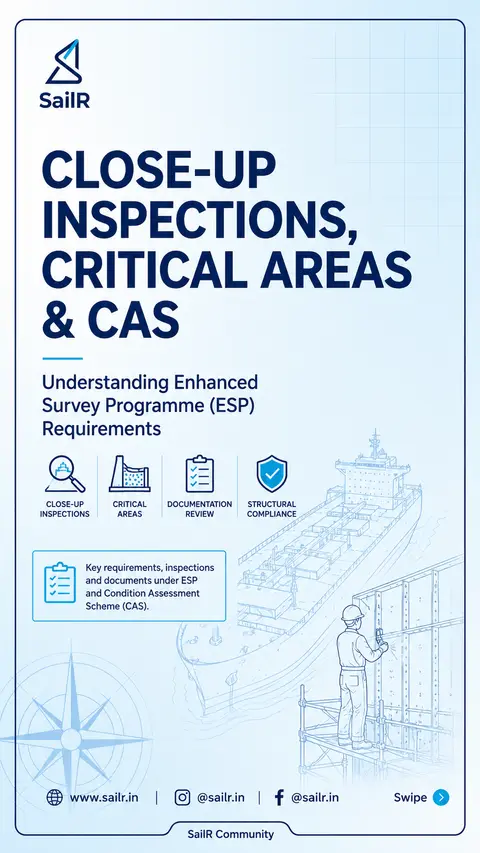
Slide 1 · CLOSE-UP INSPECTIONS, CRITICAL AREAS & CAS
CLOSE-UP INSPECTIONS, CRITICAL AREAS & CAS
Understanding Enhanced Survey Programme (ESP) Requirements
CLOSE-UP INSPECTIONS
CRITICAL AREAS
DOCUMENTATION REVIEW
STRUCTURAL COMPLIANCE
Key requirements, inspections and documents under ESP and Condition Assessment Scheme (CAS).
Slide 2 · 02 / 04
CLOSE-UP
INSPECTION
Close-up inspection means the surveyor is
within arm's reach of the structure to identify
defects not visible during general surveys.
Mandatory under the 2011 ESP Code,
governed by SOLAS Chapter XI-1 Reg. 2.
WHAT CAN BE IDENTIFIED?
CORROSION
Pitting, wastage,
and material loss
CRACKING
Fatigue cracks,
structural cracks,
and weld defects
COATING
BREAKDOWN
Coating damage,
blistering, and rust scale
STRUCTURAL
DEFORMATION
Buckling, distortion,
and plating deformation
Defects invisible during general surveys
can be identified through close-up inspection.
Slide 3 · 03 / 04
CRITICAL
STRUCTURAL AREAS
Identified during survey planning as locations particularly
vulnerable to cracking, buckling, or corrosion and listed
in the Survey Plan.
WHY THEY MATTER?
Higher risk of structural damage
Require higher inspection density
More thickness measurement points
Lower tolerance for deterioration
IDENTIFIED FROM
Previous survey reports
Damage & repair history
Sister-ship experience
Corrosion trends
Cargo & ballast history
WEB FRAME RINGS
High stress locations
susceptible to fatigue
and corrosion.
TRANSVERSE BULKHEADS
Critical for overall
strength and watertight
integrity.
DECK STRUCTURES
Exposed to repeated
loads, corrosion and
coating breakdown.
BALLAST TANK AREAS
Prone to corrosion due to
water ingress and coating
degradation.
BOTTOM STRUCTURES
Subjected to high pressure,
corrosion, and abrasion from
ballast and cargo residues.
SUSPECT AREAS
Areas where available information
indicates possible hidden deterioration
and require closer examination.
Slide 4 · 04 / 04
CONDITION ASSESSMENT
SCHEME (CAS)
A mandatory structural assessment regime for certain
ageing single-hull oil tankers as part of the
MARPOL Annex I tanker phase-out regime.
KEY ELEMENTS
WHY CAS WAS INTRODUCED
DETAILED SURVEY PLANNING
Documentation review and
survey planning.
CLOSE-UP SURVEYS
Inspection of critical and
other structural areas.
THICKNESS MEASUREMENTS
Conducted by approved TM firm
under surveyor control.
To strengthen confidence in the structural
integrity of ageing tankers and support
global tanker safety initiatives following
major tanker pollution incidents,
particularly Erika (1999).
CONDITION EVALUATION
REPORTS
Assessment of structural
condition and trends.
DAMAGE & REPAIR REVIEW
Review of damage, repairs,
modifications, and history.
FINAL COMPLIANCE VERIFICATION
Rectification of all conditions of
class and issuance of Statement
of Compliance.
KEY TAKEAWAY
ESP = Enhanced survey framework
applicable to all tankers and
bulk carriers.
CAS = Additional structural assessment
regime for ageing oil tankers.
FOLLOW SAILR
for more practical maritime learning
and exam-focused content!
Stay Informed
Learn Smarter
Sail Ahead
| |
Drafted by SailR from our daily lessons. AI-drawn illustration. Simplified to explain the idea, not to scale. Last updated 19 Oct 2026.
Spotted a mistake?