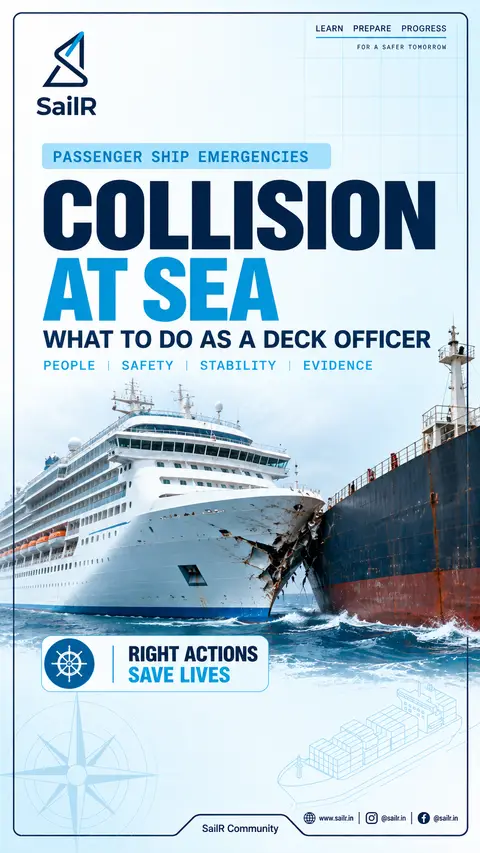
The slides, written out
AI-drawn illustration. Simplified to explain the idea, not to scale.
Slide 1 · LEARN PREPARE PROGRESS
LEARN PREPARE PROGRESS
FOR A SAFER TOMORROW
PASSENGER SHIP EMERGENCIES
COLLISION
AT SEA
WHAT TO DO AS A DECK OFFICER
PEOPLE | SAFETY | STABILITY | EVIDENCE
RIGHT ACTIONS
SAVE LIVES
| |
Slide 2 · LEARN PREPARE PROGRESS
LEARN PREPARE PROGRESS
FOR A SAFER TOMORROW
PASSENGER SHIP EMERGENCIES
COLLISION AT SEA
WHAT TO DO AS A DECK OFFICER
PEOPLE | SAFETY | STABILITY | EVIDENCE
1
THE FIRST FEW SECONDS
IMPACT → CONTROL → PROTECT
ACT FAST
THINK CLEAR
KEEP EVERYONE SAFE
IMMEDIATE ACTIONS
QUICK ACTION
SAVES LIVES
Inform the Master immediately and call the engine room. Reduce or stop the engine as required, while maintaining safe control. Change to hand steering if required.
Sound the emergency alarm and make the general announcement.
Close the watertight doors, fire doors and other openings assigned in the muster list / emergency procedures, taking account of damage control and escape arrangements.
Muster the crew at their emergency stations according to the muster list.
If there is a risk of sinking, prepare survival craft before abandonment becomes necessary, in accordance with the emergency plan.
THINK & ASSESS
Plot the exact position and time of collision. Preserve relevant course recorder and data logger information.
Sound / inspect appropriate bilges and tanks to establish the extent of flooding.
Check for fire, flooding, structural failure, stability problems and oil pollution. Take action to prevent or minimize further damage.
Exhibit the appropriate COLREG lights and shapes for the vessel's actual condition. If Not Under Command, exhibit the Rule 27 signals.
Maintain the required GMDSS watch and, when practicable, a continuous listening watch on VHF 16. Use VHF 13 as appropriate for bridge to bridge navigation safety communications.
Provide first aid where required.
Assess the condition of the other vessel and render assistance where required and safe to do so.
CALM ACTION MAKES THE DIFFERENCE
KNOWLEDGE BUILDS SAFER SEAS
Slide 3 · LEARN
LEARN
PREPARE
PROGRESS
FOR A SAFER TOMORROW
PASSENGER SHIP EMERGENCIES
COLLISION AT SEA
WHAT TO DO AS A DECK OFFICER
PEOPLE | SAFETY | STABILITY | EVIDENCE
2
THE PASSENGER DIMENSION
PEOPLE → FLOODING → STABILITY
CALM PEOPLE
FOLLOW PROCEDURES
PROTECT LIVES
PASSENGER ACCOUNTABILITY
Carry out passenger and crew muster and accountability according to the muster list and emergency procedures.
Assigned personnel assist passengers to assembly stations.
Search passenger spaces for persons who may be trapped.
Use the PA system regularly with calm, clear and understandable information.
Do not expose crew to unnecessary risk during searches.
ASSEMBLY STATION
FIRE & DAMAGE
Check immediately for fire and fire-main damage.
Check for fuel or oil release.
Establish whether fire is adjacent to accommodation or other critical spaces.
Apply boundary cooling where required by the situation and emergency procedures.
DAMAGE STABILITY
Assess the actual damaged condition using the approved stability information, damage control plan and loading computer (where fitted and approved).
Check draft, trim and list.
Assess flooding extent and location.
Consider loss of buoyancy and free-surface effects where applicable.
Determine the vessel's residual damage stability.
Collision Damage
Passenger ships have specific subdivision and damage-stability requirements under SOLAS Chapter II-1, based on a probabilistic concept. Do not assume a fixed number of compartments.
KNOWLEDGE BUILDS SAFER SEAS
Slide 4 · LEARN PREPARE PROGRESS
LEARN PREPARE PROGRESS
FOR A SAFER TOMORROW
PASSENGER SHIP EMERGENCIES
COLLISION AT SEA
WHAT TO DO AS A DECK OFFICER
PEOPLE | SAFETY | STABILITY | EVIDENCE
3
REPORTING & PRESERVE THE EVIDENCE
THE CASUALTY RECORD STARTS IMMEDIATELY
REPORT
RECORD
PRESERVE
SUPPORT
REPORT TO AUTHORITIES & COMPANY
Notify the company/owners and appropriate authorities in accordance with applicable reporting procedures.
Provide factual information including:
Date, time and position (UTC and local time)
Weather and sea conditions
Circumstances and sequence of events
Other vessel's identity and relevant details
Damage to both vessels
Injuries or casualties
Pollution (if any)
Current danger to the vessel
Whether repairs can be carried out onboard
Whether salvage, towage or docking may be required
Whether the vessel can safely continue the voyage
COMPANY / OWNERS
APPROPRIATE AUTHORITIES
KEEP COMMUNICATION LINES OPEN
PRESERVE EVIDENCE
Immediately preserve all available navigational and operational records relevant to the casualty.
ECDIS navigation records
VDR / S-VDR data
GPS and AIS information
Radar records (where available)
Course recorder
Engine room records
Echo sounder records
Bridge, radio, weather and engine logs
Passage plan, standing orders and night orders
Pilot card and relevant documents
Photographs of damage
CCTV recordings (where available)
Witness information and factual notes
VOYAGE DATA RECORDER DO NOT OPEN REPORT TO AUTHORITIES
BRIDGE LOG BOOK
UTC 12:36 Collision with vessel 12:38 Engine reduced 12:40 Sounded emergency alarm 12:45 Reported to company 12:50 Commenced assessment
ECDIS GPS AIS RADAR LOGS VDR CCTV
FACTS FIRST
Record observed facts separately from estimates or later reconstruction of courses, speeds and angle of contact.
NO FIXED TIME RULE
Do not use a fixed "60 minutes before collision" rule unless specifically required by the applicable system or authority.
KNOWLEDGE BUILDS SAFER SEAS
Slide 5 · LEARN PREPARE PROGRESS
LEARN PREPARE PROGRESS
FOR A SAFER TOMORROW
PASSENGER SHIP EMERGENCIES
COLLISION AT SEA
WHAT TO DO AS A DECK OFFICER
PEOPLE | SAFETY | STABILITY | EVIDENCE
4
LOG BOOK & CASUALTY DISCIPLINE
RECORD → REPORT → COOPERATE
ACCURATE RECORDS
PROTECT LIVES
SUPPORT INVESTIGATION
LOG BOOK ENTRIES
Document everything as early as possible:
Time of collision (UTC and local/ship time)
Position
Weather and sea conditions
Sequence of events
Vessel's actions and decisions taken
Damage and flooding observations
Communications made (internal and external)
Assistance rendered or received
Subsequent developments
DECK LOG BOOK
10:24 Collision with vessel
10:30 Engine stopped (as required)
10:32 Emergency alarm sounded
10:35 Muster crew initiated
10:40 Damage assessment commenced
10:55 Reported to company
11:10 Authorities notified
INTEGRITY OF THE RECORD
Keep the record factual and reliable:
Do not speculate on cause or liability.
Record factual observations accurately.
Preserve original records (no unauthorized alterations or deletions).
Crew to make personal notes – facts only.
Cooperate with authorized authorities and investigators.
Follow company casualty-reporting procedures.
Refer legal and insurance matters through the Master's/company's designated channels.
Accurate records today protect you, your crew and your ship tomorrow.
SURVEYORS, INVESTIGATORS & ACCESS
Control access to the vessel:
Allow access in accordance with the Master's authority, security procedures and instructions from the company, flag/port authorities, casualty investigators and designated legal/P&I representatives.
Do not make unauthorized admissions or statements concerning liability.
REMEMBER
PROTECT LIFE | CONTROL DAMAGE | RECORD FACTS | COOPERATE
KNOWLEDGE BUILDS SAFER SEAS
Drafted by SailR from our daily lessons. AI-drawn illustration. Simplified to explain the idea, not to scale. Last updated 19 Oct 2026.
Spotted a mistake?