The slides, written out
AI-drawn illustration. Simplified to explain the idea, not to scale.
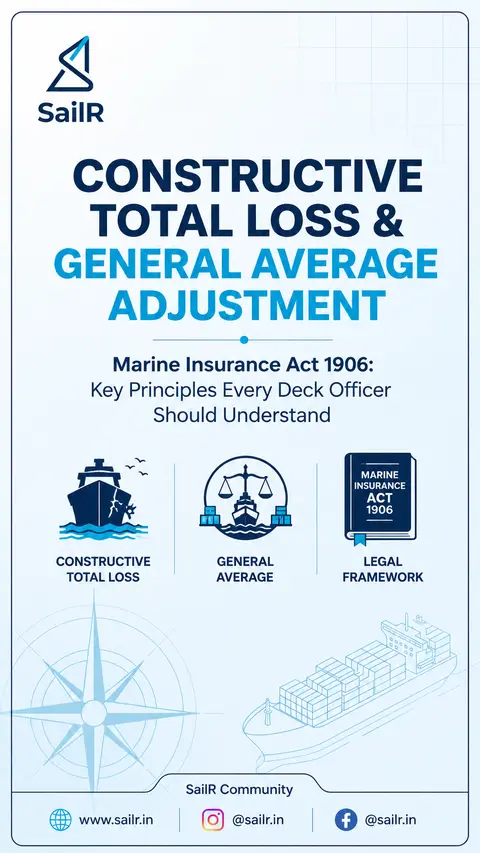
Slide 1 · CONSTRUCTIVE
CONSTRUCTIVE
TOTAL LOSS &
GENERAL AVERAGE
ADJUSTMENT
Marine Insurance Act 1906:
Key Principles Every Deck Officer
Should Understand
CONSTRUCTIVE
TOTAL LOSS
GENERAL
AVERAGE
LEGAL
FRAMEWORK
MARINE
INSURANCE
ACT
1906
Slide 2 · CONSTRUCTIVE
CONSTRUCTIVE
TOTAL LOSS (CTL)
What is CTL?
A Constructive Total Loss occurs when the vessel or cargo is not completely lost, but the situation is so severe that the law allows it to be treated as a Total Loss.
Legal Basis
Marine Insurance Act 1906
Section 60
Two Main CTL Situations
1. LOSS OF POSSESSION
Recovery unlikely
OR
Recovery cost exceeds recovered value
Examples:
Ship seized, detained, arrested or held by authorities.
2. PHYSICAL DAMAGE
Repair cost exceeds repaired value
Examples:
Extensive damage where repairing is uneconomical.
Officer Takeaway:
If repair or recovery costs exceed the asset's post-recovery value, CTL may exist.
Slide 3 · WHEN CTL EXISTS
WHEN CTL EXISTS
The Assured's Options (Section 61)
When a Constructive Total Loss exists,
the assured has two choices:
1 PARTIAL LOSS CLAIM
Treat as Partial Loss
Retain ownership
Claim for the actual damage sustained
OR
2 ABANDON TO INSURER
Issue Notice of Abandonment
Transfer rights to the insurer
Claim as if it were an Actual Total Loss
CARGO EXAMPLE
For goods, CTL may arise when:
REPAIR COST
+
FORWARDING COST TO DESTINATION
>
CARGO VALUE AT DESTINATION
If (Repair Cost + Forwarding Cost) exceeds Cargo Value at Destination, a Constructive Total Loss may exist.
OFFICER REMINDER
Always preserve evidence to support your decision:
Surveys
Repair Estimates
Recovery Quotations
Master's Protest
All Relevant Documents
Slide 4 · ROLE OF THE
ROLE OF THE
AVERAGE ADJUSTER
Who Calculates General Average?
The Average Adjuster is an independent expert who applies the York–Antwerp Rules and the Marine Insurance Act 1906 to determine how General Average costs are shared among the contributing interests (ship, cargo & freight).
Key Responsibilities
1 Determine GA Act
Confirm the act was voluntary, extraordinary and reasonably incurred in time of peril for the common safety (MIA 1906, S.66).
2 Separate GA from PA
Distinguish General Average expenditure from Particular Average or operating expenses.
3 Calculate Contributory Values
Establish the net values of ship, cargo and freight at the end of the voyage (after deducting losses).
4 Apportion GA Contribution
Apportion the total GA expenditure among all contributing interests in proportion to their values.
5 Prepare GA Adjustment
Issue a detailed adjustment statement showing the amounts payable by/to each interest with full calculation and audit trail.
6 Document Recovery Matters
Identify and document matters affecting recovery rights, contribution claims and salvage-related recoveries as part of the adjustment process.
A VALID GENERAL AVERAGE ACT MUST BE
EXTRAORDINARY
VOLUNTARY
REASONABLE
IN TIME OF PERIL
FOR COMMON SAFETY
(MARINE INSURANCE ACT 1906 – SECTION 66)
CHIEF OFFICER TAKEAWAY
Accurate and complete documentation makes the adjustment smooth and avoids disputes.
Port disbursements & expenses
Salvage & towage invoices
Repair invoices & estimates
Master's Protest
GA bonds & bank guarantees
All correspondence
Learn Maritime Insurance with SailR
Drafted by SailR from our daily lessons. AI-drawn illustration. Simplified to explain the idea, not to scale. Last updated 19 Oct 2026.
Spotted a mistake?