The slides, written out
AI-drawn illustration. Simplified to explain the idea, not to scale.
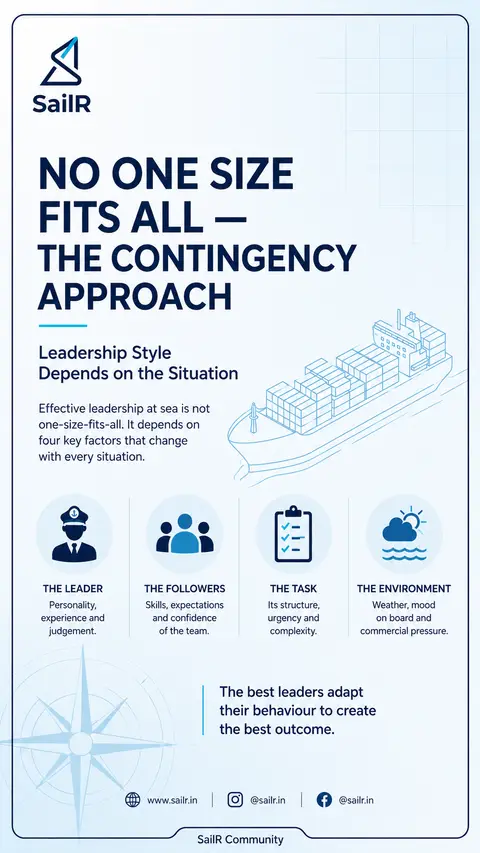
Slide 1 · NO ONE SIZE
NO ONE SIZE
FITS ALL —
THE CONTINGENCY
APPROACH
Leadership Style
Depends on the Situation
Effective leadership at sea is not
one-size-fits-all. It depends on
four key factors that change
with every situation.
THE LEADER
Personality,
experience and
judgement.
THE FOLLOWERS
Skills, expectations
and confidence
of the team.
THE TASK
Its structure,
urgency and
complexity.
THE ENVIRONMENT
Weather, mood
on board and
commercial pressure.
The best leaders adapt
their behaviour to create
the best outcome.
Slide 2 · THE FOUR FACTORS
THE FOUR FACTORS
THAT SHAPE YOUR LEADERSHIP
A practical contingency framework
considers four key factors.
1. THE LEADER
• Personality
• Experience
• Technical Competence
2. THE FOLLOWERS
• Skills
• Expectations
• Confidence
• Motivation
3. THE TASK
• Routine or Emergency
• Complexity
• Time Pressure
• Clarity of Procedures
4. THE ENVIRONMENT
• Weather Conditions
• Commercial Pressure
• Crew Morale
• Resources Available
BEST LEADERSHIP =
BEST FIT
between these four factors
for the situation at hand.
| |
Slide 3 · CHOOSE THE RIGHT STYLE
CHOOSE THE RIGHT STYLE
FOR THE SITUATION ONBOARD
Different situations call for different leadership behaviours.
Use the style that fits the moment.
1. DIRECTIVE / AUTOCRATIC
EMERGENCY / HIGH RISK
Use when time is critical, risk to life or ship is immediate, and there is no room for discussion.
SHIPBOARD EXAMPLE
War Room Style
Fire in the engine room. You give clear orders and expect immediate action. No debate. Safety first.
2. CONSULTATIVE
PLANNED / PROBLEM SOLVING
Use when the task is non-routine but not life-threatening. You need expert input and buy-in.
SHIPBOARD EXAMPLE
Plan Together, Decide Together
Planning ballast exchange in rough weather. You seek the Bosun's experience before deciding.
3. PARTICIPATIVE / DELEGATIVE
ROUTINE / HIGH TRUST
Use when the team is experienced, the task is well understood, and you have high trust in them.
SHIPBOARD EXAMPLE
Own the Work
You delegate the PMS to the Bosun and crew. You focus on oversight and support.
4. SUPPORTIVE / TEAM-BUILDING
POST-CRISIS / HIGH STRESS
Use when the team is tired, morale is low, or after a difficult event. Show care, rebuild confidence.
SHIPBOARD EXAMPLE
Care and Support
After heavy weather or a medevac, acknowledge the effort, address fatigue and support your team.
QUICK DECISION GUIDE
EMERGENCY / IMMEDIATE RISK?
YES
USE DIRECTIVE
NO
NEED IDEAS / EXPERT INPUT?
YES
USE CONSULTATIVE
NO
EXPERIENCED, COMPETENT CREW?
YES
USE DELEGATIVE
NO
LOW MORALE / TEAM STRESSED?
YES
USE SUPPORTIVE
Slide 4 · KEY TAKEAWAYS
KEY TAKEAWAYS
Great leaders adapt. They assess,
decide and lead with purpose.
1. NO SINGLE
BEST STYLE
There is no one-size-
fits-all approach.
The situation
decides.
5. SAFETY
ALWAYS
COMES FIRST
Every decision
must protect
people, the ship
and the
environment.
2. MATCH
THE STYLE TO
THE SITUATION
Consider the leader,
the followers, the task
and the environment.
EFFECTIVE
LEADERS
ADAPT
Match your leadership
style to the situation
and your people.
4. REMAIN
ACCOUNTABLE
Delegate with clarity,
provide support and
take responsibility
for the outcome.
3. BUILD TRUST
THROUGH
COMMUNICATION
Listen, understand
and show respect.
People follow those
they trust.
Leadership is earned through the
trust and confidence of the people you lead.
Drafted by SailR from our daily lessons. AI-drawn illustration. Simplified to explain the idea, not to scale. Last updated 19 Oct 2026.
Spotted a mistake?