The slides, written out
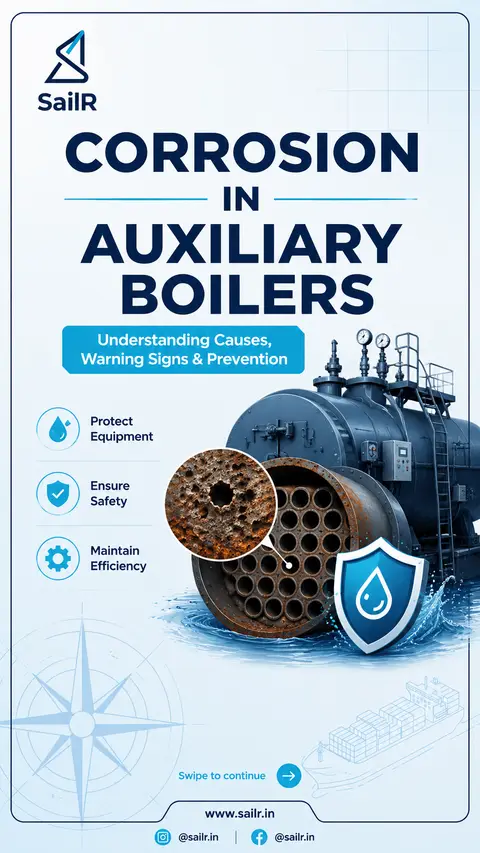
AI-drawn illustration. Simplified to explain the idea, not to scale.
Slide 1 · CORROSION
CORROSION
IN
AUXILIARY
BOILERS
Understanding Causes,
Warning Signs & Prevention
Protect Equipment
Ensure Safety
Maintain Efficiency
Swipe to continue
Slide 2 · 5 TYPES
5 TYPES
OF BOILER CORROSION
Know the Enemy. Prevent the Damage.
1
OXYGEN CORROSION
(PITTING)
Dissolved oxygen attacks bare metal forming small, deep pits. Often seen under rust deposits.
Effect: Tube thinning & potential failure
2
CAUSTIC EMBRITTLEMENT
(STRESS CORROSION CRACKING)
High stress + concentrated caustic solution cause cracking, usually near rivets, welds or tube ends.
Effect: Cracks may lead to rupture
3
GALVANIC CORROSION
Dissimilar metals create an electrochemical cell. Less noble metal corrodes faster. (e.g., copper deposition on steel tubes)
Effect: Localised wastage of tubes
4
ACID CORROSION
Low pH (below neutral) increases hydrogen ions which attack metal causing uniform wastage.
Effect: General thinning of metal
5
CORROSION FATIGUE
Cyclic stress (vibration/thermal) combined with corrosive environment causes fatigue cracks in tubes.
Effect: Tube cracking & failure
Swipe to continue
Slide 3 · EARLY WARNING SIGNS
EARLY WARNING SIGNS
Spot it early. Prevent costly failures.
WHAT YOU SEE
IT COULD MEAN
Red-brown rust in steam drum
Rusty deposits on water surface or drum internal parts.
Oxygen corrosion
Oxygen ingress due to poor deaeration, leaks or air entry.
Pits under rust scabs
Small, deep pits on water side of tubes or plates.
Oxygen pitting
Dissolved oxygen attacks metal and forms deep pits over time.
Rising chloride levels
Chloride readings increasing in boiler water tests.
Seawater contamination
Possible leak in condenser tubes or seawater ingress into system.
Copper in water sample
Copper content higher than normal.
Galvanic corrosion / system wear
Copper deposition on steel tubes or feed system component corrosion.
Low pH in boiler water
pH below the recommended alkaline range.
Acid corrosion / oil contamination
Loss of alkalinity due to oil, acids or poor treatment.
Cracks near welds or rivets
Hairline cracks around joints, rivets or tube ends.
Caustic embrittlement / stress cracking
Highly concentrated caustic with stress causes cracking.
Remember:
Corrosion damage begins long before failure becomes visible.
Slide 4 · PREVENTION IS
PREVENTION IS
BETTER THAN REPAIR
Watchkeeper's Checklist for Corrosion Control
1. WATER TREATMENT
The First Line of Defence
Ensure effective deaeration
of feed water.
Use oxygen scavengers
(sulfite / alternative).
Avoid excess hydrazine.
Maintain proper pH & alkalinity
as per manufacturer
recommendation.
Maintain coordinated phosphate
treatment & control TDS.
Prevent oil contamination.
Use only approved mineral oils.
2. ROUTINE TESTING
Test Regular. Act Early.
Test as per boiler water treatment
programme & company procedures.
Typical tests: pH, alkalinity,
chloride, phosphate, oxygen
scavenger residual, conductivity.
Immediate action on high
chloride, low pH or low scavenger.
Maintain accurate log of
all test results.
3. OPERATIONS
Good Habits Save Boilers
Blowdown regularly – maintain
correct blowdown rate.
Avoid rapid heating
(thermal shock).
Maintain proper water level.
Avoid carryover.
Ensure tight condensate
return system – no air ingress.
Reduce load and investigate
immediately if contamination
is suspected.
4. MAINTENANCE
Inspect. Maintain. Prevent.
Inspect tube ends, weld seams,
rivets for cracks.
Check deaerator performance
& venting.
Inspect feed lines, internal
feed pipes & joints.
Where fitted, inspect sacrificial
zinc anodes & renew as per
manufacturer.
Maintain boiler in proper lay-up
condition during idle periods.
SAILR WATCHKEEPER'S RULE
Good water chemistry is the first line of
defence against boiler failure.
Spot early
Prevent always
Protect equipment
Ensure safe operations
Drafted by SailR from our daily lessons. AI-drawn illustration. Simplified to explain the idea, not to scale. Last updated 19 Oct 2026.
Spotted a mistake?