The slides, written out
AI-drawn illustration. Simplified to explain the idea, not to scale.
Slide 1 · SLOW DEFORMATION
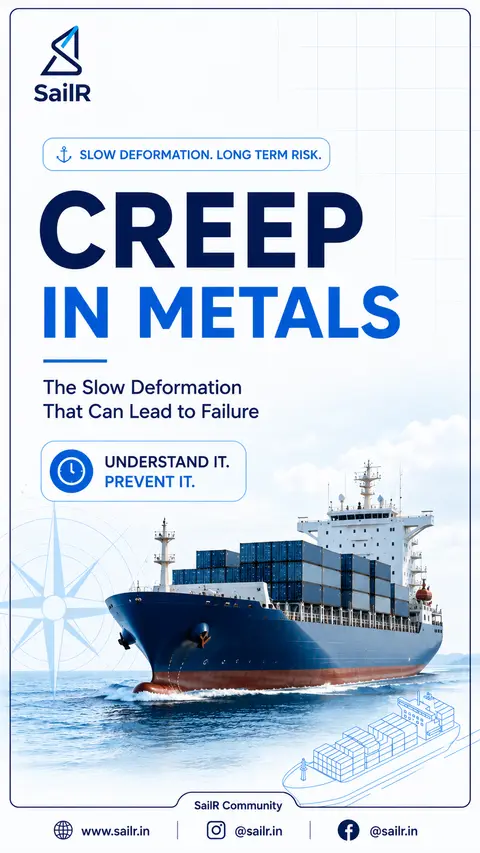
SLOW DEFORMATION. LONG TERM RISK.
CREEP
IN METALS
The Slow Deformation
That Can Lead to Failure
UNDERSTAND IT.
PREVENT IT.
Slide 2 · CREEP
CREEP
THE SLOW FAILURE
TIME DEPENDENT DEFORMATION UNDER PROLONGED STRESS
Creep is the time dependent permanent deformation of a material under stress at elevated temperature.
IMPORTANT EXAM POINT
Creep can occur at stresses well below the material's conventional yield strength.
The deformation accumulates gradually with time and can eventually lead to rupture.
STRESS
TEMPERATURE
TIME
CREEP
KEY CONDITION
Creep becomes increasingly important as temperature becomes a significant fraction of the material's absolute melting temperature. The exact temperature depends on the material, stress and service conditions.
SAILR EXAM TAKEAWAY
It is not simply "high temperature" — temperature relative to the material matters.
Slide 3 · THREE STAGES
THREE STAGES
OF CREEP
HOW CREEP DEVELOPS OVER TIME
A typical creep curve under sustained stress
at elevated temperature shows three stages.
01
PRIMARY CREEP
Initial deformation occurs
relatively rapidly, then
the creep rate decreases
with time.
02
SECONDARY CREEP
The material enters a
comparatively long period
of nearly steady
creep rate.
03
TERTIARY CREEP
The creep rate accelerates
due to damage and
microstructural changes,
eventually leading
to rupture.
TYPICAL CREEP CURVE
1
PRIMARY
CREEP
2
SECONDARY
CREEP
3
TERTIARY
CREEP
STRAIN, ε
RUPTURE
TIME, t
The secondary stage
provides a nearly constant
(minimum) creep rate and is
the most important stage
for design and life assessment.
REMEMBER
PRIMARY → SECONDARY → TERTIARY
Decreasing rate → Steady rate → Accelerating rate
Slide 4 · HOW TO IMPROVE
HOW TO IMPROVE
CREEP RESISTANCE
3 METALLURGICAL APPROACHES
01
ALLOYING
Creep resistant steels use combinations of alloying
elements such as:
Cr
Mo
V
W
Nb
B
N
These elements provide solid solution strengthening
and precipitation strengthening.
They help maintain strength at elevated temperature
and improve long term creep resistance.
Modern Cr steels rely on stable precipitates and
microstructural stability for long term performance.
02
GRAIN SIZE CONTROL
For conditions where grain boundary processes
are important, coarser grains can improve creep
resistance.
Coarser grain structure reduces grain boundary
area and associated diffusion paths, helping resist
creep deformation.
03
THERMOMECHANICAL TREATMENT
Appropriate thermomechanical processing increases
dislocation density.
It promotes the formation and stability of fine precipitates,
improving high temperature strength and creep
resistance in suitable alloys.
EXAM TAKEAWAY
Creep resistance depends on:
ALLOY COMPOSITION + GRAIN STRUCTURE +
STABLE MICROSTRUCTURE
Slide 5 · CREEP ON BOARD
CREEP ON BOARD
WHERE CAN MARINE ENGINEERS ENCOUNTER CREEP?
1. BOILERS & SUPERHEATERS
Long term exposure to high temperature and stress can produce creep deformation and eventual rupture.
2. STEAM TURBINE COMPONENTS
High temperature turbine components require materials with adequate long term creep strength.
3. DIESEL ENGINE COMPONENTS
Highly heated components can experience long term deformation when elevated temperature and sustained mechanical stress act together.
4. CYLINDER COVERS
Creep can contribute to long term deformation and damage in highly heated cylinder covers. However, cylinder head deformation or cracking may also involve thermal fatigue, combustion pressure and mechanical/thermal stresses.
REMEMBER
CREEP = TIME DEPENDENT DEFORMATION
PRIMARY → SECONDARY → TERTIARY
CONTROL IT WITH:
ALLOYING
MICROSTRUCTURE
MATERIAL SELECTION
TEMPERATURE CONTROL
STRESS CONTROL
Creep mechanisms can include dislocation movement, diffusion and grain boundary processes. The dominant mechanism depends on temperature, stress and microstructure.
Drafted by SailR from our daily lessons. AI-drawn illustration. Simplified to explain the idea, not to scale. Last updated 19 Oct 2026.
Spotted a mistake?