The slides, written out
AI-drawn illustration. Simplified to explain the idea, not to scale.
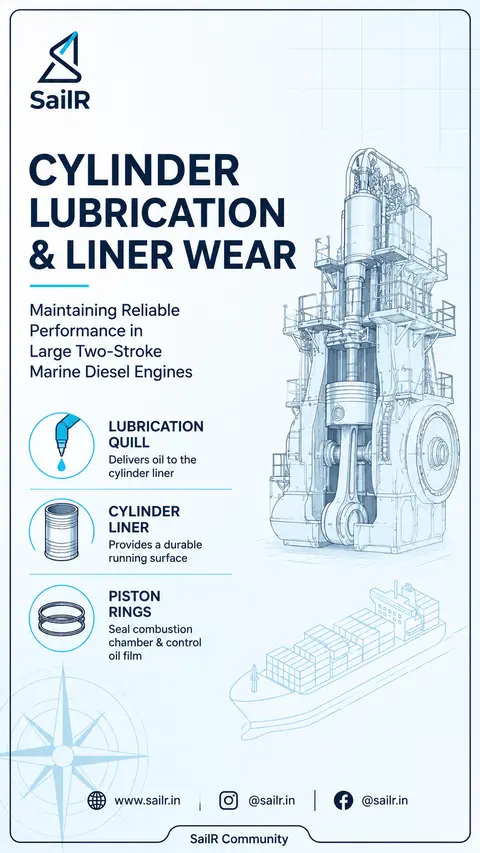
Slide 1 · CYLINDER
CYLINDER
LUBRICATION
& LINER WEAR
Maintaining Reliable
Performance in
Large Two-Stroke
Marine Diesel Engines
LUBRICATION
QUILL
Delivers oil to the
cylinder liner
CYLINDER
LINER
Provides a durable
running surface
PISTON
RINGS
Seal combustion
chamber & control
oil film
Slide 2 · PROBLEMS ASSOCIATED
PROBLEMS ASSOCIATED
WITH IMPROPER LUBRICATION
OF THE LINER AND PISTON ASSEMBLY
TOO LITTLE OIL
HIGH ABRASIVE WEAR
Metal-to-metal contact at the ring/liner interface causes rapid liner wear.
CORROSIVE WEAR
Acid attack accelerates liner corrosion, especially in the lower part of the liner.
BLOW-BY & LOCAL OVERHEATING
Loss of oil seal allows hot gases to pass, causing hot spots and oil film breakdown.
INCREASED RING & GROOVE DEPOSITS
Carbon build-up leads to ring sticking, breakage and further blow-by.
RISK OF PISTON SEIZURE
Severe wear and overheating can lead to piston seizure.
RISK OF SCAVENGE FIRE / CRANKCASE EXPLOSION
In trunk-piston engines due to excessive blow-by and oil contamination.
TOO MUCH OIL
CARBON DEPOSITS
Excess oil bakes into hard carbon on piston crown, ring grooves and exhaust system.
RING STICKING
Carbon fills ring grooves and jams rings, causing gas blow-by even with adequate oil feed.
FOULING OF TURBOCHARGER & EXHAUST SYSTEM
Unburnt oil deposits on turbine blades, reducing efficiency.
CONTAMINATION OF SCAVENGE AIR
Excess oil entering scavenge space causes deposits and can lead to scavenge fires.
INCREASED OIL CONSUMPTION
Waste of cylinder oil and higher operating costs.
RISK OF SCAVENGE FIRE
High oil carry-over can ignite in the scavenge space.
CORRECT VS INCORRECT LUBRICATION
CORRECT LUBRICATION
TOO LITTLE OIL
TOO MUCH OIL
PISTON RINGS
LINER
Adequate oil film separates ring and liner, ensuring smooth operation and minimal wear.
Thin or broken oil film causes metal-to-metal contact, wear, blow-by and overheating.
Excess oil leads to carbon deposits, ring sticking and scavenge contamination.
Slide 3 · CLOVERLEAFING & MICRO-SEIZURE
CLOVERLEAFING & MICRO-SEIZURE
DESCRIPTION AND CAUSES
A CLOVERLEAFING
B MICRO-SEIZURE
A distinctive longitudinal wear pattern on the cylinder liner caused by corrosive wear and inadequate oil distribution.
A form of adhesive wear (scuffing) caused by breakdown of the oil film at microscopic contact points, leading to surface welding and tearing.
HOW IT LOOKS
HOW IT HAPPENS
Lubrication quills
Wear is heaviest between quills
OIL FILM
LINER
RING
LINER
1 Oil film separates ring and liner surfaces.
2 At high temperature and pressure, oil film breaks down.
3 Microscopic peaks (asperities) weld together.
4 Sliding motion tears the weld, causing galling and surface damage.
RING
LINER
RING
LINER
RING
LINER
Top View (Cross-Section)
Worn areas between quills create a "clover leaf" shape
CAUSES
CAUSES
VERY HIGH LINER WALL TEMPERATURE
From inadequate cooling or engine overload.
INADEQUATE CYLINDER OIL FEED RATE
Not enough oil reaches all areas of the liner.
OIL FILM BREAKDOWN
Excessive temperature causes loss of film strength and lubricant failure.
LOW BN (BASE NUMBER) OIL
Insufficient alkalinity to neutralise acids.
INCORRECT OIL VISCOSITY OR BN
Oil not suitable for operating conditions.
EXCESS SULPHURIC ACID ATTACK
Acid builds up between quills and corrodes the liner surface.
IMPROPER RUNNING-IN
Prevents proper surface adaptation and increases wear risk.
IMPROPER MULTI-LEVEL LUBRICATION
Incorrect upper/lower oil distribution leaves mid-stroke area vulnerable.
ABRASIVE CONTAMINATION
Hard particles trapped between ring and liner break the oil film and cause scuffing.
INSUFFICIENT OIL DISTRIBUTION
Poor quill design, blockage or uneven oil spread.
WHERE IT OCCURS
RESULT
Accelerated liner wear, reduced liner life and higher risk of scuffing and blow-by.
Most commonly on the thrust side of the liner where ring pressure is highest.
Thrust Side
TYPICAL APPEARANCE
CLOVERLEAFING (Corrosive Wear)
MICRO-SEIZURE (Adhesive Wear / Scuffing)
Longitudinal wear between quills forming clover leaf pattern.
Scuffing marks and local galling on liner surface.
Slide 4 · CYLINDER OIL COMPOSITION
CYLINDER OIL COMPOSITION
FOR ENGINES OPERATING ON
RESIDUAL (HFO) FUEL
Cylinder oil is a highly specialised lubricant designed to protect the liner and piston assembly under extreme conditions of temperature, pressure and corrosive environment.
COMPONENT / PROPERTY | VERIFIED DESCRIPTION | PURPOSE
BASE OIL | High-viscosity mineral oil, typically SAE 50 grade (~21 cSt at 100°C) | Provides a thick and stable oil film that remains effective at high liner temperatures.
BASE NUMBER (BN) | Selected according to fuel sulphur content and engine manufacturer's recommendation. Modern cylinder oils are commonly available as BN 40, BN 70, BN 100 and BN 140 grades. High-sulphur residual fuels typically require BN 100 or BN 140 oils, whereas low-sulphur fuels generally require lower BN grades. | Neutralises sulphuric and other acids formed during combustion and prevents corrosive wear.
DETERGENTS | Overbased calcium detergent additives. | Provide alkalinity for acid neutralisation and help keep piston ring grooves and the combustion chamber clean.
DISPERSANTS | Ashless dispersant additives. | Keep soot and wear particles suspended in the oil to prevent sludge and deposit formation.
ANTIWEAR & CORROSION SYSTEM | Antiwear and corrosion-protection additive system suitable for boundary lubrication conditions. | Reduces wear and protects liner and rings under boundary and mixed lubrication.
ANTIOXIDANTS | Hindered phenols or aromatic amines. | Resist oil oxidation and maintain lubricant stability at high temperatures.
THERMAL STABILITY & FILM STRENGTH | High thermal stability and film strength. | Maintains an effective lubricating film at high surface temperatures and prevents breakdown or coking on the liner surface.
NOTE: Always follow the engine manufacturer's lubrication guidelines for oil selection and feed rate settings.
BEST PRACTICES FOR OPTIMAL CYLINDER LUBRICATION
CORRECT BN SELECTION | Match the oil BN to fuel sulphur content and engine manufacturer recommendations.
OPTIMISED OIL FEED RATE | Ensure correct feed rate and distribution to lubricate the entire liner surface.
REGULAR LINER MONITORING | Inspect liner wear pattern, surface condition and temperatures regularly.
DRAIN OIL ANALYSIS | Monitor BN, viscosity, iron content and contamination through regular oil analysis.
SCAVENGE INSPECTIONS | Keep scavenge spaces clean and check for oil carry-over and deposits.
FOLLOW OEM GUIDELINES | Strictly follow engine manufacturer's lubrication and maintenance instructions.
Proper cylinder lubrication is essential for maximum engine reliability, minimum wear and long liner life. The right oil, at the right rate, at the right place – every time.
| |
Drafted by SailR from our daily lessons. AI-drawn illustration. Simplified to explain the idea, not to scale. Last updated 19 Oct 2026.
Spotted a mistake?