The slides, written out
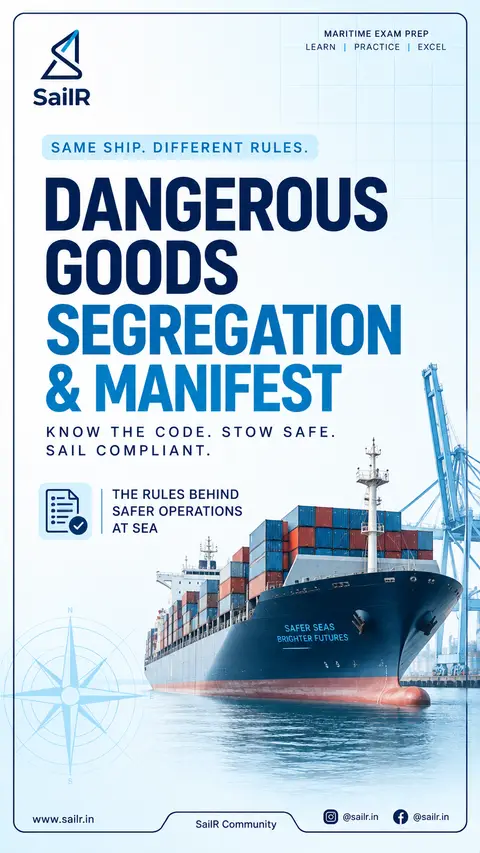
AI-drawn illustration. Simplified to explain the idea, not to scale.
Slide 1 · MARITIME EXAM PREP
SAME SHIP. DIFFERENT RULES.
DANGEROUS
GOODS
SEGREGATION
& MANIFEST
KNOW THE CODE. STOW SAFE.
SAIL COMPLIANT.
THE RULES BEHIND
SAFER OPERATIONS
AT SEA
SAFER SEAS
BRIGHTER FUTURES
Slide 2 · MARITIME EXAM PREP
DANGEROUS GOODS
PACKAGED vs BULK
KNOW WHICH CODE APPLIES
IMDG
IMSBC
IBC / IGC
ESSENTIALS
PACKAGED DANGEROUS GOODS
Carried in packages, drums, IBCs, portable tanks or cargo transport units.
APPLICABLE CODE
IMDG Code
Key segregation provisions are contained in Chapter 7.2, with additional stowage and segregation requirements depending on ship type and arrangement.
BULK DANGEROUS GOODS
Carried loose in holds or tanks, subject to applicable bulk cargo codes.
Solid bulk
IMSBC Code
Liquid chemical bulk
IBC Code
Liquefied gas bulk
IGC Code
EXAM POINT
IMDG applies to dangerous goods carried in packaged form. Bulk dangerous goods are subject to their applicable bulk cargo code.
Slide 3 · MARITIME EXAM PREP
SEGREGATION
THE CRITICAL CHECK
CHECK
VERIFY
APPLY
NEVER RELY ON THE TABLE ALONE
FOR PACKAGED DANGEROUS GOODS
1
Check the IMDG
Segregation Table
Chapter 7.2.4
2
Check the
Dangerous Goods List
Chapter 3.2
3
Check Column 16b
Specific segregation
provisions
IMPORTANT
Where a specific requirement in Column 16b of the
Dangerous Goods List conflicts with the general segregation
provisions, the specific DGL requirement takes precedence.
SUBSIDIARY RISKS MATTER
Segregation must account for applicable subsidiary hazards.
For dangerous goods with two or more subsidiary risk labels,
refer to Column 16b for the specific segregation requirements.
MIXED PACKAGED + SOLID BULK
For Group B solid bulk cargoes possessing chemical hazards
carried together with packaged dangerous goods, consult:
IMSBC Code § 9.3.3
This contains specific segregation requirements
and a segregation table.
EXAM KEY TAKEAWAY
Always check the segregation table, Column 16b
and applicable bulk cargo code before stowage.
Slide 4 · MARITIME EXAM PREP
DANGEROUS GOODS
MANIFEST
REQUIRED ON BOARD BEFORE DEPARTURE
YOUR CONSOLIDATED DG RECORD
Each ship carrying dangerous goods and marine pollutants shall have a special list, manifest or stowage plan identifying the dangerous goods and their locations.
KEY INFORMATION IN THE MANIFEST
1 UN Number
2 Proper Shipping Name
3 Class / Subsidiary Risk
4 Packing Group
5 Number and Kind of Packages
6 Mass or Volume
7 Stowage Position (hold, bay, row, tier, etc.)
8 Flashpoint (where applicable)
9 Marine Pollutant information (where applicable)
10 Emergency response information (EmS information where applicable)
FLASHPOINT REMEMBER
Where applicable, indicate the minimum flashpoint for dangerous goods having a primary or subsidiary Class 3 hazard and a flashpoint of 60°C OR BELOW (closed cup), where applicable.
EXAM POINT
The manifest confirms what dangerous goods are on board and where they are stowed, based on the approved stowage plan and applicable Code requirements.
Slide 5 · MARITIME EXAM PREP
BEFORE LOADING
THE EXAM CHECKLIST
PLAN
VERIFY
SEGREGATE
STOW
SAIL SAFE
4 CHECKS EVERY OFFICER SHOULD REMEMBER
1
VERIFY THE DECLARATION
Check the shipper's declaration and supporting documents.
Confirm UN number, proper shipping name, class, packing group and quantity.
Ensure information is accurate and complete.
2
CHECK THE DGL
Refer to the Dangerous Goods List (Chapter 3.2).
Check Column 16b for specific segregation provisions.
Where Column 16b conflicts with general provisions, the specific DGL requirement takes precedence.
3
CHECK THE SHIP'S DoC
Verify that the ship is approved for the relevant dangerous goods.
Confirm applicable carriage arrangements and stowage locations.
If the proposed carriage is not covered by the ship's approved arrangements, consult the Administration or recognized organization before carriage.
4
PLAN SEGREGATION & STOWAGE
Apply IMDG segregation provisions (Chapter 7.2) for packaged goods.
For Group B solid bulk cargoes with chemical hazards, refer to IMSBC Code § 9.3.3.
Apply applicable IBC / IGC requirements for liquid chemical and liquefied gas bulk cargoes.
Prepare stowage plan before loading and ensure compliance.
AFTER LOADING
Confirm that the actual cargo and locations are correctly reflected in the ship's special list, manifest or stowage plan.
EXAMINER'S KEY LINE
"First identify whether the dangerous goods are packaged or bulk, then apply the correct Code and verify the specific segregation requirements."
Drafted by SailR from our daily lessons. AI-drawn illustration. Simplified to explain the idea, not to scale. Last updated 19 Oct 2026.
Spotted a mistake?