Deck Cargo Precautions and Effects of Heavy Lifts on Ship Stability
- times asked
- 64
- times asked
- questions
- 5
- questions
- last asked
- 2026
- last asked
Deck cargo loading requires careful attention to structural strength, ship stability, cargo securing and safe access. Heavy lifts must be assessed throughout the lifting operation and for the intended voyage.
The slides, written out
AI-drawn illustration. Simplified to explain the idea, not to scale.
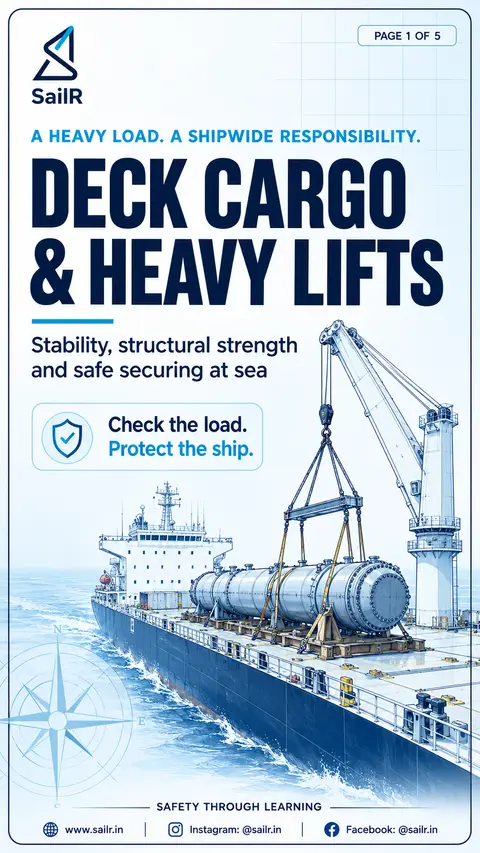
Slide 1 · Deck cargo and heavy lifts require careful planning
Deck cargo and heavy lifts require careful planning. A heavy load can challenge ship stability and structural strength. Check the load, protect the ship, and ensure safe securing at sea.
Slide 2 · Deck strength and load distribution must be checked before loading
Deck strength and load distribution must be checked before loading. Confirm that the deck, hatch covers and supporting structure can withstand the intended load. Identify concentrated point and strip loads, and use suitable beams or bearers to transfer the load to the ship’s primary supporting members. If the structural assessment is complex or stresses approach applicable limits, finite-element analysis should be considered.
Slide 3 · A heavy lift can change the ship’s stability during lifting or after the load is stowed
A heavy lift can change the ship’s stability during lifting or after the load is stowed. Carrying a heavy load high raises the ship’s centre of gravity and generally reduces GM, making the ship more tender. An off-centre or suspended load can produce a heeling moment. Assess the relevant loading and lifting conditions using the ship’s approved stability information and applicable lifting limits.
Slide 4 · Cargo must remain secure under the ship motions expected on the intended voyage
Cargo must remain secure under the ship motions expected on the intended voyage. Select suitable securing arrangements for the cargo, its weight and the expected conditions. Weather routeing can help reduce exposure to severe motions, but it does not replace proper cargo securing.
Slide 5 · Safe stowage must preserve essential access, safety arrangements and navigation functions
Safe stowage must preserve essential access, safety arrangements and navigation functions. Keep escape routes clear, maintain access to lifesaving and firefighting equipment, and do not obstruct sounding points. Deck cargo must not obstruct navigation bridge visibility as required by SOLAS V/22. Apply the relevant IMDG Code provisions to packaged dangerous goods and the applicable Timber Deck Cargo Code requirements to timber deck cargo.
What it is
Deck cargo is cargo carried on exposed decks or other designated deck areas rather than entirely within the ship’s cargo spaces. Loading it requires an assessment of the supporting structure, the ship’s stability, the securing arrangements and the effect on safe shipboard operations. Heavy lifts require additional attention because the load’s position changes during lifting and landing. The loading plan must account for the relevant conditions rather than considering only the final stowed position. (CSS Code, General Principles; 2008 Intact Stability Code, Part B, 2.9)
Why it matters
A heavy load can impose concentrated forces on the deck structure. The deck plating, hatch covers and supporting members must be suitable for the intended loading. A load that exceeds an applicable limit, or is placed where its weight cannot be adequately transferred into supporting structure, can cause structural damage. The CSS Code, Annex 13, section 5.2, addresses the transfer of concentrated loads through suitable supporting arrangements. Section 5.3 addresses when more detailed structural analysis should be considered. (CSS Code, Annex 13, 5.2–5.3)
Stability can also change significantly during a heavy lift. A load carried high raises the ship’s centre of gravity and generally reduces GM. A suspended load or one positioned away from the centreline can produce a heeling moment. The ship’s condition must therefore be assessed for the relevant lifting stages, not merely after the cargo has been landed. (2008 Intact Stability Code, Part A, 2.2; Part B, 2.9)
How it works on board
Before loading, the responsible officer should check the approved loading plan and verify the cargo particulars. The cargo weight, centre of gravity and intended bearing points must be sufficiently established to permit an appropriate structural and stability assessment. The deck and hatch-cover limits must be checked against the intended load distribution. Where concentrated loads occur, suitable beams or bearers may be needed to transfer the load into supporting members. A more detailed structural assessment should be considered where the applicable guidance calls for it. (CSS Code, Annex 13, 5.2–5.3)
During a heavy lift, the lifting plan and the ship’s stability information must guide the operation. The officer responsible should monitor the ship’s condition and coordinate the operation with any planned ballast changes. The relevant loading and lifting conditions should be assessed, including the effect of the load while suspended. The ship’s applicable lifting limits and approved procedures must be followed. (2008 Intact Stability Code, Part B, 2.9)
Cargo securing must be appropriate for the cargo and the ship motions expected on the intended voyage. The securing arrangement must prevent unacceptable movement under those conditions. Weather routeing may help reduce exposure to severe motions, but the cargo must remain adequately secured regardless of the selected route. (CSS Code, General Principles; Annex 13, 6.2)
Safe stowage also requires clear access to essential shipboard arrangements. Escape routes, lifesaving and firefighting equipment, sounding points and safe crew passage must remain accessible as applicable. Deck cargo must not obstruct the navigation bridge visibility required by SOLAS V/22. Cargo-specific provisions must also be followed where applicable. (SOLAS V/22; 2011 Timber Deck Cargoes Code, Part A, 2.9.3)
The rules
The CSS Code provides guidance for safe cargo stowage and securing. Annex 13, section 5.2, addresses concentrated loads and their transfer into supporting structure. Section 5.3 addresses consideration of finite-element analysis in applicable structural assessments. (CSS Code, Annex 13, 5.2–5.3)
The 2008 Intact Stability Code provides the relevant stability framework. Part A, section 2.2, addresses the ship’s centre of gravity and metacentric height. Part B, section 2.9, addresses relevant loading and lifting conditions. (2008 Intact Stability Code, Part A, 2.2; Part B, 2.9)
SOLAS regulation V/22 specifies navigation bridge visibility requirements. Deck cargo must be arranged so that the applicable requirements are maintained. (SOLAS V/22)
Packaged dangerous goods must comply with the applicable IMDG Code provisions. Timber deck cargo must follow the applicable requirements of the Timber Deck Cargoes Code, including its provisions on stowage, securing, stability and personnel safety. (SOLAS Chapter VII, Part A; 2011 Timber Deck Cargoes Code, Part A, 2.8–2.10)
Common mistakes
One common mistake is checking only the final cargo position while overlooking the intermediate stages of a heavy lift. A suspended load can produce a heeling moment, so the lifting condition must be assessed. Another is treating deck strength as a simple total-weight calculation. Concentrated loads and their transfer into supporting structure must also be considered. (2008 Intact Stability Code, Part B, 2.9; CSS Code, Annex 13, 5.2)
Cargo securing is another area where assumptions can lead to unsafe practice. A route chosen to avoid severe weather does not eliminate the need for suitable securing arrangements. Cargo must be secured for the conditions expected on the voyage. (CSS Code, General Principles; Annex 13, 6.2)
Finally, a stowage plan should not compromise access or navigation. Obstructed escape routes, inaccessible safety equipment or impaired bridge visibility can undermine the ship’s safe operation. Check these matters before loading is completed and verify that the applicable cargo-specific requirements have been followed. (SOLAS V/22; 2011 Timber Deck Cargoes Code, Part A, 2.9.3)
In exams
Asked 64 times across 5 different questions, most recently in 2026. Asked most in 2nd Mate (63), Chief Mate (1).
Sources
- IMO, Code of Safe Practice for Cargo Stowage and Securing, including Annex 13, sections 5.2, 5.3 and 6.2
- 2008 International Code on Intact Stability, Part A, section 2.2, and Part B, section 2.9
- SOLAS regulation V/22, Navigation bridge visibility
- IMO, International Maritime Dangerous Goods Code
- IMO Resolution A.1048 27 , Code of Safe Practice for Ships Carrying Timber Deck Cargoes, 2011
Drafted by SailR from the regulations cited. AI-drawn illustration. Simplified to explain the idea, not to scale. Last updated 27 Oct 2026.
Spotted a mistake?