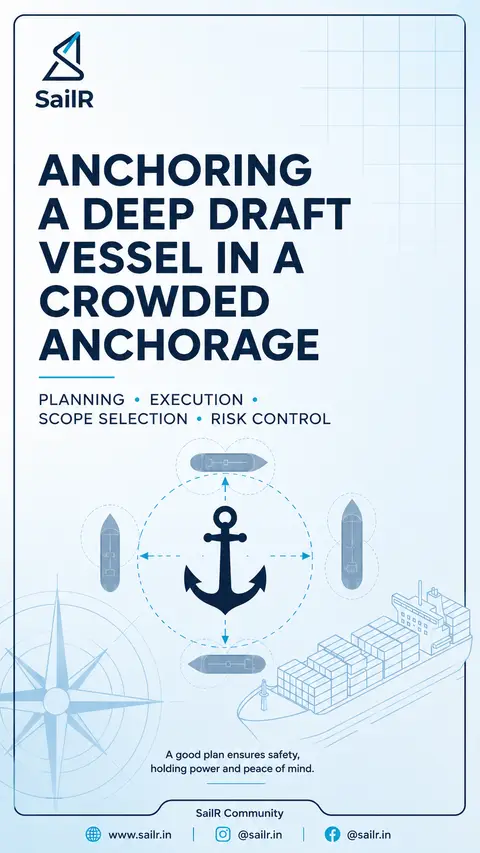
The slides, written out
AI-drawn illustration. Simplified to explain the idea, not to scale.
Slide 1 · ANCHORING
ANCHORING
A DEEP DRAFT
VESSEL IN A
CROWDED
ANCHORAGE
PLANNING • EXECUTION •
SCOPE SELECTION • RISK CONTROL
A good plan ensures safety,
holding power and peace of mind.
| |
Slide 2 · 1
1.
PLAN BEFORE
YOU ENTER
Good planning prevents close quarters
and keeps your anchor holding strong.
CONFIRM THE POSITION
Confirm designated anchorage
position with VTS / Port Authority.
ASSESS DEPTH & SEABED
Check water depth and seabed
nature. Mud, clay and sand give
good holding.
CALCULATE SWINGING ROOM
Plot your swinging circle and
estimate other ships' swing
circles to avoid overlap.
MONITOR NEARBY VESSELS
Use AIS, radar and visual bearings
to monitor anchored vessels and
their swing directions.
REVIEW ENVIRONMENT
Check wind, tide and current
(forecast too). Anticipate
changes.
BRIEF THE BRIDGE TEAM
Assign roles, communication
and contingency actions for
dragging or fouled anchor.
SWINGING ROOM EXAMPLE
20
25
25
25
23
24
20
YOUR
SWINGING
CIRCLE
N
YOUR VESSEL
SWINGING CIRCLE
SEABED GUIDE
GOOD HOLDING
POOR HOLDING
✓ Mud
✓ Clay
✓ Sand
✗ Rock
✗ Boulder
✗ Coral
A well-chosen position today
avoids a close quarters situation tomorrow.
Slide 3 · 2
2.
EXECUTE
THE APPROACH
Precise execution ensures the anchor
is set correctly and holds effectively.
BOW INTO TIDE / CURRENT
Approach with the bow into the
tide or current where practicable.
REDUCE SPEED
PROGRESSIVELY
Bring speed down to a very low
value before letting go.
MONITOR AIS + RADAR +
VISUAL BEARINGS
Check surrounding traffic, ranges
and bearings continuously.
WALK OUT ANCHOR
AS PER PROCEDURE
Commence anchor preparation
and walking out per vessel
procedure.
ANCHOR REACHES SEABED
The anchor should just touch
the seabed as the vessel stops.
VEER REQUIRED CABLE
Veer out the required scope
considering conditions and
available swinging room.
MONITOR ANCHOR HOLDING
Wait for the cable to come
slack, confirm holding and
secure the anchor.
FOR DEEPER
WATER ANCHORAGES
Special anchoring precautions
may be required depending on
vessel type and conditions.
Walking out the anchor
under power may be
necessary before release.
Follow company procedures,
manufacturer guidance and
windlass limitations.
AFTER ANCHORING – MONITOR CONTINUOUSLY
Set anchor watch on radar
(ranges / bearings).
Monitor GPS position and
swing pattern.
Re-assess wind, tide and current
regularly.
Investigate any movement
outside expected swing pattern.
Slide 4 · 3
3. SELECTING
THE RIGHT SCOPE
The right amount of cable gives holding power
without increasing the risk of close quarters.
FACTORS AFFECTING SCOPE
WATER DEPTH
Deeper water requires
more cable for proper
catenary.
SEABED TYPE
Mud, clay and sand hold better
than rock, coral or boulder.
WEATHER FORECAST
Strong winds or approaching
storms may require more scope.
TIDAL STREAM & CURRENT
Stronger current increases
anchor load and requires
additional scope.
AVAILABLE SWINGING ROOM
Scope is limited by the space
available to swing safely.
ANCHOR & CHAIN CONDITION
Well-maintained equipment
provides better holding.
SCOPE TRADE-OFF
LESS SCOPE
MORE SCOPE
VS
Smaller
swing radius
Higher drag
risk
Better holding
performance
Larger
swing radius
KEY TAKEAWAY
THERE IS NO SINGLE UNIVERSAL SCOPE FORMULA.
The amount of cable veered should be determined using:
Company
procedures
Environmental
conditions
Water
depth
Seabed
characteristics
Available
swinging room
MORE PLANNING TODAY,
SAFER ANCHORING TOMORROW.
CONTINUOUS MONITORING
KEEPS YOU IN CONTROL.
SAIL SAFE.
ANCHOR SMART.
Drafted by SailR from our daily lessons. AI-drawn illustration. Simplified to explain the idea, not to scale. Last updated 19 Oct 2026.
Spotted a mistake?