The slides, written out
AI-drawn illustration. Simplified to explain the idea, not to scale.
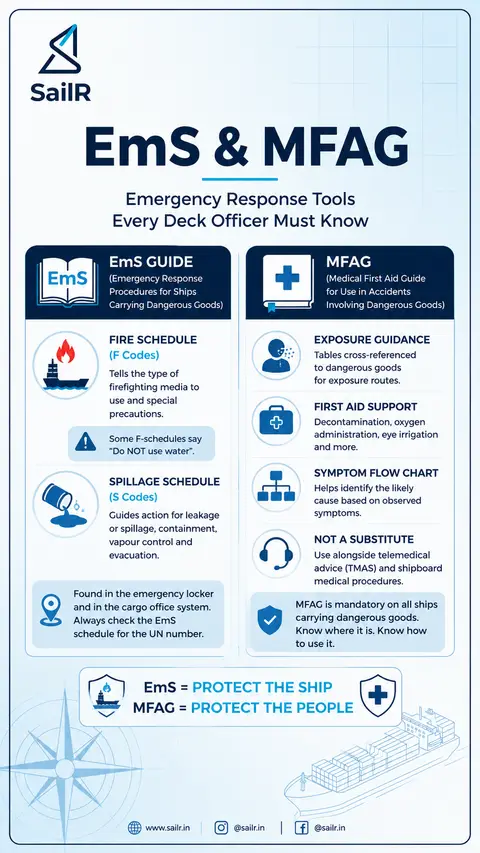
Slide 1 · EmS & MFAG
EmS & MFAG
Emergency Response Tools
Every Deck Officer Must Know
EmS GUIDE
(Emergency Response Procedures for Ships Carrying Dangerous Goods)
MFAG
(Medical First Aid Guide for Use in Accidents Involving Dangerous Goods)
FIRE SCHEDULE
(F Codes)
Tells the type of firefighting media to use and special precautions.
Some F-schedules say "Do NOT use water".
SPILLAGE SCHEDULE
(S Codes)
Guides action for leakage or spillage, containment, vapour control and evacuation.
Found in the emergency locker and in the cargo office system. Always check the EmS schedule for the UN number.
EXPOSURE GUIDANCE
Tables cross-referenced to dangerous goods for exposure routes.
FIRST AID SUPPORT
Decontamination, oxygen administration, eye irrigation and more.
SYMPTOM FLOW CHART
Helps identify the likely cause based on observed symptoms.
NOT A SUBSTITUTE
Use alongside telemedical advice (TMAS) and shipboard medical procedures.
MFAG is mandatory on all ships carrying dangerous goods. Know where it is. Know how to use it.
EmS = PROTECT THE SHIP
MFAG = PROTECT THE PEOPLE
Slide 2 · DG SEGREGATION
DG SEGREGATION
IMDG CODE CHAPTER 7.2
Dangerous goods must be stowed according to the required segregation categories.
1
AWAY FROM
Minimum segregation requirement as defined in IMDG Code 7.2. Arrangement depends on vessel design, cargo unit type and stowage location.
2
SEPARATED FROM
In different compartments or holds. A fire-resistant deck or bulkhead is sufficient.
3
SEPARATED BY A COMPLETE COMPARTMENT OR HOLD FROM
A complete intervening compartment or hold separates the two dangerous goods.
4
SEPARATED LONGITUDINALLY BY AN INTERVENING COMPLETE COMPARTMENT OR HOLD FROM
At least one complete compartment or hold must be between the two dangerous goods longitudinally.
Improper segregation can turn a cargo incident into a major emergency.
Slide 3 · DG MANIFEST
DG MANIFEST
THE SHIP'S DANGEROUS GOODS INVENTORY
Prepared before departure and kept on board
throughout the voyage.
UN
1
UN NUMBER
Four digit identification
number of the dangerous good.
2
PROPER SHIPPING NAME
As per the Dangerous
Goods List (not a trade name).
3
CLASS &
SUBSIDIARY RISK
Primary class and any
subsidiary risks.
4
PACKING GROUP
Packing Group I, II or III
(where applicable).
5
QUANTITY
Total gross mass (kg)
or volume (L).
6
STOWAGE POSITION
Exact container slot,
bay, row or hold number.
7
NUMBER & TYPE
OF PACKAGES
Total number of packages
and packing type.
BEFORE DEPARTURE:
Manifest matches
the actual stowage plan.
All DG containers
verified physically.
Packing certificates
and documents complete.
Any discrepancy must be
resolved before sailing.
DANGEROUS GOODS
MANIFEST
The DG Manifest must be signed by the
Master or Chief Officer and must be available
for Port State Control, Pilot or Authorities.
Slide 4 · CLASS 1 EXPLOSIVES
CLASS 1 EXPLOSIVES
KNOW THE DIVISION BEFORE LOADING
Class 1 dangerous goods are divided into six divisions
based on the type of explosion hazard.
THE SIX DIVISIONS
1.1
MASS EXPLOSION HAZARD
Substances and articles that have a mass explosion hazard.
1.2
PROJECTION HAZARD
Substances and articles that have a projection hazard but not a mass explosion hazard.
1.3
FIRE & MINOR BLAST HAZARD
Substances and articles that have a fire hazard and either a minor blast hazard or a minor projection hazard, or both.
1.4
MINOR EXPLOSION HAZARD
Substances and articles that present no significant hazard.
1.5
VERY INSENSITIVE SUBSTANCES
Substances that have a mass explosion hazard but are very insensitive.
1.6
EXTREMELY INSENSITIVE ARTICLES
Articles which do not have a mass explosion hazard.
STOWAGE & SEGREGATION DEPEND ON
DIVISION
1.1 to 1.6
COMPATIBILITY GROUP
(A to S)
IMDG CODE REQUIREMENTS
Strict compliance with the IMDG Code is essential.
Get the stowage and segregation right. Every time.
Drafted by SailR from our daily lessons. AI-drawn illustration. Simplified to explain the idea, not to scale. Last updated 19 Oct 2026.
Spotted a mistake?