The slides, written out
AI-drawn illustration. Simplified to explain the idea, not to scale.
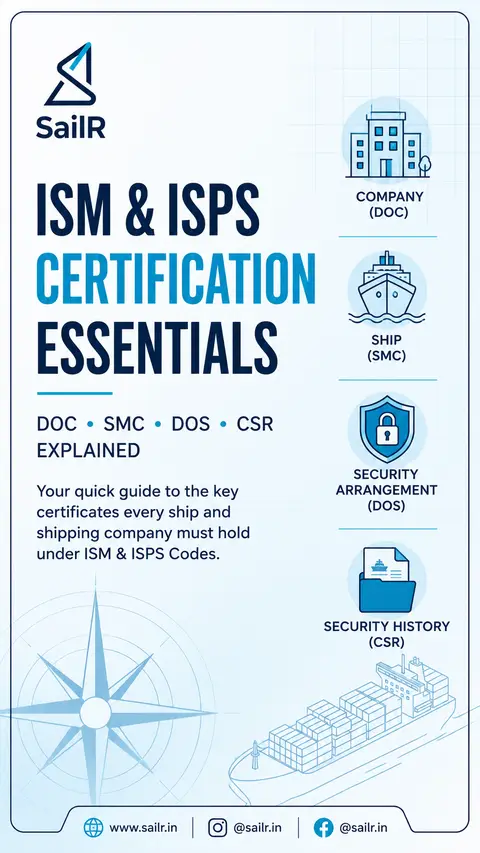
Slide 1 · ISM & ISPS
ISM & ISPS
CERTIFICATION
ESSENTIALS
DOC • SMC • DOS • CSR
EXPLAINED
Your quick guide to the key certificates every ship and shipping company must hold under ISM & ISPS Codes.
COMPANY (DOC)
SHIP (SMC)
SECURITY ARRANGEMENT (DOS)
SECURITY HISTORY (CSR)
Slide 2 · ISM CODE
ISM CODE:
WHO GETS WHAT?
The backbone of the ISM Code
DOC
SMC
DOCUMENT OF COMPLIANCE
SAFETY MANAGEMENT CERTIFICATE
ISSUED TO:
The Company
ISSUED TO:
Each Individual Ship
PROVES:
Company's SMS ashore meets ISM requirements
PROVES:
Ship's SMS onboard is implemented effectively
VALIDITY:
5 years
VALIDITY:
5 years
VERIFICATION:
Annual (within 3 months of anniversary date)
VERIFICATION:
One intermediate verification between 2nd and 3rd anniversary dates
INTERIM DOC:
12 months
INTERIM SMC:
6 months
SCOPE:
Specific to the ship types included in audit
KEY PRE-CONDITION:
Objective evidence should demonstrate SMS has been operating effectively onboard & ashore (commonly ~3 months*)
IN PRACTICE:
DOC is the company's license to manage ships.
SMC is the ship's license to sail.
A Port State Control (PSC) inspector will always check both.
If the DOC is invalid, the ship is considered non-compliant, even if the SMC is valid.
Slide 3 · ISPS CODE
ISPS CODE:
DOS – DECLARATION OF SECURITY
Agreement on Security Measures Between Ship & Port Facility
WHAT IS DOS?
A document that records an agreement between a ship and a port facility (or between ships) regarding the specific security measures each will implement during a period of interaction.
DECLARATION OF SECURITY
WHEN IS A DOS REQUIRED?
SECURITY LEVEL 2
When the ship or port facility is operating at Security Level 2.
SECURITY LEVEL 3
When the ship or port facility is operating at Security Level 3.
SHIP-TO-SHIP OPERATIONS
When conducting ship-to-ship activities (e.g., STS transfer).
CHANGE IN SECURITY LEVEL
When there is a change in the security level.
SPECIFIC SECURITY THREAT
When a specific threat has been identified.
REQUEST BY SSO OR PFSO
When the Ship Security Officer (SSO) or Port Facility Security Officer (PFSO) judges it necessary.
KEY CONTENT
Access Control
Restricted Areas
Cargo Control
Delivery of Stores
Monitoring Arrangements
IN PRACTICE:
If the port is at Level 1, a DOS is not normally required. However, if requested by the PFSO or during STS operations, a DOS must be completed before operations commence. The SSO typically signs the DOS.
Slide 4 · ISPS CODE
ISPS CODE:
CSR – CONTINUOUS
SYNOPSIS RECORD
The Ship's Permanent History File
WHAT IS CSR?
A ship-specific historical record issued by the Flag State containing information about the ship's identity, ownership, class, registered owner and any other entity responsible for the operation of the ship.
CSR
CONTINUOUS SYNOPSIS RECORD
It provides an onboard trail of the ship's history and supports maritime security transparency and due diligence.
KEY FACTS
Issued by the Flag State
Maintained for the Ship's Entire Life
Historical Records Never Removed
Supports Maritime Security Transparency
HOW CSR FOLLOWS THE SHIP THROUGH ITS LIFE
BUILD SHIP
FLAG STATE REGISTRATION
OWNERSHIP CHANGES
MANAGEMENT CHANGES
FLAG TRANSFERS
MAJOR CONVERSIONS
The CSR is amended whenever changes occur and must be kept on board and available for inspection at all times.
QUICK SUMMARY
DOC Company Compliance
SMC Ship Compliance
DOS Security Arrangement
CSR Security History Record
IN PRACTICE:
When a ship changes flag, the new Flag State issues a new CSR (or endorses the existing one), but the old record remains in the document. It is a chain of custody for the ship's security identity.
Drafted by SailR from our daily lessons. AI-drawn illustration. Simplified to explain the idea, not to scale. Last updated 19 Oct 2026.
Spotted a mistake?