The slides, written out
AI-drawn illustration. Simplified to explain the idea, not to scale.
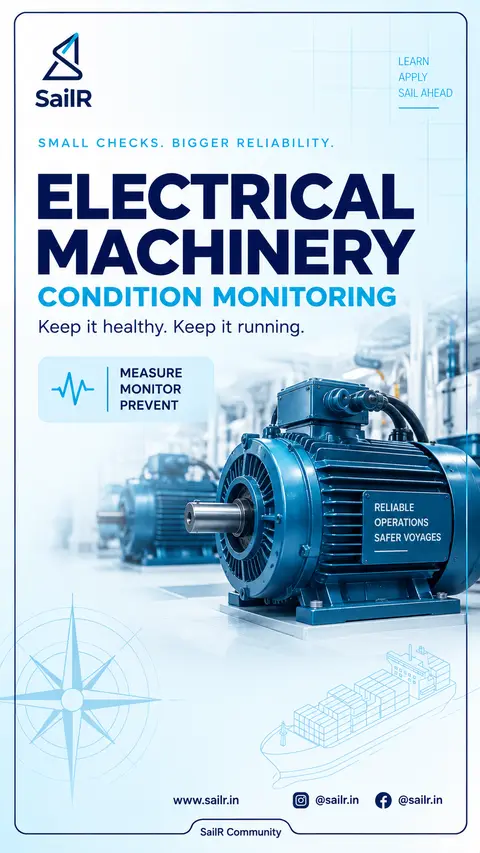
Slide 1 · LEARN
LEARN
APPLY
SAIL AHEAD
SMALL CHECKS. BIGGER RELIABILITY.
ELECTRICAL
MACHINERY
CONDITION MONITORING
Keep it healthy. Keep it running.
MEASURE
MONITOR
PREVENT
RELIABLE
OPERATIONS
SAFER VOYAGES
Slide 2 · ELECTRICAL MACHINERY
ELECTRICAL MACHINERY
CONDITION
MONITORING
Keep it reliable. Prevent unexpected failures.
For electrical machinery such as:
Electric Motors | Alternators
Two practical parameters to record
01
INSULATION RESISTANCE
Assesses the condition of electrical insulation.
MΩ
02
TEMPERATURE
Tracks winding and bearing thermal condition.
SUPPORTING PARAMETER
VIBRATION
A mechanical measurement that provides valuable information about bearings, imbalance, misalignment and looseness.
KEY TAKEAWAY
If the question forces you to choose two:
Insulation Resistance + Temperature
These are strong practical choices for assessing electrical-machine condition.
Ref: IEC 60034-1:2026 | IEC 60034-27-4:2018
LEARN
APPLY
SAIL AHEAD
Slide 3 · ELECTRICAL MACHINERY CONDITION MONITORING
ELECTRICAL MACHINERY CONDITION MONITORING
02
INSULATION RESISTANCE
Assesses the condition of electrical insulation.
LEARN
APPLY
SAIL AHEAD
HOW IS IT MEASURED?
Use an insulation-resistance tester ("Megger" type) which applies a DC test voltage and measures the resistance.
Measure between winding and earth.
Where applicable, also between phases or other insulation barriers.
Use the test voltage as per manufacturer's instructions and applicable standards.
INSULATION TESTER
> 1000 MΩ
BEFORE TESTING
ISOLATE
LOCK OUT
TEST
DISCHARGE
Ensure the equipment is de-energised and isolated.
Follow safe working procedures (e.g. lock out tag out).
After testing, discharge the windings safely to earth (as per manufacturer's instructions).
Do not apply a test voltage that could damage the equipment.
WHAT DOES IT REVEAL?
A falling trend may indicate deterioration of the insulation condition.
Possible contributors include:
Moisture or condensation
Contamination (salt, dust, oil)
Ageing of insulation
Insulation damage (thermal, mechanical, electrical)
Adverse operating environment
TYPICAL TREND
Insulation Resistance (MΩ)
Time
Trend analysis provides more useful condition information than relying on a single reading.
KEY TAKEAWAY
Regular insulation resistance measurements and trend analysis help identify changes in insulation condition.
Ref: IEC 60034-27-4:2018 | IEC 60034-1:2026
Slide 4 · 03/04
ELECTRICAL MACHINERY CONDITION MONITORING
LEARN
APPLY
SAIL AHEAD
03
TEMPERATURE
Tracks winding and bearing thermal condition.
WHAT TO MONITOR?
WINDING TEMPERATURE
BEARING TEMPERATURE
• Winding temperature
• Bearing temperature
• Temperature trend during operation
HOW IS IT MEASURED?
Embedded temperature detectors (RTDs, thermistors or other suitable detectors), where fitted.
Resistance method or other approved temperature measurement methods, as applicable.
Thermometer or thermal imaging for accessible surface temperatures.
RTD / Thermistor
Temperature meter (resistance method)
IR / Thermal camera
WHAT CAN A RISING TEMPERATURE INDICATE?
WINDING TEMPERATURE ↑
• Overload or excessive load
• Restricted cooling or inadequate ventilation
• Unbalanced operating conditions
• Internal electrical or winding abnormalities
BEARING TEMPERATURE ↑
• Abnormal bearing or operating condition
• Investigate lubrication, loading, alignment and cooling as applicable
IMPORTANT
IR / thermal camera measures ACCESSIBLE SURFACE TEMPERATURE.
It does NOT directly measure the internal winding hot-spot temperature.
KEY TAKEAWAY
Monitor temperature trends against the machine's specified limits and operating conditions.
Ref: IC 60034-1:2026
Slide 5 · 04/04
LEARN
APPLY
SAIL AHEAD
ELECTRICAL MACHINERY CONDITION MONITORING
04
VIBRATION
A key indicator of mechanical condition.
Helps detect changes related to bearings, imbalance, misalignment
and looseness in rotating machinery.
HOW IS IT MEASURED?
• Measure vibration at defined locations
on the bearing housing or other
appropriate machine locations.
• Measurements are taken in horizontal,
vertical and axial directions as applicable.
• Use the same measurement locations
for repeat readings to make trend
comparison meaningful.
Vibration Sensor
Vertical
Axial
Horizontal
WHAT CAN RISING VIBRATION INDICATE?
Bearing deterioration
Unbalance
Misalignment
Mechanical looseness
IMPORTANT TO NOTE
• Vibration levels should be evaluated using an applicable standard such as ISO 20816-3 for relevant machinery types and operating conditions.
• ISO 20816-3 applies to specified industrial machinery (including flexible-coupled electric motors) and has limitations (e.g. usual power and speed ranges).
• The standard provides vibration measurement and evaluation guidance. Detailed fault diagnosis (e.g. bearing faults) should use manufacturer guidance and additional diagnostic tools.
Typical Vibration Trend
Vibration Level (mm/s)
Time
A rising trend indicates a change in machine condition and should be investigated.
WHY IS IT USEFUL FOR ELECTRICAL MACHINERY?
Mechanical and electrical conditions can interact. A bearing problem can lead to increased vibration, abnormal operating condition and possible secondary effects on the machine.
KEY TAKEAWAY
Regular vibration monitoring and trend analysis help identify developing problems and support reliable operation.
Ref: ISO 20816-3:2022 | ABB Motor Condition Diagnostics (Guidance)
Drafted by SailR from our daily lessons. AI-drawn illustration. Simplified to explain the idea, not to scale. Last updated 19 Oct 2026.
Spotted a mistake?