The slides, written out
AI-drawn illustration. Simplified to explain the idea, not to scale.
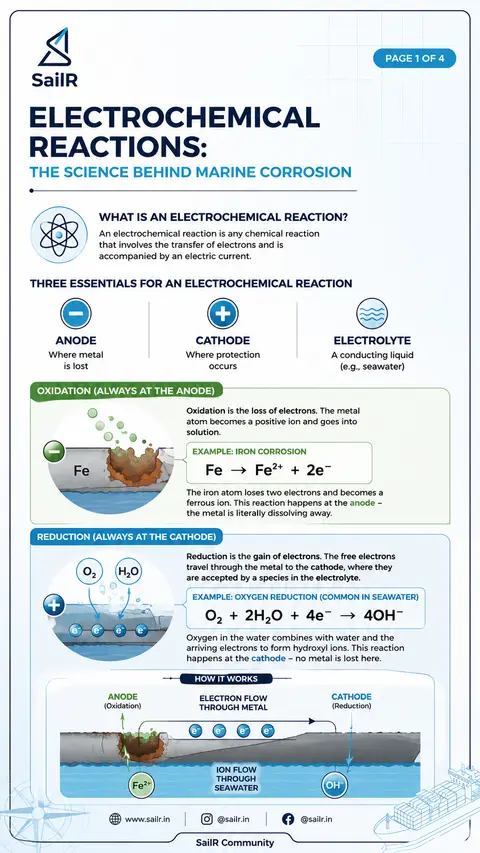
Slide 1 · ELECTROCHEMICAL
ELECTROCHEMICAL
REACTIONS:
THE SCIENCE BEHIND MARINE CORROSION
WHAT IS AN ELECTROCHEMICAL REACTION?
An electrochemical reaction is any chemical reaction
that involves the transfer of electrons and is
accompanied by an electric current.
THREE ESSENTIALS FOR AN ELECTROCHEMICAL REACTION
ANODE
Where metal
is lost
CATHODE
Where protection
occurs
ELECTROLYTE
A conducting liquid
(e.g., seawater)
OXIDATION (ALWAYS AT THE ANODE)
Oxidation is the loss of electrons. The metal
atom becomes a positive ion and goes into
solution.
EXAMPLE: IRON CORROSION
Fe → Fe2+ + 2e−
The iron atom loses two electrons and becomes a
ferrous ion. This reaction happens at the anode –
the metal is literally dissolving away.
REDUCTION (ALWAYS AT THE CATHODE)
Reduction is the gain of electrons. The free electrons
travel through the metal to the cathode, where they
are accepted by a species in the electrolyte.
EXAMPLE: OXYGEN REDUCTION (COMMON IN SEAWATER)
O2 + 2H2O + 4e− → 4OH−
Oxygen in the water combines with water and the
arriving electrons to form hydroxyl ions. This reaction
happens at the cathode – no metal is lost here.
HOW IT WORKS
ANODE (Oxidation)
ELECTRON FLOW THROUGH METAL
CATHODE (Reduction)
ION FLOW THROUGH SEAWATER
Fe2+
OH−
Slide 2 · GALVANIC CORROSION
GALVANIC CORROSION:
WHY DISSIMILAR METALS CORRODE
WHAT IS GALVANIC CORROSION?
Galvanic corrosion occurs when two dissimilar metals are electrically connected in the presence of an electrolyte (seawater). The more active (anodic) metal corrodes preferentially, while the more noble (cathodic) metal is protected.
BRONZE PROPELLER (MORE NOBLE) CATHODE
STEEL HULL (MORE ACTIVE) ANODE
CONDITIONS REQUIRED
• Two dissimilar metals
• Electrical connection between them
• Presence of an electrolyte (Seawater)
MARINE EXAMPLE
A bronze propeller on a steel hull. Without adequate cathodic protection and shaft bonding arrangements, the adjacent steel structure may become anodic and corrode preferentially.
ELECTRICAL CONNECTION
STEEL HULL
BRONZE PROPELLER
SEAWATER (ELECTROLYTE)
ANODE ( Corrodes )
CATHODE ( Protected )
GALVANIC SERIES IN SEAWATER
Metals are ranked by their natural electrochemical potential. The further apart two metals are, the greater the driving voltage and the higher the risk of corrosion.
ACTIVE (ANODIC) METALS
More likely to corrode
INCREASING NOBILITY
NOBLE (CATHODIC) METALS
More resistant / Protected
MAGNESIUM
ZINC
ALUMINIUM
MILD STEEL (IRON)
COPPER
BRONZE
STAINLESS STEEL
GOLD
KEY TAKEAWAY
The more active (anodic) metal corrodes. Proper material selection, isolation, and cathodic protection are essential to prevent galvanic corrosion in marine systems.
Slide 3 · PREVENTING GALVANIC CORROSION
PREVENTING GALVANIC CORROSION:
SIX PRACTICAL CORROSION PREVENTION METHODS
A combination of these methods gives the best protection for hull structures and marine equipment.
1 SACRIFICIAL ANODES
A more active metal is attached to the hull to corrode preferentially, protecting the steel.
Common Materials:
Zinc, Aluminium, Magnesium
Inspect regularly and replace when they reach the minimum allowable remaining mass as per class/manufacturer limits.
2 ICCP SYSTEMS
An external DC power source drives current through inert anodes to protect the hull. Maintains the hull at a protection potential appropriate for the vessel.
Modern Systems Use:
MMO-coated titanium or platinized titanium anodes
Protection Potential:
Commonly around −0.80 to −0.90 V vs Ag/AgCl (seawater reference electrode)
3 PROTECTIVE COATINGS
High-performance coatings isolate the hull from the electrolyte, breaking the electrolytic circuit.
Examples:
Epoxy primers, anti-corrosive systems, anti-fouling top coats
Even small coating damage can create local anodes — keep coatings in good condition.
4 ELECTRICAL ISOLATION
Isolate dissimilar metals electrically using insulating gaskets, sleeves, or washers. This prevents the galvanic cell from forming.
Applications:
Pipe flanges, valve connections, through-hull fittings, etc.
Use approved insulating materials suitable for marine environments.
5 PROPER MATERIAL SELECTION & AREA RATIOS
Avoid large cathodic areas coupled to small anodic areas. If dissimilar metals are unavoidable, keep area ratios favourable and use protective coatings.
SMALL ANODE
LARGE CATHODE
LARGE ANODE
SMALL CATHODE
6 INSPECTION & MAINTENANCE
Regular inspection ensures the protection systems are working effectively.
Check sacrificial anodes for wastage.
Verify ICCP reference electrode readings and rectifier output.
Inspect coatings in critical areas and repair defects.
Focus on high-risk areas: sea chests, rudder trunks, stern frame, seawater inlets.
BEST PRACTICE
Protective coatings and cathodic protection systems work together — never rely on only one method.
Slide 4 · MARINE ENGINEER
MARINE ENGINEER
INSPECTION CHECKLIST
PROTECT TODAY, SAIL TOMORROW
1. SACRIFICIAL ANODES
Inspect anodes for wastage and damage.
Replace when they reach the manufacturer's or class-required minimum remaining mass.
2. ICCP SYSTEM
Verify reference electrode readings are within the target range.
Check rectifier output (voltage & current).
Confirm system alarms and monitoring status.
3. HULL COATINGS
Inspect hull for coating damage, blistering, cracking or disbondment.
Repair coating holidays and pinholes promptly.
4. CONNECTIONS & ISOLATION
Check insulating gaskets, sleeves and washers at flanges and fittings.
Ensure dissimilar metals are properly isolated.
HIGH-RISK AREAS
Inspect these zones carefully during every drydock.
SEA CHESTS
Prone to coating damage and corrosion.
RUDDER TRUNK
Constantly immersed and high corrosion risk.
STERN FRAME
Coating damage and turbulence increase risk.
SEAWATER INLETS
Check for coating condition and anode efficiency.
KEY LEARNING POINTS
Oxidation occurs at the anode (metal loss).
Reduction occurs at the cathode (protection).
Seawater acts as the electrolyte, completing the electrochemical circuit.
Cathodic protection supplements, but does not replace, protective coatings.
Regular inspection & maintenance extend asset life and reduce corrosion risk.
BEST PRACTICE
A well-protected ship is safer, more efficient and more economical.
Drafted by SailR from our daily lessons. AI-drawn illustration. Simplified to explain the idea, not to scale. Last updated 19 Oct 2026.
Spotted a mistake?