The slides, written out
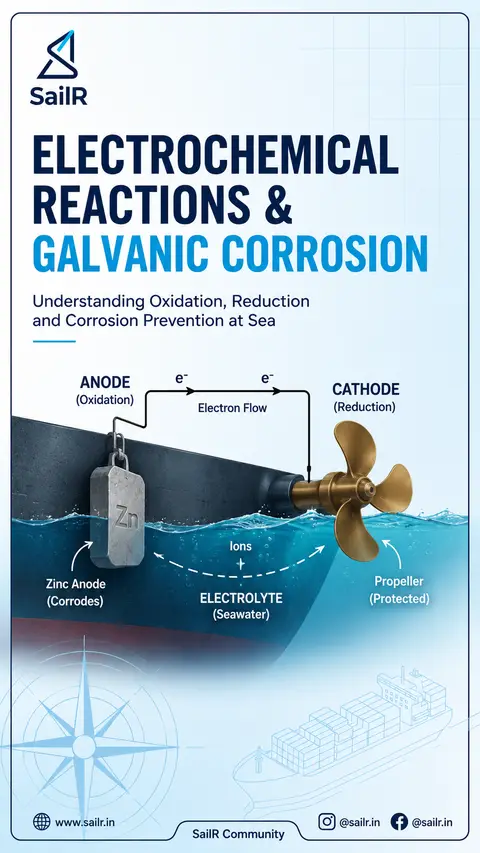
AI-drawn illustration. Simplified to explain the idea, not to scale.
Slide 1 · ELECTROCHEMICAL
ELECTROCHEMICAL
REACTIONS &
GALVANIC CORROSION
Understanding Oxidation, Reduction
and Corrosion Prevention at Sea
e⁻ e⁻
ANODE
(Oxidation)
Electron Flow
CATHODE
(Reduction)
Ions
Zinc Anode
(Corrodes)
ELECTROLYTE
(Seawater)
Propeller
(Protected)
Slide 2 · HOW CORROSION
HOW CORROSION
HAPPENS
Electrochemical reactions occur when electrons flow from the anode to the cathode through an electrolyte (seawater).
THE CORROSION CELL
ANODE (Oxidation)
e⁻
CATHODE (Reduction)
Zn
Ions
ELECTROLYTE (Seawater)
OXIDATION (ANODE REACTION)
Loss of electrons
Metal goes into solution as positive ions (cations)
Occurs at the anode
Metal is destroyed (corroded)
EXAMPLE:
Zinc oxidation (sacrificial anode)
Zn → Zn²⁺ + 2e⁻
REDUCTION (CATHODE REACTION)
Gain of electrons
Substance in the electrolyte accepts electrons
Occurs at the cathode
No metal loss (protected)
EXAMPLES:
1. Oxygen reduction (neutral/alkaline seawater)
O₂ + 2H₂O + 4e⁻ → 4OH⁻
2. Hydrogen evolution (acidic / oxygen-starved environments)
2H⁺ + 2e⁻ → H₂
EXAM TIP – REMEMBER THIS!
ANODE = OXIDATION
= METAL LOSS (CORROSION)
CATHODE = REDUCTION
= NO METAL LOSS (PROTECTED)
The whole process is a continuous electron transfer cycle.
Slide 3 · GALVANIC CORROSION
GALVANIC CORROSION
WHY IT HAPPENS
Galvanic corrosion occurs when two dissimilar metals are electrically connected in a conductive electrolyte (seawater).
THE GALVANIC CORROSION PROCESS
ANODE
(Less noble metal)
CORRODES
e⁻
Electron Flow
CATHODE
(More noble metal)
PROTECTED
ELECTROLYTE (from anode) + (Seawater)
Oxidation occurs at the anode. Metal dissolves into the electrolyte as ions.
Reduction occurs at the cathode. No metal loss. The cathode is protected.
THE GOLDEN RULE
SMALL ANODE + LARGE CATHODE = VERY RAPID CORROSION
A small anode connected to a large cathode produces a high corrosion rate at the anode because the large cathode demands lots of electrons.
Always try to make the anode area large relative to the cathode.
TYPICAL GALVANIC SERIES IN SEAWATER (Most Anodic → Most Cathodic)
MAGNESIUM
ALUMINIUM
ZINC
STEEL
BRONZE
STAINLESS STEEL (PASSIVE)
Most Active (Anodic)
Most Noble (Cathodic)
GALVANIC CORROSION REQUIRES 3 THINGS
Dissimilar Metals
Electrical Contact
Conductive Electrolyte (Seawater)
Slide 4 · PREVENTING
PREVENTING
GALVANIC CORROSION
Practical methods to break the galvanic cell
and protect ship structures and equipment.
1
ELECTRICAL
INSULATION
Break the electrical
connection between
dissimilar metals.
Non-metallic
Gaskets
Insulating
Sleeves
Insulating
Washers
Commonly used in flanges,
bolted joints, and connections
(e.g., aluminium superstructure
to steel hull).
2
KEEP ELECTROLYTE
OUT
A galvanic cell cannot exist
without the electrolyte.
Seal joints and crevices
Keep surfaces clean and dry
Maintain paint systems and
sealants
Keep it dry, clean
and well protected.
3
PROTECTIVE
COATINGS
Isolate metals from the
electrolyte with high-quality
protective coatings.
EPOXY
COATING
MARINE
PAINT
Coat both metals where practical
If only one can be coated, the more
noble (cathodic) metal is generally
preferred
Inspect and maintain coatings
regularly
Good coatings dramatically
reduce galvanic corrosion.
4
TRANSITION JOINTS
Use explosion-bonded transition joints
for permanent dissimilar metal connections.
Aluminium
Steel
Explosion-bonded
interface
No crevices
Can be painted
and protected
Ideal for steel–aluminium
connections
5
CATHODIC PROTECTION
Use sacrificial anodes to protect all metals
in a galvanic couple.
Anodes are less
noble than both
metals
They corrode
sacrificially
Protect steel,
bronze, and other
noble metals
ZINC
(Zn)
ALUMINIUM
(Al)
MAGNESIUM
(Mg)
KEY TAKEAWAYS
Oxidation
occurs at
the anode.
Metal loss.
Reduction
occurs at
the cathode.
No metal loss.
Galvanic corrosion
requires dissimilar
metals, electrical
contact and an
electrolyte.
Good design,
insulation,
coatings and
cathodic
protection
prevent corrosion.
Prevention is
always better
than repair –
protect the ship,
protect the mission.
Drafted by SailR from our daily lessons. AI-drawn illustration. Simplified to explain the idea, not to scale. Last updated 19 Oct 2026.
Spotted a mistake?