The slides, written out
AI-drawn illustration. Simplified to explain the idea, not to scale.
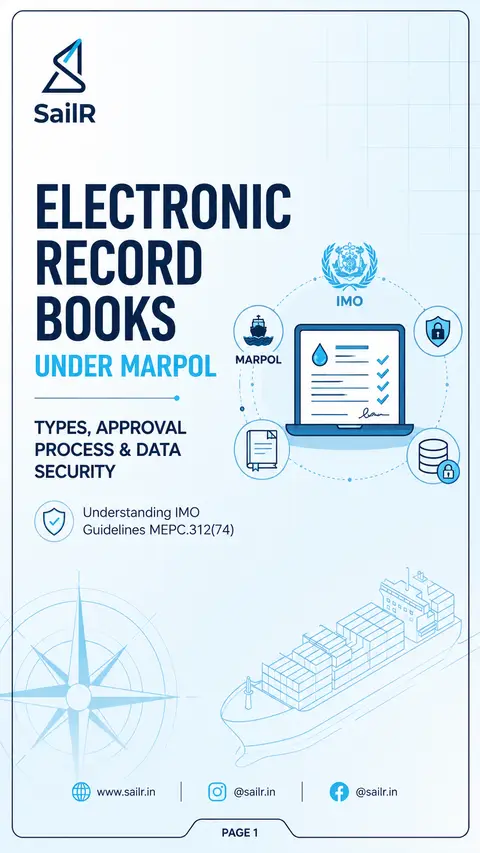
Slide 1 · ELECTRONIC
ELECTRONIC
RECORD
BOOKS
UNDER MARPOL
TYPES, APPROVAL
PROCESS & DATA
SECURITY
Understanding IMO
Guidelines MEPC.312(74)
IMO
MARPOL
Slide 2 · TYPES OF ELECTRONIC
TYPES OF ELECTRONIC
RECORDS COVERED
Under MEPC.312(74) – Guidelines for the use of
Electronic Record Books under MARPOL
ANNEX I
OIL RECORD BOOK
PART I
Machinery space
operations
OIL RECORD BOOK
PART II
Cargo/ballast
operations
MARPOL Annex I
Regs 17.1 & 36.1
ANNEX II
CARGO
RECORD BOOK
MARPOL Annex II
Reg 15.1
ANNEX V
GARBAGE RECORD BOOK
PART I (ALL SHIPS)
MARPOL Annex V
Reg 10.3
GARBAGE RECORD BOOK
PART II (FIXED/FLOATING
PLATFORMS)
MARPOL Annex V
Reg 10.3
ANNEX VI
OZONE-DEPLETING
SUBSTANCES (ODS)
RECORD BOOK
Reg 12.6
RECORD OF TIER &
ON/OFF STATUS OF
MARINE DIESEL ENGINES
Reg 13.5.3
RECORD OF FUEL
OIL CHANGEOVER
Reg 14.6
RECORD BOOK OF
ENGINE PARAMETERS
NOx Technical Code 2008,
para 6.2.2.7
NOTE
A separate set of guidelines,
MEPC.372(80), covers the
Ballast Water Record Book
under the BWM Convention.
Slide 3 · FLAG STATE
FLAG STATE
APPROVAL PROCESS
How Electronic Record Books (ERBs) are
approved for use on board
1
SELECT / DEVELOP ERB SYSTEM
The shipowner or company selects or
develops an ERB system that meets the
functional requirements of the Guidelines.
2
SUBMISSION TO FLAG
ADMINISTRATION
The system is submitted to the Flag State
Administration for review and evaluation.
3
COMPLIANCE REVIEW
The Administration checks that the system
satisfies:
• Data integrity & manipulation prevention
• Audit logging & role-based access control
• Retention of records as per MARPOL
• Hard-copy verified true copy on demand
• Compatibility with MARPOL formats &
visible amendments
4
FLAG APPROVAL ISSUED
If the ERB passes, the Flag Administration
issues an approval, authorising the ship to
use the ERB in lieu of traditional paper
record books.
5
SYSTEM UPDATES MAINTAINED
The approved ERB must be kept updated
to reflect MARPOL amendments before
they enter into force, without losing or
corrupting existing records.
REQUIRED FEATURES
Tamper-proof
entries
Ability to produce
hard-copy verified true copy
Retention
compliance for
all records
Amendment
visibility &
transparency
Regular updates
as per MARPOL
amendments
Slide 4 · WHY ELECTRONIC
WHY ELECTRONIC
RECORD BOOKS?
Advantages of ERBs & Security Measures
for Data Integrity
ADVANTAGES OF ERBs
FASTER & EFFICIENT AUDITS
Records are easy to review,
export and present.
QUICK SEARCH & RETRIEVAL
Find any entry in seconds
with powerful search tools.
REDUCED PAPERWORK
No more storing years of
hard-copy record books.
LOWER HUMAN ERROR
System validations ensure
accurate and compliant entries.
TRANSPARENT AUDIT TRAIL
Every change is logged, traceable
and visible.
ENVIRONMENTALLY FRIENDLY
Supports sustainable operations
and reduces paper use.
DATA INTEGRITY &
SECURITY MEASURES
ROLE-BASED ACCESS CONTROL
Unique user ID & password for
every officer. No shared logins.
ELECTRONIC SIGNATURES
Entries signed digitally with secure
authentication as per flag State
standards.
AUDIT LOGGING
Automatically logs user, date/time (UTC),
type of action (new/amend/delete) and
retains logs for the required period.
TAMPER-EVIDENT RECORDS
Once saved, entries cannot be changed
without leaving a permanent trace.
AMENDMENT VISIBILITY
All amendments are clearly marked with
reason, user ID and timestamp.
DATA SOURCE PROTECTION
Sensor data is protected from
manipulation. Any change in data
source is logged.
HARD-COPY OUTPUT
System can produce a printed,
verified true copy on demand,
signed by the Master.
EVERY AMENDMENT REMAINS PERMANENTLY TRACEABLE.
FOLLOW SAILR FOR MARITIME COMPLIANCE INSIGHTS
Drafted by SailR from our daily lessons. AI-drawn illustration. Simplified to explain the idea, not to scale. Last updated 19 Oct 2026.
Spotted a mistake?