The slides, written out
AI-drawn illustration. Simplified to explain the idea, not to scale.
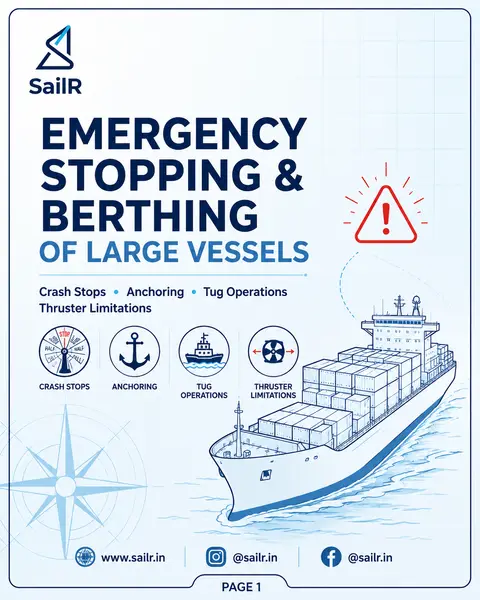
Slide 1 · EMERGENCY
EMERGENCY
STOPPING &
BERTHING
OF LARGE VESSELS
Crash Stops • Anchoring • Tug Operations
Thruster Limitations
CRASH STOPS
ANCHORING
TUG OPERATIONS
THRUSTER LIMITATIONS
Slide 2 · 1
1. EMERGENCY
STOPPING MANŒUVRES
A. CRASH STOP (FULL ASTERN)
ENGINE ORDER SEQUENCE
• Order "Stop" followed by "Full Astern".
• For fixed-pitch direct-drive diesel engines, RPM must be reduced to zero or near-zero before engaging astern.
• The vessel continues ahead due to momentum even after astern thrust develops.
• On vessels fitted with a single right-handed propeller, transverse thrust may initially swing the stern to port.
• IMO Resolution A.601(15) requires wheelhouse manoeuvring information posters onboard.
• Large tankers may require up to approximately 15 ship lengths to stop under certain loading and environmental conditions.
1. STOP
2. FULL ASTERN
3. RPM DECAYS TO ZERO
WHAT HAPPENS DURING CRASH STOP
SHIP'S FORWARD MOTION
ASTERN THRUST
Ship continues moving ahead
Wake washes forward
Deceleration increases
Transverse thrust may swing stern to port
TYPICAL STOPPING DISTANCE
Up to approx. 15 ship lengths
STOP
B. EMERGENCY ANCHOR STOPPING
EMERGENCY ANCHOR DEPLOYMENT SEQUENCE
• Emergency anchoring should only be attempted at very low speed.
• Anchoring equipment is not designed to stop a vessel at normal sea speed.
• Brake application must be controlled progressively to avoid shock loading on the cable, windlass, and stopper arrangements.
• Anchor drag can assist in rapid deceleration in confined waters.
• Vessel may swing due to wind and tidal forces during anchor-assisted stopping.
• Follow vessel manoeuvring manual and Master's judgement.
1. ANCHORS STAND-BY. Walk out clear of hawsepipe.
2. ORDER TO DROP THE ANCHOR. Let go the anchor smoothly.
3. CONTROLLED BRAKING. Apply brake progressively.
4. ANCHOR DRAG SLOWS THE SHIP. Monitor movement. Be ready to slip or cut if required.
WARNING: Dropping an anchor from higher speed can cause severe damage to windlass, deck gear, or lead to chain parting.
Slide 3 · 2
2. BERTHING IN
STRONG ONSHORE WIND
Use tide • Tugs • Anchors • Technique together for a safe berth
1. TIDE MANAGEMENT
Prefer slack water where possible.
If a stream exists, choose stem tide (heading into the current).
Currents are generally more predictable than wind at low speed.
2. TUG POSITIONING
WIND
Make tugs fast before close approach.
FORWARD TUG (PUSHES OFF)
Use offshore-quarter positions for maximum leverage.
Aft tug gives greater turning moment under headway (pivot forward).
AFT TUG (PUSHES OFF)
3. ANCHOR ASSISTANCE
Anchor selection depends on berth configuration and the intended pivot effect.
Use anchor only when swing room is available.
Avoid anchor use where risk of fouling the berth or other ships exists.
EXAMPLE USE
Anchor holds the bow off the berth while tugs control the approach.
4. BERTHING STRATEGY
Approach with the bow into the wind (stem the wind).
Use a controlled angled (V-approach).
Avoid parallel approaches in strong onshore wind.
Pass spring lines early – first line should be a spring from well forward or aft to control fore-and-aft movement.
GOOD APPROACH (V-APPROACH)
WIND
Maintain control, keep bow into wind, use tugs to swing and ease alongside.
BAD APPROACH (PARALLEL)
WIND
Wind pushes the ship onto the berth. High risk of contact and loss of control.
5. KEY REMINDERS
Pilot-Master exchange must include tug power, configuration and plan.
Ensure adequate bollard pull for the expected conditions.
Pass spring lines early to control ship's movement.
Use engine in harmony with tugs at all times.
Clear communication between bridge, tugs and engine room.
Slide 4 · 3
3. THRUSTER EFFECTIVENESS
IN HIGH FREEBOARD VESSELS
Thrusters are a valuable tool, but windage can overwhelm their capability.
A. THRUSTER PERFORMANCE BASICS
Bow and stern thrusters are most effective at very low speed (dead in the water or near-stopped).
With little or no headway, combined fore and aft thrust can move the ship laterally with good precision (pivot point approx. amidships).
Thruster effectiveness reduces significantly as vessel speed increases due to propeller wash and water flow through the tunnel.
BOW THRUSTER
PIVOT POINT (AMIDSHIPS) AT LOW SPEED
STERN THRUSTER
= LATERAL MOVEMENT
B. WIND FORCE vs THRUSTER FORCE
WIND FORCE (SIDE FORCE)
THRUSTER SIDE FORCE (EFFECTIVE)
WIND
On high freeboard vessels, strong beam winds can easily exceed the available lateral force from thrusters.
High windage vessels such as container ships and PCC/PCTCs are especially vulnerable to strong beam winds.
C. THRUSTER LIMITATION WITH SPEED
DEAD IN THE WATER
VERY LOW SPEED
MODERATE SPEED
HIGH SPEED
100% EFFECTIVE
GOOD EFFECTIVENESS
REDUCED (30–50%)
POOR (>50% REDUCTION)
As speed increases, propeller wash and flow interference reduce thruster efficiency significantly.
D. THRUSTER USE IN PRACTICE
BERTHING (FINISHING TOUCH)
UNBERTHING (ONSHORE WIND)
WIND
BOW THRUSTER
STERN THRUSTER
TUG ASSIST
Use thrusters for fine positioning in the last few metres. Rely on tugs for primary lateral control in strong winds.
Use stern thruster to push the stern clear of the berth first, then use bow thruster with headway and tug assistance.
E. BEST PRACTICE & OPERATIONAL NOTE
Plan for tug assistance as primary force in strong beam winds.
Use thrusters primarily for fine adjustments and holding the ship.
Account for wind reduction in thruster effectiveness during manoeuvre planning.
Follow vessel's manoeuvring manual and wheelhouse poster (IMO Resolution A.601(15)).
Maintain clear communication between bridge, tugs and engine room at all times.
OPERATIONAL NOTE: Environmental conditions, wind direction, vessel design and loading condition must always be considered by the Master and Pilot.
Drafted by SailR from our daily lessons. AI-drawn illustration. Simplified to explain the idea, not to scale. Last updated 18 Oct 2026.
Spotted a mistake?