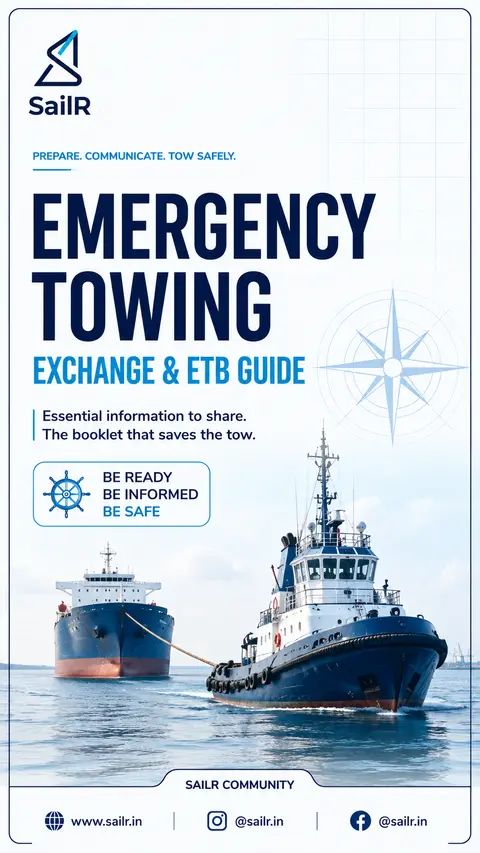
The slides, written out
AI-drawn illustration. Simplified to explain the idea, not to scale.
Slide 1 · PREPARE
PREPARE. COMMUNICATE. TOW SAFELY.
EMERGENCY
TOWING
EXCHANGE & ETB GUIDE
Essential information to share.
The booklet that saves the tow.
BE READY
BE INFORMED
BE SAFE
Slide 2 · SLIDE 1 OF 4
BEFORE THE FIRST
HAWSER GOES ACROSS
Safe towing starts with a complete information exchange.
1. YOUR SHIP'S CONDITION
Vessel name, call sign & IMO number
Position, course & speed
Nature of emergency (be blunt & accurate)
Draft (fore & aft) & displacement
Seaworthiness – damage, freeboard, list & trim
Status of propulsion, steering & on deck power
Crew on board & POB, injuries
Weather, sea state, wind & current
Immediate hazards – lee shore, traffic, shallow water, etc.
2. TOWING CONNECTION INFORMATION
Forward & aft strong points
Type, dimensions & applicable SWL / working strength
Towing brackets, bitts or other approved points
Fairlead details – internal dimensions & position
Chafing chain, where available
Towing pennant wire – diameter, length & strength
Insurance wire, where carried – diameter, length & strength
Shackles, spare wires, messengers & other available equipment
Possibility of using ship's winches to heave the line
3. WORKING ARRANGEMENTS & TERMS
Agree towing plan – bow or stern tow, heaving line & towline supply
Method of connection – bollard, anchor chain or main bridle
VHF working channels, backup communication & hand signals
Salvage (LOF / negotiated) or towage contract – get it in writing
Safe towing speed considering weather & both vessels
Signals to be exhibited – NUC, RAM, towing lights/shapes
Both Masters aligned on the arrangements before coming alongside
TELL THEM EVERYTHING ABOUT YOUR CONDITION, YOUR CONNECTION POINTS & THE WORKING METHOD BEFORE YOU ARE ALONGSIDE.
Slide 3 · SLIDE 2 OF 4
EMERGENCY TOWING
BOOKLET (ETB)
Your ship's towing blueprint – all the
critical information in one place.
1. SHIP SPECIFIC DATA
Ship's name, call sign and IMO number
Anchor details – weight, type, shackle & connection details
Cable & chain details – lengths, connection details, proof loads
Height of mooring deck(s) above base line
Draft range
Displacement range
Equipment Number (EN)
Calculated in accordance with IACS UR A1.2, as amended,
considering deck cargoes at the ship's nominal capacity
condition in accordance with IACS UR A2.0.
2. DRAWINGS & CAPACITIES
Towing equipment locations
Strong point locations
Assembly and rigging diagrams
Equipment capacities
Connection point SWLs (Safe Working Loads)
THE ETB TURNS SHIP SPECIFIC
TOWING INFORMATION INTO AN
IMMEDIATELY USABLE PLAN.
Keep it updated.
Keep it accessible.
Keep it ready.
Slide 4 · SLIDE 3 OF 4
PLAN THE TOW
BEFORE THE POWER FAILS
The ETB must account for practical emergency towing limitations.
1. RIGGING & DECK OPERATIONS
Fore and aft towing arrangements
Bridle and towline rigging diagrams
Crew organization and task allocation
Required tools and safety equipment
Fairleads and towing leads
Avoid sharp corners, edges and stress concentrations
2. DEAD SHIP CONSIDERATIONS
Loss of winch power
Heaving and handling heavy lines
Available emergency equipment
Rapid disconnection arrangements
Rudder and propeller shaft preparations
Ballast and trim considerations
3. OPERATIONAL LIMITS
Limiting sea states
Recommended / established towing speeds
Weather limitations
Ship's damaged condition
Steering and propulsion status
A TOWING PLAN MUST STILL WORK
WHEN THE SHIP'S NORMAL SYSTEMS DO NOT.
Slide 5 · SLIDE 4 OF 4
MAKE THE ETB
AVAILABLE WHEN
IT MATTERS
Communication, accessibility and regulatory updates you must know.
1. COMMUNICATION PLAN
THE MASTER SHOULD BE ABLE TO PROVIDE INFORMATION ON:
Damage and seaworthiness
Steering
Propulsion
On deck power
Onboard towing equipment
Emergency rapid disconnection system
Forward and aft towing points
Strong points and applicable SWLs (Safe Working Loads)
Towing equipment dimensions and capacities
Relevant ship particulars
2. ETB COPIES ON BOARD
MINIMUM 3 COPIES:
1 Bridge
2 Forecastle space
3 Ship's office or Cargo Control Room
3. SHORE-SIDE ACCESS
Copy held by owner/operator.
Available to towage / salvage company early in an emergency.
Electronic format recommended for rapid distribution.
4. 2028 REGULATORY UPDATE
FROM 1 JANUARY 2028
Emergency towing arrangements become mandatory for NON-TANKER SHIPS OF 20,000 GT AND ABOVE constructed on or after 1 January 2028, under the relevant SOLAS amendments.
SOLAS II-1/Reg. 3-4
IMO RESOLUTION MSC.549(108)
SOURCE: SOLAS II-1/Reg. 3-4 | IMO MSC.1/Circ.1255/Rev.1 | IMO MSC.549(108) IACS UR A1.2 (as amended) & IACS UR A2.0
Drafted by SailR from our daily lessons. AI-drawn illustration. Simplified to explain the idea, not to scale. Last updated 19 Oct 2026.
Spotted a mistake?