Enclosed space entry on ships: what counts as one, gas testing limits and precautions before entry
- ETO
- MEO Class 4
- MEO Class 2
- UK EOOW
- UK Management
- 2nd Mate
- times asked
- 60
- times asked
- questions
- 7
- questions
- last asked
- 2026
- last asked
An enclosed space can look empty and still hold air that kills in a few breaths. Here is how the current IMO guidance defines one, what the gas meter must read, and what has to be in place before anyone goes in.
The slides, written out
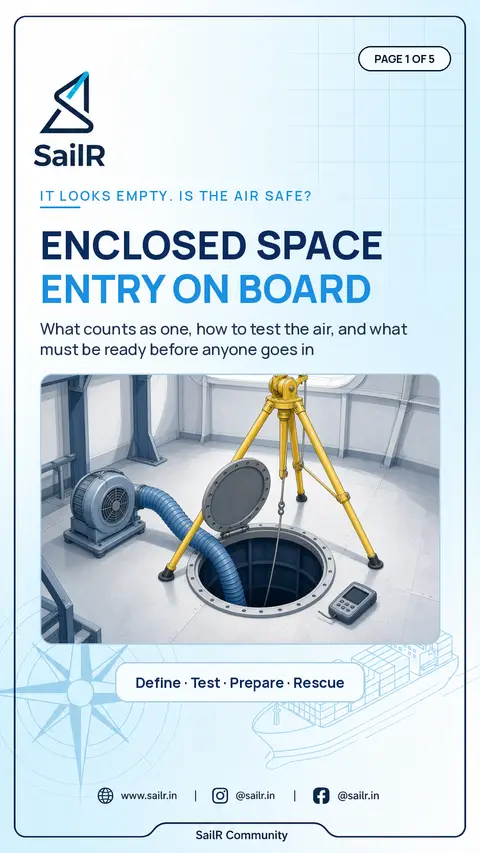
AI-drawn illustration. Simplified to explain the idea, not to scale.
Slide 1 · It looks empty
It looks empty. Is the air safe? Enclosed space entry on board: what counts as one, how to test the air, and what must be ready before anyone goes in. The four steps are define, test, prepare and rescue.
Slide 2 · What counts as one
What counts as one. A space counts as enclosed when it may hold bad air and has any one of these traits: limited openings for entry and exit, inadequate ventilation, or it is not designed for continuous occupancy. Examples are bilge spaces, tanks, pump-rooms, chain lockers and engine crankcases. A space connected by a door, even a watertight one, is treated as hazardous until it has been tested. Every ship should keep an Enclosed Space Register. Ref: IMO Res. MSC.581(110), paras 2.1, 2.2, 2.8, 4.2.
Slide 3 · Testing the air
Testing the air. A portable gas meter samples the space at the top, the middle and the bottom. Steady readings needed before entry are 20.9% oxygen, carbon dioxide below 0.5%, flammable gas below 1% of the lower flammable limit, and toxic gases below 50% of their occupational exposure limit. Stop ventilation for about 10 minutes and let conditions settle before testing. Gases can layer, so sample at several levels. An oxygen or flammable reading does not show toxic gas. SOLAS XI-1/7 requires a portable meter for oxygen, flammable gases or vapours, hydrogen sulphide and carbon monoxide, with means to calibrate it. Ref: IMO Res. MSC.581(110), paras 7.2, 7.4, 7.6, 7.7, App 2 note 2. SOLAS XI-1/7.
Slide 4 · Before anyone goes in
Before anyone goes in. The order is permit, isolate, ventilate, test and attend. The permit is issued by the master or a nominated responsible person and is valid for 8 hours at most. Blank pipelines and valves and isolate electrical power; the safety management system may need an electrical isolation permit. No single person entry is allowed, and an attendant stays at the entrance with tested communication. Rescue and resuscitation gear is placed at the entrance, and entrants wear personal gas detectors. Ref: IMO Res. MSC.581(110), paras 3.11, 5.1 to 5.3, 6.5, App 2.
Slide 5 · When it goes wrong
When it goes wrong. When a hold's hatch is open the hold air can clear, but bad air stays trapped in an enclosed ladder trunk whose bottom opening is blocked by cargo. The attendant stays out, raises the alarm and never enters before help arrives. Known or suspected bad air needs positive-pressure breathing apparatus, and an emergency escape breathing device is not for entry. Crew with entry or rescue duties hold an entry and rescue drill every 2 months. Common mistake: an open hatch is not proof of safe air. In 2024, three port workers in India died in coal-hold ladder trunks. Ref: MSC.581(110) 6.4, 8.5, 9.2, 10.3.1, App 1. SOLAS III/19.3.3. DGS Circular 23 of 2024.
What it is
An enclosed space is any space that may contain a hazardous atmosphere or lack oxygen and has any one of three traits: limited openings for entry and exit, inadequate ventilation, or a design that was never meant for continuous human occupancy. One trait is enough. (MSC.581(110), para 2.1)
The IMO list is wide on purpose. It names cargo holds, bilge spaces, ballast and other tanks, pump-rooms, chain lockers and engine crankcases, and it says the list is not limited to these. For an engineer that puts the crankcase door and the bilge well in the same category as a ballast tank. (MSC.581(110), para 2.1)
The current text adds two terms that change how you think about a door. A connected space is one joined to a possibly hazardous space by permanent or temporary means, such as a door. Even a watertight manual door counts, because nobody outside can tell whether it is open, closed or properly sealed. A connected space is treated as hazardous until testing proves otherwise. An adjacent space only shares a boundary, so it becomes dangerous if that barrier fails. (MSC.581(110), paras 2.2, 2.3)
These recommendations are now in resolution MSC.581(110), adopted on 27 June 2025. They replace A.1050(27), which the IMO Assembly revoked in December 2025. If your company procedures still quote A.1050(27), they are quoting a revoked text. (MSC.581(110), operative para 3; LR Class News 04/2026)
Why it matters
Bad air gives no warning. A space filled with carbon dioxide or another toxic gas looks normal, and nothing you can see or smell will alarm you. (MSC.581(110), para 10.5.8)
The margins are small. Carbon dioxide at 4% may cause serious oxygen deprivation, permanent brain damage, coma or death. One deep breath of 100% nitrogen will prove fatal. (MSC.581(110), paras 10.5.3, 10.2.2)
The Indian record shows what happens when a space is entered without a test. DGS Circular 23 of 2024 describes two incidents at Indian ports in 2024 in which three port workers died. In both, they entered the enclosed Australian ladder trunk of a hold carrying coal, where the atmosphere was oxygen deficient and rich in methane, and the space had not been checked before entry. (DGS Circular 23 of 2024)
How it works on board
Testing comes first, and it starts with the fans off. Gas testing should be done with ventilation stopped and after conditions have stabilized. The example permit in the IMO text suggests stopping ventilation for about 10 minutes before the pre-entry readings are taken and recorded. (MSC.581(110), para 7.6; Appendix 2 note 2)
Gases layer inside a tank. Sample at as many levels and areas as needed to get a representative picture, and remember that some corners cannot be reached from outside. Flexible hoses or fixed sampling lines can reach remote areas without anyone going in. Test before entry and at regular intervals until the work is finished. (MSC.581(110), paras 7.2, 7.3)
The readings you need are steady values of 20.9% oxygen by volume, carbon dioxide below 0.5% (5,000 ppm), less than 1% of the lower flammable limit where flammable gas is possible, and less than 50% of the occupational exposure limit of any toxic gas. National requirements may differ. If the oxygen reading is below 20.9%, or there is even a low level of flammable or toxic gas, the space is treated as unsafe. (MSC.581(110), paras 6.5.3, 7.4)
An oxygen or flammable reading tells you nothing about toxicity, and the reverse is also true. The meter must suit the cargo or contents, and carbon dioxide sensors should work in an oxygen-depleted atmosphere. (MSC.581(110), paras 7.1, 7.7)
From the electrical side, isolation is part of the entry, not a separate job. The example permit asks whether the space has been segregated by blanking off or isolating connecting pipelines, valves and electrical power or equipment. The company system may also call for an energy isolation or electrical isolation permit. The Enclosed Space Register records lighting arrangements, including intrinsically safe lighting where appropriate. (MSC.581(110), para 5.3, para 4.2.8, Appendix 2 Section 1)
Working spaces such as bow thruster rooms and other machinery rooms that connect to cargo holds through doors, trunks or pipework should be treated as connected spaces. Use of certified safe type electrical equipment for an explosive atmosphere should be considered there. (MSC.581(110), para 10.3.2)
Once inside, ventilation keeps running. After any break the atmosphere is retested before re-entry, and if the ventilation fails everyone leaves at once. (MSC.581(110), para 8.3)
The rules
The mandatory rules sit in SOLAS, and the detailed method sits in the IMO recommendations:
SOLAS XI-1/7 requires every ship to which chapter I applies to carry portable atmosphere testing instruments able to measure at least oxygen, flammable gases or vapours, hydrogen sulphide and carbon monoxide, with suitable means of calibration. It entered into force on 1 July 2016. (SOLAS XI-1/7; MSC.380(94))
MSC.581(110) recommends at least two sets of gas detection equipment as required by SOLAS XI-1/7. (MSC.581(110), para 7.3)
SOLAS III/19.3.3 requires crew with enclosed space entry or rescue duties to take part in an entry and rescue drill at least once every two months. (SOLAS III/19.3.3; MSC.350(92))
Each drill covers protective equipment, communication, atmosphere instruments, rescue equipment, and first aid and resuscitation. (SOLAS III/19.3.6.2; MSC.350(92))
No one opens or enters without authorization from the master or a responsible person nominated by the master. A responsible person is at management level: master, chief mate, chief engineer officer or second engineer officer. (MSC.581(110), paras 2.6, 5.1)
The entry permit is never valid for longer than eight hours. (MSC.581(110), para 5.2)
Single person entry is not permitted. (MSC.581(110), para 3.11)
Every ship should have an Enclosed Space Register. (MSC.581(110), para 4.2)
At Indian ports, booby hatches of unused holds are kept closed and locked, accesses are marked with the space they serve, and shore personnel enter only with ship staff authorization. (DGS Circular 23 of 2024)
Common mistakes
The commonest is treating an open hatch as proof of safe air. The IMO text warns that an open door or hatch may wrongly be read as a sign of a safe atmosphere, and recommends an attendant or a physical barrier at the opening. (MSC.581(110), para 6.4)
Trusting the hold reading for the access trunk is the next one. When hatches are opened to ventilate a hold at discharge, the hazardous atmosphere often stays trapped in the enclosed ladder trunk, and that trunk is hard to ventilate until the cargo blocking its bottom has been removed. (MSC.581(110), paras 10.3.1.1, 10.3.1.2)
Going in after a collapsed colleague kills rescuers. The attendant never enters before help has arrived and the situation has been evaluated, and many accidents have been made worse by ill-equipped ad hoc rescue attempts. (MSC.581(110), paras 8.5, 11.2)
Using an EEBD to enter is wrong. Where the atmosphere is known or suspected to be unsafe, wear positive-pressure breathing apparatus. Air-purifying respirators, dust masks and canister masks should not be used, and EEBDs are not suitable for entry. (MSC.581(110), para 9.2)
In exams
Asked 60 times across 7 different questions, most recently in 2026. Asked most in ETO (30), MEO Class 4 (20), MEO Class 2 (3), UK EOOW (3).
Sources
- IMO Resolution MSC.581 110 , Revised recommendations for entering enclosed spaces aboard ships adopted 27 June 2025 , paras 1.2, 1.3, 2.1 to 2.8, 3.11, 4.2, 4.8, 5.1 to 5.3, 6.4, 6.5, 7.1 to 7.7, 8.2, 8.3, 8.5, 9.1, 9.2, 10.2.2, 10.3.1, 10.3.2, 10.5.3, 10.5.8, 11.2, Appendix 1, Appendix 2
- SOLAS regulation XI-1/7, Atmosphere testing instrument for enclosed spaces, as adopted by IMO Resolution MSC.380 94 in force 1 July 2016
- SOLAS regulations III/19.3.3 and III/19.3.6, Enclosed space entry and rescue drills, as adopted by IMO Resolution MSC.350 92 in force 1 January 2015
- DGS Circular 23 of 2024 31 July 2024 , Safety measures to be followed by personnel on entry into enclosed spaces following recent incidents at Indian ports, incident summary and recommendation 1
- Lloyd's Register Class News 04/2026 26 February 2026 , revocation of A.1050 27 by the 34th IMO Assembly
Drafted by SailR from the regulations cited. AI-drawn illustration. Simplified to explain the idea, not to scale. Last updated 29 Oct 2026.
Spotted a mistake?