The slides, written out
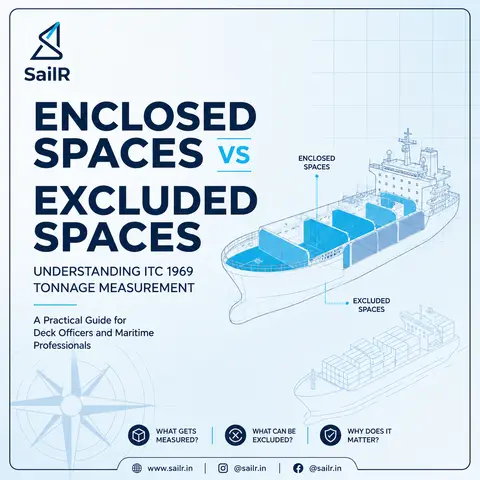
AI-drawn illustration. Simplified to explain the idea, not to scale.
Slide 1 · ENCLOSED
ENCLOSED
SPACES VS
EXCLUDED
SPACES
UNDERSTANDING ITC 1969
TONNAGE MEASUREMENT
A Practical Guide for
Deck Officers and Maritime
Professionals
ENCLOSED
SPACES
EXCLUDED
SPACES
WHAT GETS
MEASURED?
WHAT CAN BE
EXCLUDED?
WHY DOES IT
MATTER?
Slide 2 · WHAT IS AN
WHAT IS AN
ENCLOSED SPACE?
For tonnage measurement purposes, enclosed spaces are spaces included within the moulded volume of all enclosed spaces of the ship as determined under the International Convention on Tonnage Measurement of Ships, 1969.
COMMON EXAMPLES
Accommodation spaces
Engine room
Cargo holds
Stores
Tanks
Passageways
KEY POINT
All enclosed spaces contribute to V (Total Enclosed Volume).
GROSS TONNAGE FORMULA
GT = K1V
where:
K1 = 0.2 + 0.02 log10 V
V = Total Enclosed Volume (m³)
GT = Gross Tonnage
TAKEAWAY
More enclosed volume generally results in a higher Gross Tonnage.
EXAMPLES OF ENCLOSED SPACES
ACCOMMODATION SPACES
ENGINE ROOM
CARGO HOLDS
STORES
TANKS
PASSAGEWAYS & CORRIDORS
Slide 3 · WHAT IS AN
WHAT IS AN
EXCLUDED SPACE?
Excluded spaces are spaces satisfying the criteria of Annex I
Regulation 2(5) of the International Convention on Tonnage
Measurement of Ships, 1969.
MEASURED ENCLOSED SPACE
EXCLUDED SPACE (EXAMPLES)
Bounded by the ship's structure,
decks and bulkheads.
Open to the weather and arranged in
accordance with Reg. 2(5) criteria.
Open-ended
deckhouse
recesses
Qualifying
weather-
exposed
spaces
Qualifying
open
structures
TYPICAL EXAMPLES
COMMON EXAMPLES
Accommodation
spaces
Engine
room
Cargo
holds
Tanks &
stores
Passageways &
corridors
Open-ended
deckhouse
recesses
Weather-exposed
spaces (meeting
Reg. 2(5))
Qualifying
open
structures
KEY PRINCIPLE
These spaces are generally arranged
so that they are open to the weather
and do not meet the Convention's
definition of enclosed spaces.
NOT AUTOMATICALLY
EXCLUDED
Not every open space
Spaces modified
for cargo use
Spaces that fail
Regulation 2(5) criteria
IMPORTANT RULE
A space intended for cargo
carriage cannot simultaneously
be treated as an excluded
space for tonnage-measurement
purposes.
REMEMBER
If a space is excluded from V,
it also falls outside the enclosed
cargo-space volume used in
net tonnage calculations.
KEY TAKEAWAY
Exclusion depends on the specific criteria of ITC 1969 Regulation 2(5),
not on appearance alone.
Slide 4 · WHY THE DISTINCTION
WHY THE DISTINCTION
MATTERS
Correct classification of spaces impacts tonnage, compliance,
costs and operational freedom.
TONNAGE FORMULAS
(ITC 1969)
CORRECT CLASSIFICATION
GROSS TONNAGE
GT = K1V
where:
K1 = 0.2 + 0.02 log10 V
V = Total Enclosed Volume (m³)
INCORRECT CLASSIFICATION
Accurate Gross Tonnage (GT)
Re-measurement
requirements
Accurate Net Tonnage (NT)
Certificate discrepancies
Correct port dues and fees
Regulatory findings
Certificate compliance
Port-State observations
and enforcement action
Smooth inspections
and operations
Commercial and
operational implications
NET TONNAGE
NT = K2Vc(4d/3D)² + K3(N1 + N2/10)
where:
Vc = Volume of all enclosed cargo spaces (m³)
d = Moulded draught amidships (m)
D = Moulded depth (m)
N1 = Number of persons carried
N2 = Number of persons in cabins
SIMPLE RULE
Enclosed Space = Included in Tonnage Measurement
Excluded Space = Only if it meets ITC 1969 exclusion criteria
REMEMBER
Use of an excluded space in a manner inconsistent with the approved
tonnage arrangement may result in remeasurement, certificate issues,
or enforcement action by authorities.
| |
Drafted by SailR from our daily lessons. AI-drawn illustration. Simplified to explain the idea, not to scale. Last updated 19 Oct 2026.
Spotted a mistake?