EU ETS vs FuelEU Maritime: Green Shipping Corridors and Decarbonisation Costs
Shipping decarbonisation involves separate rules for emissions, energy intensity and ship efficiency. Understanding how these measures differ helps explain the compliance and investment challenges facing ship operators.
The slides, written out
AI-drawn illustration. Simplified to explain the idea, not to scale.
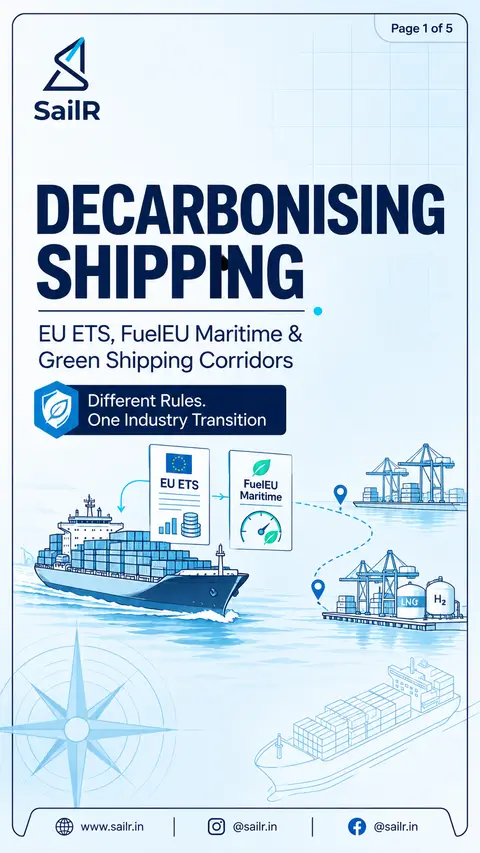
Slide 1 · This infographic explains how the EU Emissions Trading System, FuelEU Maritime and gree…
This infographic explains how the EU Emissions Trading System, FuelEU Maritime and green shipping corridors contribute to maritime decarbonisation. It introduces the different compliance mechanisms and the commercial challenges associated with the transition.
Slide 2 · The EU ETS puts a price on covered greenhouse-gas emissions and requires the responsibl…
The EU ETS puts a price on covered greenhouse-gas emissions and requires the responsible shipping company to surrender allowances for its covered emissions. FuelEU Maritime limits the greenhouse-gas intensity of energy used on board and provides for penalties when the applicable requirements are not met. These measures have different compliance tests.
Slide 3 · A green shipping corridor is a specific maritime route where public and private stakeho…
A green shipping corridor is a specific maritime route where public and private stakeholders work together to enable and demonstrate lower-emission shipping. Ship operators, fuel suppliers, ports, cargo owners and public authorities can coordinate fuel availability, infrastructure and commercial arrangements to support the transition.
Slide 4 · EEXI addresses the technical energy efficiency of ships, while CII addresses operationa…
EEXI addresses the technical energy efficiency of ships, while CII addresses operational carbon intensity. The EU ETS creates costs associated with covered emissions, and FuelEU Maritime establishes limits for the greenhouse-gas intensity of energy used on board. Each measure has its own requirements, so meeting one does not automatically satisfy the others.
Slide 5 · Maritime decarbonisation can require investment in vessel modifications, fuel procureme…
Maritime decarbonisation can require investment in vessel modifications, fuel procurement and supporting infrastructure. Lower-emission fuels can be more expensive, and suitable fuel and port infrastructure may not be consistently available across a ship's trading routes. Operators must assess these factors alongside the separate compliance requirements that apply to their ships.
What it is
The EU ETS and FuelEU Maritime regulate different aspects of maritime decarbonisation. The EU ETS is an emissions-pricing mechanism. Shipping companies within its scope must surrender allowances covering their applicable verified emissions. FuelEU Maritime instead limits the yearly average greenhouse-gas intensity of the energy used on board a ship during a reporting period. These mechanisms address related environmental objectives through separate compliance tests. (Directive 2003/87/EC, Articles 3gb and 12; Regulation (EU) 2023/1805, Article 4)
A green shipping corridor takes a route-based approach to the transition. It is a specific maritime route where technological, economic and regulatory conditions are developed to enable zero-emission shipping. Public and private stakeholders coordinate the conditions needed to support cleaner vessels, suitable fuels and the infrastructure required to operate them. (Global Maritime Forum, Green corridors: Definitions and approaches, section “Definitions”)
Why it matters
A ship operator needs to distinguish between paying for covered emissions and meeting an energy-intensity limit. EU ETS compliance is linked to the emissions covered by the scheme. FuelEU Maritime compliance depends on the greenhouse-gas intensity of the energy used on board. A decision that helps with one mechanism does not automatically meet the requirements of the other. (Directive 2003/87/EC, Articles 3ga–3gb and 12; Regulation (EU) 2023/1805, Articles 4 and 23)
Green corridors address a different problem. Lower-emission shipping depends on more than the vessel itself. Fuel supply, port readiness, customer demand and coordination across the maritime value chain all affect whether a route can support the transition. A corridor creates a framework for bringing these elements together on a defined trade route. (Global Maritime Forum, The next wave: Green corridors, section on critical building blocks)
How it works on board
The practical starting point is to identify which requirements apply to the ship and its operations. EEXI addresses technical energy efficiency, while CII addresses operational carbon intensity. The EU ETS and FuelEU Maritime introduce separate emissions and energy-intensity obligations within their respective scopes. The operator should assess each applicable requirement on its own terms rather than treating decarbonisation compliance as a single test. (MARPOL Annex VI, Regulations 23 and 28; Directive 2003/87/EC, Articles 3ga–3gb and 12; Regulation (EU) 2023/1805, Article 4)
Fuel and route planning also matter when considering lower-emission shipping. A corridor initiative can bring ship operators together with fuel suppliers, ports, cargo owners and public authorities. These participants can work on a viable fuel pathway, infrastructure readiness and the commercial arrangements needed to support its use. The exact arrangements depend on the route and the participating stakeholders. (Global Maritime Forum, The next wave: Green corridors, section on critical building blocks)
The rules
The EU ETS applies to qualifying maritime activities within the scheme's scope. Its geographical coverage depends on the voyage and port activity, with specific rules for voyages within the EU and voyages connecting EU and non-EU ports. (Directive 2003/87/EC, Article 3ga)
Shipping companies covered by the EU ETS must surrender allowances for the emissions subject to the scheme, following the applicable requirements. (Directive 2003/87/EC, Articles 3gb and 12(3)(c))
FuelEU Maritime sets limits on the yearly average greenhouse-gas intensity of energy used on board. The calculation follows the methodology established in the Regulation. (Regulation (EU) 2023/1805, Article 4 and Annex I)
FuelEU Maritime provides for financial penalties where the applicable requirements are not met, under the calculation and conditions set out in the Regulation. (Regulation (EU) 2023/1805, Article 23 and Annex IV, Part B)
EEXI and CII are separate measures under MARPOL Annex VI. Their requirements should be assessed independently of EU ETS and FuelEU Maritime compliance. (MARPOL Annex VI, Regulations 23 and 28)
Common mistakes
One mistake is to assume that paying for covered emissions under the EU ETS means a ship has met FuelEU Maritime requirements. The two measures address different matters. Another is to assume that any ship calling at an EU port is automatically subject to every obligation in both schemes. Applicability depends on the scope and provisions of each instrument. (Directive 2003/87/EC, Article 3ga; Regulation (EU) 2023/1805, Article 2)
A further mistake is to treat a green shipping corridor as a fuel supply project alone. Corridor development involves coordination across the value chain, including fuel pathways, demand and policy. Operators should also avoid assuming that a fuel label by itself proves a particular greenhouse-gas outcome. Fuel performance needs to be assessed using the relevant accounting methodology and applicable requirements. (Global Maritime Forum, The next wave: Green corridors, section on critical building blocks; Regulation (EU) 2023/1805, Article 4 and Annex I)
Drafted by SailR from the regulations cited. AI-drawn illustration. Simplified to explain the idea, not to scale. Last updated 1 Nov 2026.
Spotted a mistake?