The slides, written out
AI-drawn illustration. Simplified to explain the idea, not to scale.
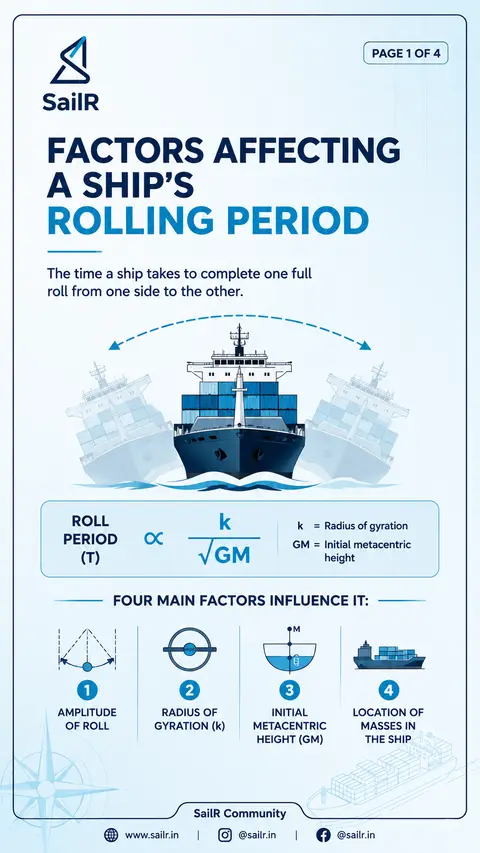
Slide 1 · FACTORS AFFECTING
FACTORS AFFECTING
A SHIP'S
ROLLING PERIOD
The time a ship takes to complete one full
roll from one side to the other.
ROLL
PERIOD
(T)
∝
k
√GM
k = Radius of gyration
GM = Initial metacentric
height
FOUR MAIN FACTORS INFLUENCE IT:
1
AMPLITUDE
OF ROLL
2
RADIUS OF
GYRATION (k)
3
INITIAL
METACENTRIC
HEIGHT (GM)
4
LOCATION OF
MASSES IN
THE SHIP
| |
Slide 2 · AMPLITUDE OF ROLL &
AMPLITUDE OF ROLL &
RADIUS OF GYRATION (k)
1
AMPLITUDE
OF ROLL
2
RADIUS OF
GYRATION (k)
For small heel angles
(approximately 10–15°),
the natural roll period
remains essentially
constant while the roll
amplitude gradually
decreases because
of damping.
The radius of gyration represents
the distribution of a ship's mass
about its centre of gravity.
Increasing k increases rotational
inertia and produces a longer,
slower roll.
EFFECT OF CHANGING k
Like a tightrope
walker uses a
long pole to
increase k and
reduce wobble.
Arms in
Lower k
Faster spin
Arms out
Higher k
Slower spin
IN A SHIP
Weights concentrated
near centreline
Weights spread out
towards the sides
Lower k
Shorter roll period
Higher k
Longer roll period
Higher k → Longer Roll Period
Lower k → Shorter Roll Period
DAMPED ROLL MOTION
Period (T)
Period
remains
constant
Angle of heel
Time
Amplitude
decreases
due to
damping
The time between
successive rolls
stays the same.
Slide 3 · GM & SYNCHRONISM
GM & SYNCHRONISM:
THE KEY TO SAFE ROLLING
3 INITIAL METACENTRIC HEIGHT (GM)
Roll period is inversely proportional to √GM.
A larger GM gives a shorter roll period;
a smaller GM gives a longer roll period.
STIFF SHIP (HIGH GM)
TENDER SHIP (LOW GM)
High GM
Shorter roll period
Faster rolling motion
Low GM
Longer roll period
Slower rolling motion
GM ↑ → Period ↓
GM ↓ → Period ↑
Quicker roll, higher initial stability
Slower roll, lower initial stability
Actual roll period depends on both GM and the ship's radius of gyration (k).
There is no universal "ideal" roll period; it varies with ship type, size and loading condition.
4 SYNCHRONISM – A DANGEROUS CONDITION
When the ship's natural roll period approaches the encounter wave period,
successive encounter waves reinforce the ship's natural roll motion.
If damping is insufficient, roll amplitude may increase rapidly.
1 ENCOUNTER WAVE
2 SHIP ROLLS
3 WAVE REINFORCES THE ROLL
4 AMPLITUDE BUILDS UP
HOW TO AVOID IT
Primary operational response:
ALTER COURSE
ALTER SPEED
to change the encounter wave period and move away from synchronism.
DANGER: If synchronous rolling continues, roll amplitude may increase rapidly, increasing the risk to the vessel, cargo and personnel.
Minimum permissible GM is specified in the vessel's approved Stability Booklet in accordance with applicable statutory stability requirements.
Slide 4 · LOCATION OF MASSES
LOCATION OF MASSES
& OPERATIONAL TAKEAWAYS
The distribution of weights in a ship affects both the radius of gyration (k)
and the metacentric height (GM), and therefore the roll period.
1
HORIZONTAL
MOVEMENT
Moving weights away from
the centreline increases
the radius of gyration (k).
Higher k
→ Longer
Roll Period
EXAMPLE: CARGO / BALLAST DISTRIBUTION
Weights concentrated
near centreline
Weights spread out
towards the sides
(e.g., wing tanks)
Lower k
Shorter roll period
Higher k
Longer roll period
2
VERTICAL
MOVEMENT
Moving weights higher
raises the centre of gravity (G),
reduces GM and increases
the roll period.
Lower GM
→ Longer
Roll Period
EXAMPLE: CARGO / WEIGHT MOVEMENT
Weights low
(in lower holds)
Weights high
(on deck)
M
G
M
G
Higher GM
Shorter roll period
Lower GM
Longer roll period
KEY TAKEAWAYS
For small heel angles (approximately 10–15°), the natural
roll period remains essentially independent of amplitude.
Increasing k (radius of gyration) increases roll period.
Increasing GM generally shortens the natural roll period
while increasing initial stability.
Horizontal distribution of weights affects k.
Vertical movement of weights affects GM.
The roll period depends on both GM and k
(ship dimensions and loading condition).
If synchronous rolling develops, alter course and/or speed
to change the encounter wave period.
OPERATIONAL RESPONSE
If signs of synchronous rolling are
observed:
ALTER COURSE
Change heading to modify
the encounter wave period.
ALTER SPEED
Increase or decrease speed
to move away from synchronism.
Ballast or cargo adjustments are
loading-management measures
and not immediate shiphandling
responses.
Minimum permissible GM is specified in the vessel's approved Stability Booklet
in accordance with applicable statutory stability requirements (e.g., IMO IS Code).
There is no universal minimum GM value for all ships.
Stability Booklet
Drafted by SailR from our daily lessons. AI-drawn illustration. Simplified to explain the idea, not to scale. Last updated 19 Oct 2026.
Spotted a mistake?