The slides, written out
AI-drawn illustration. Simplified to explain the idea, not to scale.
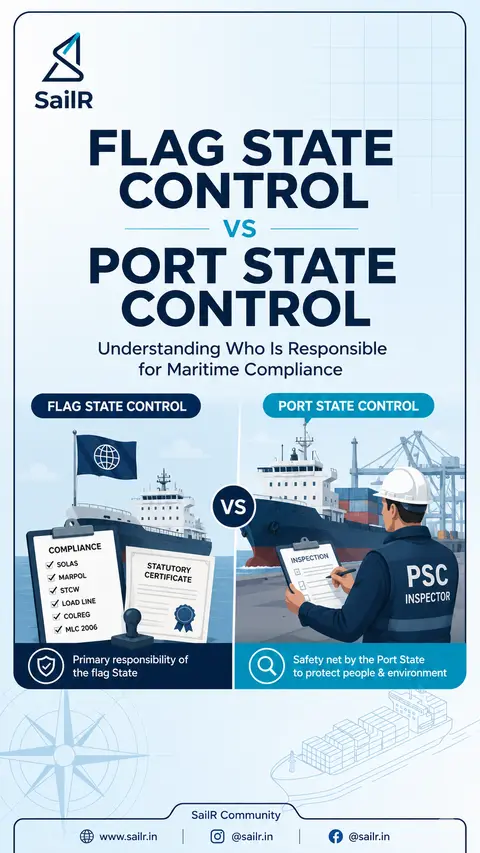
Slide 1 · FLAG STATE CONTROL
FLAG STATE CONTROL
VS
PORT STATE CONTROL
Understanding Who Is Responsible for Maritime Compliance
FLAG STATE CONTROL
PORT STATE CONTROL
COMPLIANCE
SOLAS
MARPOL
STCW
LOAD LINE
COLREG
MLC 2006
STATUTORY CERTIFICATE
INSPECTION
PSC INSPECTOR
Primary responsibility of the flag State
Safety net by the Port State to protect people & environment
Slide 2 · FLAG STATE
FLAG STATE
CONTROL
PRIMARY RESPONSIBILITY
The flag State has the primary responsibility under Article 94 of UNCLOS to ensure ships flying its flag comply with international requirements.
KEY RESPONSIBILITIES
REGULATORY OVERSIGHT
Enacts national legislation implementing:
SOLAS • MARPOL • STCW • LOAD LINE COLREG • MLC 2006
CERTIFICATION & SURVEYS
• Conducting statutory surveys and inspections at the intervals required by the conventions
• Issuing the ship's statutory certificates
• Continuous compliance monitoring
RECOGNISED ORGANISATIONS
• Authorises classification societies (ROs) to carry out surveys on its behalf
ISM OVERSIGHT
• Audits of shipping companies
• Verification of safety management systems and company performance and company performance
Slide 3 · PORT STATE CONTROL
PORT STATE CONTROL
THE SAFETY NET
PSC ensures that foreign ships entering a port do not pose unacceptable risks to safety, health or the marine environment.
WHAT PSC CHECKS
CERTIFICATES
Validity and authenticity of statutory certificates.
SAFETY EQUIPMENT
Firefighting systems, lifesaving appliances and emergency systems.
POLLUTION PREVENTION
MARPOL compliance and pollution prevention equipment.
CREW COMPETENCY
STCW certification, crew qualifications and safe manning.
WORKING CONDITIONS
MLC 2006 compliance: living and working conditions on board.
NO MORE FAVOURABLE TREATMENT
Ships cannot gain a competitive advantage by operating under flags that fail to implement international convention standards.
Slide 4 · DETENTION GROUNDS
DETENTION GROUNDS
WHEN CAN A SHIP BE DETAINED?
A vessel may be detained when deficiencies are clearly hazardous to safety, health, or the environment.
COMMON REASONS FOR DETENTION
MISSING STATUTORY CERTIFICATES
Absence or invalidity of required certificates.
MAIN ENGINE OR STEERING FAILURE
Critical machinery or steering system not in working order.
SERIOUS STRUCTURAL DETERIORATION
Cracks, severe corrosion or structural weaknesses.
FIRE SAFETY DEFICIENCIES
Inadequate firefighting systems, faulty alarms or extinguishers.
LIFEBOAT OR LIFE-SAVING EQUIPMENT FAILURES
Unserviceable lifeboats, davits, or safety appliances.
POLLUTION CONTROL FAILURES
Inoperative oily-water separator, leaking valves, or tampered equipment.
UNSAFE CARGO STOWAGE
Improper stowage, securing, or handling of cargo.
STCW OR SAFE-MANNING DEFICIENCIES
Unqualified crew, insufficient manning or fatigue concerns.
SERIOUS MLC VIOLATIONS
Unsanitary conditions, poor accommodation, inadequate food, water or medical care.
THE CHAIN OF RESPONSIBILITY
FLAG STATE
Maintains Compliance
PORT STATE
Verifies Compliance
DETENTION
When Risks Become Unacceptable
SOURCES
IMO Port State Control Guidance | Paris MoU | Tokyo MoU
Drafted by SailR from our daily lessons. AI-drawn illustration. Simplified to explain the idea, not to scale. Last updated 19 Oct 2026.
Spotted a mistake?