The slides, written out
AI-drawn illustration. Simplified to explain the idea, not to scale.
Slide 1 · FLOODABLE LENGTH,
FLOODABLE LENGTH,
PERMISSIBLE LENGTH &
PERMEABILITY
Understanding Key Ship
Subdivision Concepts
SAFETY
BY DESIGN
DAMAGE
STABILITY
SOLAS
COMPLIANT
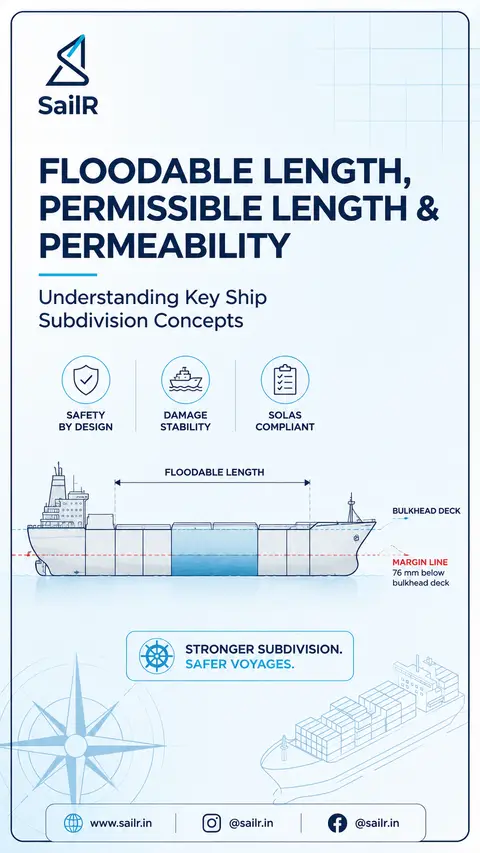
FLOODABLE LENGTH
BULKHEAD DECK
MARGIN LINE
76 mm below
bulkhead deck
STRONGER SUBDIVISION.
SAFER VOYAGES.
Slide 2 · 1
1. FLOODABLE LENGTH
The floodable length at any point in a ship's length is the maximum length of a compartment, centred at that point, which can be flooded without causing the margin line to become submerged.
FLOODABLE LENGTH
BULKHEAD DECK
MARGIN LINE
76 mm below the bulkhead deck
MARGIN LINE
Imaginary line drawn all around the vessel, 76 mm below the upper surface of the bulkhead deck at the ship's side.
If flooding causes the margin line to become submerged, the vessel no longer satisfies the applicable subdivision and damage-stability criterion.
FLOODABLE LENGTH REPRESENTS THE MAXIMUM SURVIVABLE COMPARTMENT SIZE BEFORE REGULATORY DAMAGE LIMITS ARE EXCEEDED.
Slide 3 · 2
2. PERMISSIBLE LENGTH
The permissible length is the actual maximum length a compartment may have.
It is obtained by applying the factor of subdivision (F) to the floodable length.
PERMISSIBLE LENGTH FORMULA
Permissible Length = Floodable Length × F
Where, F = Factor of Subdivision (0 < F ≤ 1.0)
Since F is always less than or equal to 1.0, the permissible length is always less than (or equal to) the floodable length.
IMPACT OF FACTOR OF SUBDIVISION (F)
SHIP TYPE | FACTOR F | RESULT
PASSENGER SHIP (More people at risk) | LOWER (e.g. 0.50 – 0.75) | SMALLER COMPARTMENTS Higher standard of subdivision for enhanced safety.
CARGO SHIP (Lower risk to life) | HIGHER (e.g. 0.75 – 0.90) | LARGER COMPARTMENTS Lower subdivision standard compared to passenger ships.
SMALLER PERMISSIBLE LENGTHS IMPROVE SURVIVABILITY BY ENSURING MORE RESILIENCE AFTER FLOODING.
| |
Slide 4 · 3
3. PERMEABILITY
OF COMPARTMENTS
Permeability (μ) is the percentage of a compartment's
volume that can be occupied by water after flooding.
PERMEABILITY FORMULA
μ (%) = Volume Occupied by Water / Total Enclosed Volume × 100
If a compartment is empty, permeability is high (up to 100%).
If filled with machinery or cargo, permeability is lower.
TYPICAL REGULATORY DAMAGE-STABILITY PERMEABILITIES
SPACE TYPE | PERMEABILITY (μ)
MACHINERY SPACES 85%
ACCOMMODATION / SERVICE SPACES 95%
CARGO / STORE SPACES 60%
HOW PERMEABILITY AFFECTS FLOODING
ACCOMMODATION SPACE (TYPICAL)
Permeability 95%
Mostly empty spaces allow more water to enter.
MACHINERY SPACE (TYPICAL)
Permeability 85%
Machinery occupies volume, reducing water entry.
CARGO / STORE SPACE (TYPICAL)
Permeability 60%
Cargo or stores occupy more volume, limiting water entry.
KEY TAKEAWAY
Lower permeability means less floodwater enters the compartment, preserving buoyancy and improving the ship's damage-survivability.
Source: SOLAS Chapter II-1
| |
Drafted by SailR from our daily lessons. AI-drawn illustration. Simplified to explain the idea, not to scale. Last updated 19 Oct 2026.
Spotted a mistake?