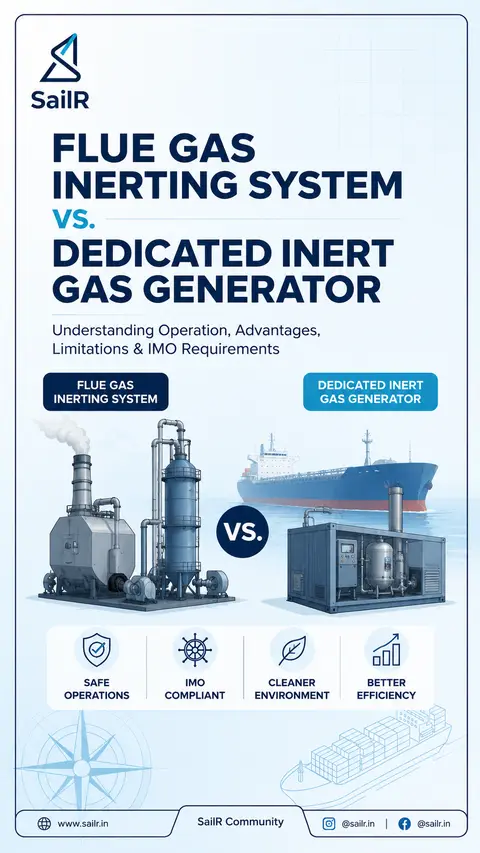
The slides, written out
AI-drawn illustration. Simplified to explain the idea, not to scale.
Slide 1 · FLUE GAS
FLUE GAS
INERTING SYSTEM
VS.
DEDICATED INERT
GAS GENERATOR
Understanding Operation, Advantages,
Limitations & IMO Requirements
FLUE GAS
INERTING SYSTEM
DEDICATED INERT
GAS GENERATOR
VS.
SAFE
OPERATIONS
IMO
COMPLIANT
CLEANER
ENVIRONMENT
BETTER
EFFICIENCY
Slide 2 · FLUE GAS
FLUE GAS
INERTING
SYSTEM
(FROM BOILERS)
Uses exhaust gas from boilers,
treated and delivered as inert gas
to the cargo tanks.
Exhaust Gas
from Boiler
Scrubber
(SO2 Removal)
Fan & Water
Seal Unit
To Inert Gas
Main
ADVANTAGES
NO SEPARATE FUEL COST
Uses exhaust product of main
boiler or auxiliary boiler already
produced for other purposes.
GOOD CAPACITY
Large boilers can produce
substantial volumes, meeting
125% discharge-rate requirement.
ESTABLISHED TECHNOLOGY
Scrubber, fans, water seal and
regulating valve are well-proven
with straightforward operation.
COST EFFECTIVE
Economical solution when
boilers are in continuous
operation.
LIMITATIONS
OXYGEN CONTENT
Delivered inert gas must remain
≤5% O2 as per IMO requirements.
Requires continuous monitoring.
BOILER DEPENDENCY
Insufficient gas when boilers are
at low load or secured. No boilers
= no inert gas.
SO2 & SOOT
Requires efficient scrubbing
(~90% SO2 removal). Soot
build-up needs regular cleaning.
TEMPERATURE & MOISTURE
Gas is saturated and near
seawater temperature, which
may cause condensation and
corrosion.
BEST SUITED FOR VESSELS WITH CONTINUOUS BOILER OPERATION
AND ADEQUATE FLUE GAS AVAILABILITY.
Slide 3 · LOW OXYGEN
LOW OXYGEN
HIGH SAFETY
DEDICATED
INERT
GAS GENERATOR
Self-contained system that produces inert gas independently of main or auxiliary boilers.
ADVANTAGES
LOWER & STABLE OXYGEN CONTENT
Typically produces very low O2 (commonly around 0.5–2%), well below the 5% IMO limit, giving greater safety margin.
INDEPENDENT OPERATION
Operates independently with own burner, fan, cooling water pump and fuel supply. Works even with boilers secured.
BETTER GAS QUALITY
Significantly lower sulphur compounds and soot. Suitable for sensitive cargoes and reduces corrosion.
COMPACT & SELF-CONTAINED
Compact unit, easy to install aft of cargo spaces and pump rooms with minimal footprint.
OPERATIONAL FLEXIBILITY
Can be run at required capacity as per cargo operations and stopped when not needed.
LIMITATIONS
FUEL & OPERATING COST
Consumes fuel (MGO/LSMGO or approved fuel), leading to higher running cost compared to flue gas systems.
SYSTEM COMPLEXITY
Includes burner management system, combustion controls, safety interlocks and monitoring equipment.
HIGHER INITIAL COST
Equipment and installation cost are higher than utilising boiler flue gas.
MAINTENANCE NEEDS
Requires regular maintenance of burner, controls, valves, sensors and other components.
PREFERRED WHERE OPERATIONAL FLEXIBILITY, INDEPENDENCE AND CONSISTENT INERT GAS QUALITY ARE PRIORITIES.
Slide 4 · COMPARISON &
COMPARISON &
MACHINERY SPACE SAFETY
Choosing the Right Inert Gas Solution
FEATURE
FLUE GAS SYSTEM (FROM BOILERS)
DEDICATED INERT GAS GENERATOR
BOILER DEPENDENCY
Yes – requires boilers in operation
No – independent system
FUEL CONSUMPTION
Minimal additional cost
Separate fuel required (MGO/LSMGO/BOG)
OXYGEN CONTROL
Operates close to the ≤5% O2 limit
Lower and more stable (typically 0.5–2% O2)
GAS QUALITY
Higher moisture, SO2 & soot
Cleaner gas with very low sulphur & soot
MAINTENANCE
Scrubber, fans, uptake lines, water seal
Burner, controls, safety systems, components
OPERATIONAL FLEXIBILITY
Moderate – depends on boiler load & availability
High – run when needed at any required capacity
INITIAL COST
Lower
Higher
BOTH SYSTEMS MUST COMPLY WITH IMO FSS CODE:
IG Delivery ≤5% O2 • Continuous Monitoring • Automatic Diversion of Off-Spec Gas
125% of Maximum Cargo Discharge Rate Capacity
WHY NOT USED FOR MACHINERY SPACES?
REQUIRES PERSONNEL ACCESS
Machinery spaces require routine access for operation, maintenance and watchkeeping. Continuous inert atmospheres are unsafe for human occupancy.
GAS QUALITY CONCERNS
Flue gas is hot and may contain SO2, soot, CO and moisture even after scrubbing, causing corrosion, equipment damage and health hazards.
SOLAS REQUIRES FIXED SYSTEMS
SOLAS II-2 requires fixed fire-extinguishing systems (e.g., CO2 or approved equivalents) for machinery spaces, not continuous inerting systems.
DIFFERENT SAFETY OBJECTIVE
Cargo tank inerting prevents fire/explosion by reducing oxygen. Machinery-space systems extinguish fire by rapidly lowering oxygen concentration during an emergency.
KEY TAKEAWAY
FLUE GAS SYSTEM:
Economical & proven solution when boilers are available.
DEDICATED IG GENERATOR:
Greater flexibility, cleaner inert gas quality and independence from boiler operation.
THE RIGHT CHOICE ENSURES SAFE, EFFICIENT & COMPLIANT TANKER OPERATIONS.
Drafted by SailR from our daily lessons. AI-drawn illustration. Simplified to explain the idea, not to scale. Last updated 19 Oct 2026.
Spotted a mistake?