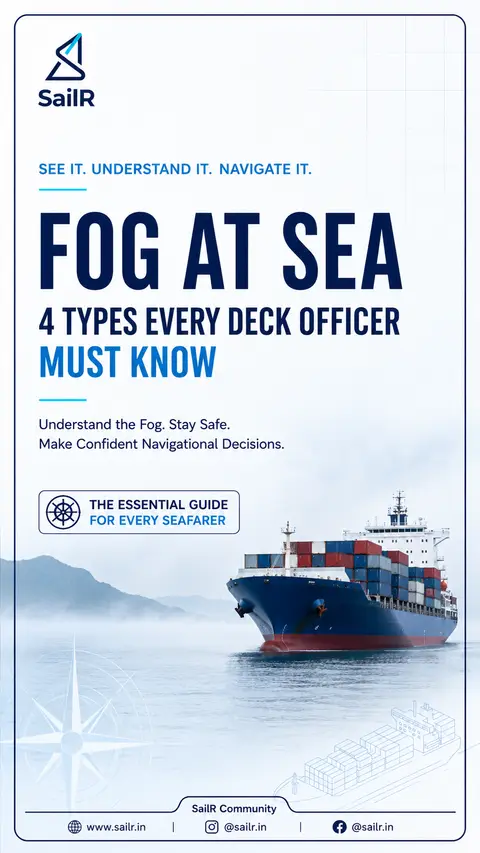
The slides, written out
AI-drawn illustration. Simplified to explain the idea, not to scale.
Slide 1 · SEE IT
SEE IT. UNDERSTAND IT. NAVIGATE IT.
FOG AT SEA
4 TYPES EVERY DECK OFFICER
MUST KNOW
Understand the Fog. Stay Safe.
Make Confident Navigational Decisions.
THE ESSENTIAL GUIDE
FOR EVERY SEAFARER
| |
Slide 2 · 1/4
FOG AT SEA
4 TYPES EVERY DECK OFFICER SHOULD RECOGNISE
01
ADVECTION FOG
Warm, moist air → cool sea surface → condensation
Relatively warm, moist air moving horizontally over a cooler sea surface gets cooled from below. When the air cools to its saturation point, condensation forms fog.
KEY CONDITIONS
Wind conditions can vary; advection fog may occur with moderate to strong winds.
The underlying sea surface is sufficiently colder than the moist air mass for cooling to bring the air to saturation.
Stronger winds may lift or mix the fog into low cloud, although dense sea fog can persist in some situations.
CLASSIC LOCATION:
GRAND BANKS, NEWFOUNDLAND
Warm, moist air encounters the cold Labrador Current, producing dense sea fog.
BRIDGE TAKEAWAY:
Advection fog can persist for prolonged periods and is not restricted to overnight formation.
| |
Slide 3 · 2/4
FOG AT SEA
4 TYPES EVERY DECK OFFICER SHOULD RECOGNISE
02
RADIATION FOG
Fog formed by overnight cooling of land
On clear nights, the land loses heat by long-wave radiation and cools the air in contact with it toward saturation. Condensation then forms fog near the surface.
FAVOURABLE CONDITIONS
CLEAR SKIES
Maximum radiative cooling occurs.
LIGHT WINDS
Light or calm conditions favour formation.
DAMP / LOW LYING AREAS
Valleys, marshes and low ground favour formation.
NAVIGATOR'S WATCH
Cold air is heavier and can drain downhill, so radiation fog often becomes dense in hollows, valleys and low lying areas near the coast.
Radiation fog commonly develops over land, particularly under clear and calm conditions, and fog can also affect nearby coastal waters.
TIMING
OVERNIGHT FORMATION
MOST DENSE AROUND SURPRISE
DISPERSES AS SURFACE WARMS
BRIDGE TAKEAWAY:
Approaching a lee shore around dawn after a clear night? Expect the possibility of poor visibility near the coast.
Slide 4 · FOG AT SEA
FOG AT SEA
4 TYPES EVERY DECK OFFICER SHOULD RECOGNISE
03 ARCTIC SEA SMOKE
Very cold air → much warmer water → sea smoke forms
When very cold air moves over relatively warm water, intense evaporation adds moisture to the cold air. The air quickly reaches saturation and the vapour condenses, producing sea smoke (steam fog).
KEY CONDITIONS
A large air–sea temperature difference is favourable for sea smoke formation.
Wind conditions can vary; sea smoke can occur when very cold air moves over warmer water.
A continuous supply of very cold air over open (unfrozen) water helps maintain sea smoke.
WHERE IT OCCURS
Arctic & Antarctic waters
High latitudes (e.g., Baltic Sea) in winter
Cold continental or polar air moving over warmer water
Open leads and openings in sea ice
Lakes, rivers and inland waters in cold conditions
NAVIGATOR'S NOTE
Sea smoke can reduce visibility suddenly and locally, especially in polar regions and near open water during very cold conditions.
QUICK MEMORY
VERY COLD AIR
MUCH WARMER WATER
INTENSE EVAPORATION
CONDENSATION (SEA SMOKE)
BRIDGE TAKEAWAY:
Expect variable visibility in polar waters and near open water in very cold conditions. Monitor weather, temperature and ice conditions.
| |
Slide 5 · FOG AT SEA
FOG AT SEA
4 Types Every Deck Officer Should Recognise
04
SMOG, HAZE & COLREGS
Know the difference • Stay compliant • Stay safe
SMOG
Smog is a term commonly used for conditions where fog occurs together with heavy air pollution.
Pollutants can interact with fog droplets, producing the characteristic polluted atmosphere associated with smog.
HAZE
Reduced visibility caused mainly by fine dry particles, such as dust, smoke or pollution.
Note: The 1,000 m criterion belongs to the distinction between fog and mist (visibility < 1 km for fog) and not to a universal definition of haze.
BRIDGE ACTION
When visibility becomes restricted:
COLREG RULE 19 APPLIES
Every vessel must proceed at a safe speed adapted to the prevailing circumstances and restricted visibility.
Proper lookout must be maintained by all available means, including radar.
Use radar to obtain early warning of risk of collision, assess the situation and take action in ample time.
Use appropriate sound signals as required by the Rules.
QUICK MEMORY
ADVECTION FOG → Warm air over cold water
RADIATION FOG → Surface cooling at night
ARCTIC SEA SMOKE → Cold air over warm water
SMOG → Fog with heavy pollution
REMEMBER
Poor visibility doesn't come with a warning. Good judgment, correct equipment and Rule 19 keep everyone safe.
| |
Drafted by SailR from our daily lessons. AI-drawn illustration. Simplified to explain the idea, not to scale. Last updated 19 Oct 2026.
Spotted a mistake?